Table of Contents
- Food packaging films are not substitutes. They are tools for very specific tasks
- What the choice of food film really depends on
- Main types of films used in food packaging
- LDPE, HDPE and PE — differences that actually matter
- How film affects food safety and work hygiene
- Practical usage scenarios in gastronomy and food production
- Where losses from poor film selection most often appear
- How to read film parameters so you don’t buy “blindly”
- Case study: when one “do-it-all” film started to ruin work organization
- Starting point
- What the real problem was
- How the analysis looked
- Errors that only emerged during the process
- Step-by-step actions
- What did not work immediately
- Effects after a few weeks
- Conclusions from practice
- FAQ: practical questions about films for food packaging
- Most frequent mistakes when choosing and using films for food packaging
- Myths about films for food packaging that regularly spoil purchasing decisions and work organization
- Comparison of solutions: which film and packing method work in specific conditions
- Things you rarely hear when choosing food packaging film, but which later decide between problems or calm at work
- Checklist before choosing film for food packaging
- Market trends and development directions for food packaging film
Food packaging films are not substitutes. They are tools for very specific tasks. In practice, the problem is rarely simply the question “which film to choose”. The real trouble begins a moment later...
Food packaging films are not substitutes. They are tools for very specific tasks
In practice the problem seldom boils down to the simple question “which film to choose”. The real trouble begins shortly afterward: the product loses freshness, the packaging steams from the inside, the seal doesn’t hold, a portion looks worse after transport than at the time of serving, and staff use more material than they should. In gastronomy and the food industry a film must perform a concrete job — protect the food, maintain hygiene, limit losses and enable efficient organization of production or serving. If chosen poorly, problems appear quickly.
The most common mistake is treating all films as one product group. Meanwhile, cling film for manual wrapping behaves differently than stretch film for load stabilization, differently from sealing film intended for trays, and yet differently from thin bags used for portioning or separating raw materials. Differences do not end with thickness or transparency. Stretchability, mechanical resistance, airtightness, weldability, response to temperature, contact with fat, water vapor and condensation all matter.
Therefore selection of film starts not from a catalog but from the process. You need to know exactly what happens to the product from packing to serving, sale or delivery. A freshly cooked dish packed for takeaway needs different protection than fresh meat in a cold store, different than a cake set aside for further decoration, and different than ready components stored between shifts. This is where the real difference begins between a solution that works and one that only “somehow” fulfills its function.
What the choice of food film really depends on
Choosing packaging material must be based on several variables at once. The product type alone is not enough. Packaging temperature, storage time, transport method, risk of mechanical damage, and whether the product should be merely covered or actually provided with a barrier all matter.
Product temperature and packing conditions
This is one of the first parameters that eliminates random decisions. A cool, moist product stored in a fridge behaves differently than a warm, steaming product served immediately after preparation. If film is used too early on a hot item, excessive condensation of water vapor can occur. As a result the packaging loses its aesthetics, droplets form on the surface, and for some products texture also deteriorates.
In production kitchens this is visible when packing bread, deli products and ready meals. Too tight closure of a product that has not yet released its heat can accelerate wetting and shorten the time the product keeps an appropriate appearance. On the other hand, too loose protection of chilled food leads to surface drying, absorption of odors and risk of secondary contamination.
Product type: dry, moist, fatty, delicate
Film behaves differently with each of these food types. Dry products usually do not demand high barrier properties, but they easily lose freshness with prolonged contact with air. Moist products require better control of condensation and airtightness. Fatty items need materials resistant to contact with contents, without risk of weakening the package or degrading appearance. Delicate products — for example cakes, sandwiches, salads or portioned components — require film that protects without excessive pressure.
In practice this means the same outlet may need several types of film at once. One will work for covering GN containers in the cold room, another for sealing trays, and another for protecting cartons and pallets during transport. Trying to replace all those functions with one material usually ends in operational losses.
Storage time and product route
The longer the time between packing and use, the more important packaging predictability becomes. Short-term protection “for a moment” allows a larger margin for error. Storage for several hours, a day or a few days already requires greater material discipline. Seal stability, airtightness, resistance to deformation and behavior at cold temperatures matter.
Transport also adds complexity. Packaging that looks good on the counter does not necessarily work well in a delivery van, on a transport trolley or in a reusable crate. Vibrations, pressure and temperature changes quickly reveal whether the film was chosen for real conditions or only for the moment of packing.
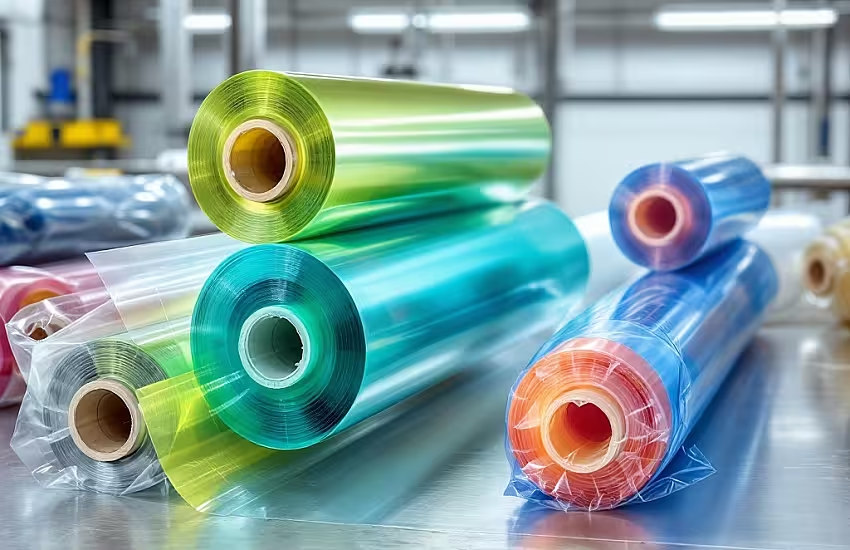
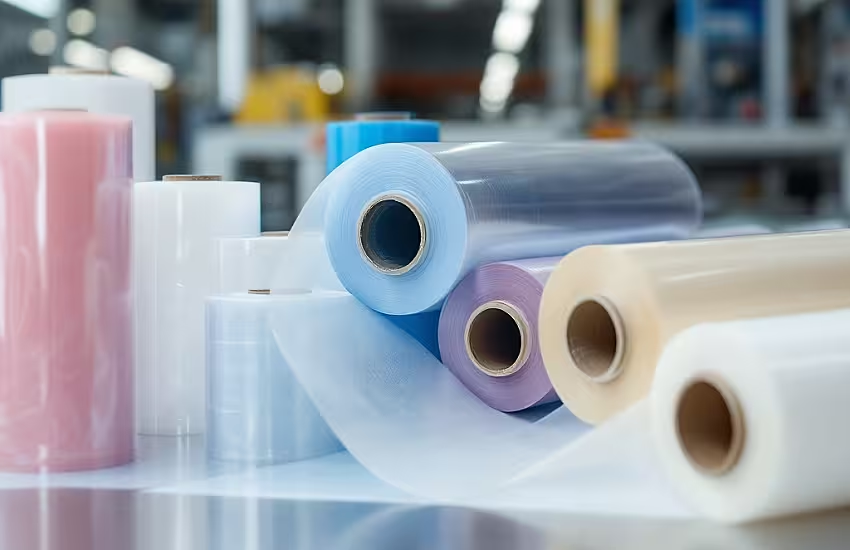
Main types of films used in food packaging
Classification makes sense only if it translates into application. Material names alone do not solve the problem. You need to understand how a given film type behaves in use and what it was intended for.
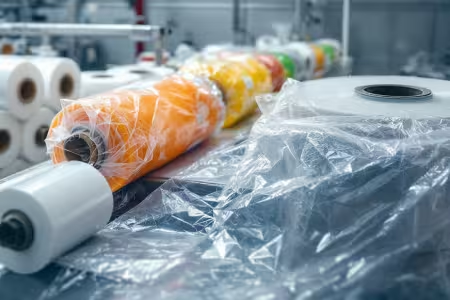
Cling film for manual protection of food
This solution is common in kitchens, food outlets, patisseries and shops. It is mainly used for day-to-day covering of products and containers. Its task is to limit contact with air, dirt and foreign odors. It works well for shorter storage of semi-finished products, ready portions, baked goods or components prepared for further processing.
In daily work not only adhesion matters, but also user comfort. Film that tears badly, rolls up on the reel or does not keep tension prolongs work and increases consumption. Staff then instinctively use more of it because they try to “make up” for insufficient functionality with additional layers. This is a common, underrated organizational problem.
With manual packing it is particularly clear that film must be neither too fragile nor excessively rigid. Too thin will tear on container edges. Too little elasticity will hinder airtight covering of irregular shapes. Therefore thickness alone is not a sufficient selection criterion.
Sealing film for tray sealing and closure
Here precision counts. Sealing film must work with the container, the sealing temperature and the machine parameters. It’s not enough that it “fits by size”. If the material does not create a repeatable closure, leaks, corner peeling or damage on opening will appear.
This is especially important for ready meals, lunch portions, diet catering and deli production. In these applications packaging serves a dual function: it protects the product and organizes the serving process. Any instability in the seal disrupts operations. Staff must improve packing, set aside defective units or repack the goods.
If a company works with sealable packaging, a good reference point are solutions from the PE film category, because in this group the film’s user properties are most often analyzed in terms of airtightness, flexibility and resistance to standard working loads.
Stretch film for collective packaging and transport
Stretch film is not intended for direct contact with every form of food in the same way as classic cling film. Its basic role is stabilization of collective packages, containers, cartons and pallet loads. In food logistics it is the first line of defense against shifting, tearing of the transport set and external contamination.
Most often the problem is not the lack of stretch film but its incorrect use. Too weak tension does not stabilize the load. Too strong tension deforms cartons, containers and delicate unit packaging. With transport of chilled products there is also the risk of condensation and cardboard weakening, so the film must not only hold but also support the whole transport unit structure.
In warehouses and production helpful supplementary elements include pallet pads, which separate the goods from the supporting surface and improve hygiene of collective packing. It’s a small element, but in practice it makes a difference when storing and transporting food.
Bags, pouches and film interleaves
This group is often neglected, yet it is responsible for operational order in many facilities and kitchens. Bags and pouches are used for portioning, separation of raw materials, protection of semi-products, packing components and organizing storage. Interleaves separate product layers, protect surfaces and reduce sticking or damage during storage.
Selection of such materials depends on very practical parameters: size, thickness, type of gusset and filling method. Staff care about pace of work. If a bag opens poorly, is the wrong format or tears when the product is inserted, the issue quickly stops being isolated. It begins to affect the entire production shift.
In general applications solutions from the LDPE film products group are often used because this material combines flexibility with good functional resistance. In practice it works where packaging should be convenient in daily handling and tolerate typical storage and production loads.
LDPE, HDPE and PE — differences that actually matter
Product descriptions often include material acronyms which say little without context. For the user the most important thing is how a given material behaves during packing and storage of food.
LDPE: flexibility and ease of use
LDPE films are usually softer and more flexible. They conform well to the product or container shape, so they are often used in bags, pouches, interleaves and covers that require some plasticity. In manual work staff usually notice the difference immediately — the material lays better, “pops” less and cooperates better with irregular loads.
This does not mean LDPE is a solution for everything. If more stiffness or a different strength profile is needed, another type of film must be chosen. However, in applications where easy forming and good resistance to everyday use matter, LDPE very often delivers predictable results.
HDPE: stiffness, lightness and specific technical uses
HDPE typically provides a stiffer, lighter and “drier” feeling material. Such films are used where a certain technical form, separation or light protection with maintained functionality is needed. In warehouse and transport practice HDPE often appears in auxiliary products, interleaves and technical solutions related to organization of packing.
The difference is especially evident when comparing manual handling. HDPE behaves differently when stretched and folded than LDPE. If staff expect high flexibility but receive a stiffer film, they will quickly consider it inconvenient, even if it technically meets some requirements. Therefore material must be matched not only to the product but also to the way it is used.
PE as a broad material group
PE, polyethylene, is a broader concept covering various grades and functional variants. From the perspective of food packaging it is important not to stop at the acronym. Two films both labeled PE can behave differently in terms of stretchability, thickness, puncture resistance or weld comfort.
That is why in professional selection it is not enough to write “we need PE film”. You must go a level deeper and define the application, format, packing method and storage conditions. Only then does the choice make technological sense.
How film affects food safety and work hygiene
Food safety does not end with product composition and storage temperature. Packaging is part of the protection system. It should limit contact with the environment, support operational cleanliness and reduce risk of secondary contamination during storage, transport and serving.
In gastronomy this is visible when storing components in the kitchen fridge. An open container with sauce, portioned vegetables or prepared meat quickly absorbs odors and is more exposed to contact with other products and micro-dirt generated during work. Even if exposure time is short, repeated use of such a pattern increases operational risk.
A good film does not replace hygiene procedures but reinforces them. It makes it easier to separate batches, cover semi-products, protect containers after washing and cover products awaiting further processing. In food facilities packaging should create a predictable barrier between the product and the working environment.
Material resistance to damage also matters. Torn film, a leaking seal or too loose closure does not always produce an immediately visible problem. Sometimes the effects appear later — in the form of drying, deterioration of appearance, leakage or reduced shelf-life.
Practical usage scenarios in gastronomy and food production
Packing semi-finished products between shifts
This is an everyday situation in restaurants, patisseries, bakeries and central kitchens. After finishing a processing stage some product goes to the fridge or storage to be used a few hours later. In such a scenario film should primarily protect against drying, odors and dirt, but also allow quick access at the next use.
If protection is too weak, staff find the product in the morning with altered surface and poorer presentation. If too airtight for a still-warm fill, moisture appears and quality declines. This simple example shows how much packaging depends on packing time, not just product type.
Serving and delivery of ready meals
In catering and takeaway the packaging must withstand more than a few minutes on a shelf. The product may be moved, stacked, transported in bags or collective containers. Film used to close packaging cannot peel off at the corners or release with light pressure.
Appearance matters too. Customers do not judge dish and packaging separately — they perceive the whole. Wavy film, a steamed interior or signs of leakage reduce perceived quality even if the product itself is fine. From an operational perspective packaging must support serving standards, not only “close” the container.
Storage and collective transport
Here stability counts. Cartons, containers and wrapped sets must arrive without shifting, damage or contamination. Stretch film, interleaves, protective bags and pallet protection elements act as a systemic solution. A single material may seem minor, but together they form a safe transport system.
For food products there is also a requirement to maintain order and cleanliness of the load. Tearing of collective packaging or contact of a carton with a dirty warehouse surface is not only aesthetic. It often results in extra work, repacking or rejection of part of the goods.
Where losses from poor film selection most often appear
At first you notice small things. A roll runs out too quickly. A worker wraps a product twice because one layer does not give confidence. A seal needs redoing. Some trays return for repacking. Bags tear during filling. Then these small issues add up to a bigger problem: slower work, higher material use, more waste and worse process repeatability.
The second level of losses is product quality. It is not always spoilage. More often it is loss of fresh appearance, drying out, deformation of portions or weakened presentation after transport. In gastronomy and retail that is enough for a product to be perceived as less valuable.
The third level concerns organization. If packaging works unstably, staff begin to create their own workarounds: additional layers of film, combining several materials, manual fixes, changes in work order. That signals the material was not chosen for the real process. A good film tidies work. A bad one complicates it.
How to read film parameters so you don’t buy “blindly”
In practice the most informative are not marketing slogans but specific user data. Look at dimensions, thickness, material type, presence of gussets, packaging method and intended working use. Size alone is insufficient. A bag with similar width can behave completely differently if it has different thickness or side construction.
Thickness affects resistance, but cannot be interpreted independently of material. A thinner film of one type may be functionally sufficient in a light application, while a thicker film poorly matched to the process will only hinder work. The same goes for format — an oversized format generates unnecessary consumption, undersized causes damage and leaks.
For bags and pouches pay attention to gussets because they determine real capacity and ease of filling. For protective and technical films consider whether the material should be separating, protective or stabilizing. Each role requires slightly different user properties.
That is why professional food packaging is not about choosing the “strongest” or “thickest” film. It is about matching material to product, process and working conditions. This is the foundation from which safety, hygiene and predictability of all packing begin.
Case study: when one “do-it-all” film started to ruin work organization
This project shows well that the conversation about food packaging films rarely ends with the material itself. The client’s problem didn’t look big at first. It was a company in the gastronomy sector serving a small catering operation, production of takeaway meals and backing for two retail points. The team worked efficiently, orders grew, but increasingly the same topic returned: packaging began to hinder work instead of organizing it.
There was no single spectacular mistake. Instead there was a set of small issues that at first seemed unrelated. In the cold room some containers were incorrectly secured. During transport scuffs of collective packaging occurred. Portion additions packed in thin bags sometimes looked fine and sometimes had to be repacked. The shift manager said plainly that the material “theoretically exists”, but staff still improvised.
Starting point
The client used several types of packaging, but for years selection was mainly by habit. They ordered what was on hand and “somehow worked”. When the scale of work was smaller, that model still worked. After orders increased it turned out the same material was used for tasks of completely different character.
The most problems concerned three areas:
packing portions and additions prepared in advance,
separating product layers during cold room storage,
securing collective units for transport between the kitchen and pickup points.
On paper everything matched. In practice employees added extra layers, changed how they folded bags, and sometimes transferred products into other packaging after the first preparation stage. This usually signals the problem lies not with people but with a poorly set up process.
What the real problem was
The client initially framed the issue as “we need better film”. After a short conversation it became clear this was too general. The difficulty was not low quality of one product but lack of distinction between functions.
The kitchen used bags that were too thin for portions that later went into collective containers. They did not always tear immediately, but during faster packing and contact with a moist product they could sit poorly. Staff therefore took a second bag “just in case”. For separating layers improvised solutions were used, causing some products to stick or lose aesthetics when separated. Transport was a separate issue. Cartons and containers were wrapped with material that did not provide stability during short but frequent runs.
These were not breakdowns that stop production. They were problems more costly over time: slower work, greater material use, more corrections and less predictable final effects.
How the analysis looked
We started not from a catalog but from observing two working shifts. That stage can be uncomfortable because it reveals things no one had recorded before. We were interested not in what the company declared it did but in how packaging was really used.
We checked four elements:
which products are packed manually and how much time passes from preparation to storage,
which packages are duplicated or reinforced by staff,
at which moments damages or repackings appear,
what the route of goods looks like from the back room to the vehicle and further to the pickup point.
Already the first day revealed several things the client had not previously linked to film. Workers set aside some portions because “that batch packed poorly”. It was not the product but the fact the pouch after filling was too unpredictable. In the cold room some containers were stacked without sensible separation. At pickup the driver corrected the wrapping of sets because containers were too loose during handling.
Errors that only emerged during the process
The most interesting thing was that the client initially wanted to solve the problem with one new product. After analysis that would have been another mistake. The process required splitting tasks into three material groups.
There was also a classic operational problem: part of the team had their own habits. Some wrapped tightly, others left more slack. Some took thicker bags right away, others economized and then corrected. Without aligning these differences even the best change of packaging would not have produced a stable result.
The second difficulty was more technical. The client had limited storage space and did not want to introduce too many formats. That’s understandable, but in practice a compromise had to be found: fewer stock items, each with a clearly assigned function.
Step-by-step actions
1. Separating applications instead of seeking one “universal” solution
First we organized places of material use. For packing portions and additions we provided separate pouches, for layer separation separate interleaves, and for transport protection a separate group of technical products. This sounded simple, but for the client it was a significant organizational change. Previously one type of packaging tried to perform several functions.
For portioning we tested solutions from the LDPE film products group because we wanted a material convenient for manual work and more predictable in daily filling. For lighter items and smaller portions formats similar to bag 170x350 performed well, while for larger volumes wider variants similar to bag 470x600 worked better. The point wasn't choosing the “biggest” but matching to the repeatable range of portions.
2. Introducing interleaves where improvised solutions were used before
In the cold room and when setting aside semi-products the client previously used random sheets or additional bags cut by hand. That took time and gave uneven results. We proposed ready film interleaves for layer separation. For this client a format similar to interleave 600x645 fit trays and containers used in production.
It was a small change, but practice shows such details recover time. Staff stopped cutting material on the fly. Products separated more evenly, and the number of surface damages decreased when stacking several layers.
3. Separate approach to transport protection
The third stage organized collective packing. Here we focused not on aesthetics but on stability and hygiene. For some loads we introduced a simpler scheme using materials from the PE film group, and when palletizing and staging goods we added a pad to separate product from the base, like a pallet pad 900x1300.
It wasn't needed for every order, so we didn't roll it out broadly right away. We limited use to batches that waited longer for pickup or went through more than one internal transport stage.
4. Limiting number of formats to the minimum, but without mixing functions
The client feared the warehouse would fill with more SKUs after changes. We agreed a simple division: one format for small portions, one for larger ones, one interleave and one group of materials for logistics. That was enough to tidy most of the work without creating warehouse chaos.
5. A short instruction for shifts, without “training for training’s sake”
We did not prepare elaborate presentations. Experience shows that for such implementations one working sheet in the packing area works better than a long procedure description. So we wrote only three rules: which material for what, when not to double-package and when to use interleaves. That was enough to reduce improvisation.
What did not work immediately
The first implementation was too optimistic. We assumed one lighter format would be sufficient for two types of additions. In practice the material worked well for one product group but for the other staff returned to double packaging. We had to correct selection and move that group to a slightly different format.
The second problem concerned habits. During the first week some workers still reached for old solutions even if the new ones were more convenient. That is normal. In facilities and kitchens people use what they know and what lets them keep pace. Therefore it was important not only to deliver materials but to place them exactly where the task was performed.
Relocating packaging closer to actual usage points reduced errors without additional talks.
Effects after a few weeks
There was no “everything changed 180 degrees” effect. And that’s good because such claims usually don’t match reality. Improvement came in stages.
After about a month the client noticed primarily three things:
fewer repackings of portions prepared in advance,
shorter time to prepare batches for cold storage and transport,
fewer situations where employees added material “just in case”.
The shift manager pointed to another effect we hadn’t planned as a main goal. It became easier to introduce new employees to the packing area. Previously everyone explained it differently. After organizing materials and uses a new person understood faster what goes where and why.
On the quality side repeatability improved. Layered products looked better after separation, and manually packed portions required fewer corrections. In transport the number of small damages to collective packaging decreased, especially during short frequent runs between points.
Conclusions from practice
This case shows that a guide to film types makes sense only when translated into specific tasks. The material name alone does not organize work. Assigning what is used for portioning, separation and transport stabilization does.
The second observation is less obvious. In many companies packaging problems do not show up as client complaints but as staff behavior. If employees constantly reinforce, correct, cut or duplicate material, it is usually not overcautiousness. It signals that the packaging does not match real working conditions.
A third point concerns the warehouse. More variants do not always mean a better process. Sometimes three or four well-chosen solutions eliminate most problems. One condition: every material must have a clear role. Otherwise the company will again use “whatever is at hand”.
Finally, consider the durability of the material under backroom and warehouse conditions. In this project we also paid attention to how rolls and packages are stored because badly stored material changes behavior faster than many assume. This topic is well developed in the text about how light, temperature and storage conditions affect plastics: factors affecting the durability of polyethylene film.
If I had to name the most important practical takeaway, it would be simple: a well-selected film does not make an impression by itself. It simply stops being a problem. And in gastronomy and food packaging that is usually the best possible result.
FAQ: practical questions about films for food packaging
How to practically verify whether a film is really suitable for contact with a specific food product?
The description “for food contact” does not close the topic. In real work it matters whether the material is approved for the intended use, not only generally for food. Short contact is evaluated differently than long-term contact. The product type also matters: dry, acidic, fatty, salty, moist.
It is safest to start with manufacturer or supplier documentation. In practice look for a declaration of conformity, information on intended use and operating conditions. If the film will touch a fatty product or be stored for a long time, check whether that scenario is covered. It happens that a material is formally approved for food contact but not for every type of contact or condition.
The second stage is a user test. Not a laboratory one but a working one. Pack the real product and evaluate after 24–72 hours several points: odor on opening, surface appearance, amount of condensation, state of the seal or closure, ease of separating the product from the film. If the product changes smell, adheres or the packaging noticeably loses form, it’s a warning sign.
In facilities working across many product groups a simple rule works: do not approve a new film for permanent use after a single “successful day”. It is wiser to run a short series of trials across several batches and shifts. That reveals problems not visible during calm test packing. Experience shows this stage most often distinguishes a correct choice from later internal complaints.
Can one film affect taste or smell of food even if it seems neutral?
Yes, and it doesn’t have to indicate a material defect. Sometimes the problem is improper matching to the product or storage conditions. Most sensitive are items with subtle aromas: confectionery bread, cheeses, herbs, ready sandwiches, deli products with spices. Even if the film has no noticeable smell “dry”, after sealing a product and several hours in a fridge differences can be noticeable.
The source can be several things. First: too airtight closure of a product still emitting moisture and aromas. Second: storing rolls or bags near chemicals, spices or other intense odors. Third: using a material that works technically but gives an unwanted sensory effect with a specific product.
Therefore with delicate products do not finish the assessment at appearance. Perform a simple organoleptic test: compare a packaged sample with a reference sample and check after a typical storage time. Such a test is simple and can save a lot of work. Especially where not only durability but also end-customer perception matters.
What usually causes welding or sealing problems when the machine itself operates correctly?
Usually it is not one parameter but a collision of several small mismatches. Film can be technically correct, the device functional, and the seal still uneven. In practice check three areas at once: cleanliness of the sealing surface, repeatability of the container and stability of the film itself.
On production lines a deceptive detail often interferes: contamination of edges with fat, sauce or condensation. Even good film will not close a tray properly if the contact surface is wet or greasy. A second problem is scatter in container quality. If the rim has slight deformations or dimensional differences between batches, the seal will be strong sometimes and weak other times. Thirdly, consider storage of the material. A roll kept in improper conditions may behave differently under the same machine settings.
Also look at symptoms. If the seal fails at corners, the cause is different than when the whole width waves. If the film peels during opening in layers, investigate not only temperature but compatibility with the tray type. Good implementations often rely on a short test matrix: one parameter change, one test, one observation. Without that it’s easy to “overshoot” settings and look for faults in the wrong place.
How to organize storage of rolls and packaging so film does not change properties before use?
This topic is often overlooked and then returns in complaints about tearing material, weaker seals or worse elasticity. Film dislikes random storage. It is harmed not only by sun but also long-term temperature fluctuations, compression by heavy cartons, dust and proximity to heat sources.
A simple system works best. Rolls and packages should be stored in a dry place without direct light exposure, away from warehouse doors, heaters and windows. Don’t place materials right by the ramp or in a zone where cold air comes in winter and high temperatures in summer. Such cycles quickly reflect in usability stability.
Second is rotation. If old and new batches lie together, staff often take the nearest. Then it seems “the same film works sometimes and sometimes not”. The real problem is lack of clear rotation and mixing of batches. Implement FIFO and mark receipt dates.
If a company wants deeper understanding of how storage conditions affect the material, the article on factors affecting the durability of polyethylene film is helpful. Operationally the key is: even good material loses predictability if stored carelessly.
When is it better to choose perforated film or less airtight solutions instead of maximum sealing?
Not every product likes full airtightness. This applies especially to items that “work” after packing: continue releasing moisture, have delicate structures or poorly tolerate internal condensation. In such cases too-tight sealing can worsen appearance faster than looser protection.
Good examples are baked goods with a crispy crust, some bakery items, freshly prepared plant products and some desserts. Here the goal is not always total isolation from air. Sometimes limiting excess moisture and preserving the proper surface is more important. If packaging collects condensation after a short time, consider not only the material but the whole packing logic.
The decision should come from observing the product after a typical storage time, not theory. If after a few hours the product softens, mattes or looks worse despite correct sealing, the packaging may be too airtight for that use. In such situations practical technology matters more than team habit.
How to reduce film waste in gastronomy and production without worsening packing safety?
Most waste does not stem from using film itself but from mismatch of format to work. If staff cut too long pieces or grab too big a bag “just in case”, losses rise quickly and silently. Organizational errors add to this: packaging stored far from the workstation, no standard length, mixing sizes in one zone.
Effective waste reduction usually starts with measurement. Check for a few days which materials are most often discarded as unused remnants, which packing forms require corrections and where repacking occurs most often. Without such observation companies often cut usage “blindly”, which leads to more damage.
Second step is standardization. For some applications it’s better to choose ready formats than always working from a roll. In many processes order leads to shifting to repeatable solutions, e.g. selected LDPE film products in specific dimensions instead of improvising with too-wide material. This reduces waste, speeds work and lowers mistakes.
Third element is ergonomics. If the film is poorly fed, the roll jams or staff must reach for it multiple times a minute, they will take more material for peace of mind. A well-arranged workstation often reduces consumption more than the product change itself.
Do film color and transparency matter practically, or is it only aesthetics?
They matter more than usually assumed. Transparency affects visual control of the product, which in gastronomy and warehousing is crucial. If staff cannot clearly see contents, they open packages for inspection more often, move batches, mislabel or miss small leaks. This increases unnecessary manipulation.
Color can also organize the process. Some facilities use visual differentiation of auxiliary materials for specific zones, product groups or logistic functions. It’s not about looks but faster decisions during a shift. Staff immediately see which material is for technical protection, which for separation and which for a specific production stage.
Be careful that color does not hinder content assessment where quick identification is important. In food areas too dark or unreadable solutions can complicate work more than help. Material appearance should support organization, not complicate it.
What mistakes occur most often when packing frozen or very cold products?
Most common error is evaluating packaging at the moment of sealing rather than after several hours at low temperature. Material may look fine immediately after packing, while later problems emerge: stiffness, micro-damages, weakened corners, harder opening or cracking during handling.
Second problem is ignoring condensation during transitions between temperature zones. If a cold product reaches a warmer environment even for completion, moisture can deposit on packaging surface and affect stability of collective packing. This is especially visible with cartons later wrapped or stacked.
Third concerns handling and transfer. For frozen goods packaging behaves differently under pressure and sharp edges of frozen product reveal weak points faster. Therefore tests for such applications should include storage but also actual handling, stacking and unpacking.
If difficulties appear specifically in cold zones, analyze the whole system: material, filling method, pace of work and product route. Only then can you see if the issue is the film, organization or both combined.
How to recognize that the problem is not the film but the workstation organization?
There are clear signals. If the same film gives good results on one shift but poor on another, first inspect work organization. Similarly if the material “suddenly” stops working after moving the station, changing containers or speeding up serving.
Typical signs of organizational issues: rolls stored in different places, no consistent measuring method, unclear material differentiation, the need to rotate a container multiple times to close it properly, and situations where a worker must hold the product with one hand while struggling with the film with the other. Then even good material starts being judged as inconvenient.
A simple observation for tens of minutes helps. You don’t need a complex audit. Just watch how many movements a worker makes, how often they fix the film, where waste is placed and whether material is exactly where it’s used. Often a small change in holder height or accessory placement has a bigger effect than replacing the entire assortment.
This is one reason practical experience from a supplier matters. A product sheet alone won’t show how the material behaves in the real rhythm of a kitchen or packing room.
How to choose film for a process that changes seasonally, e.g. increased orders at holidays or during catering season?
Seasonal load increases expose process weak points faster than calm periods. Material that “managed” on a small scale may hinder when repetition rises, pace speeds up and temporary staff appear. Therefore for seasonality it’s not enough to ask whether the film works. Ask whether it works stably under pressure.
A good solution is to prepare a base variant and a peak variant. This does not always mean a different material. Sometimes changing format, supply method or switching to more repeatable auxiliary packaging suffices. During high season solutions that reduce staff decisions work better.
Practically it’s worth analyzing before the season: which stations have the most corrections, where material use rises fastest and which packages are hardest to introduce to new staff. If this review is done before the season, you can avoid emergency changes during peak operations. That’s usually more cost-effective than firefighting production issues later.
Most frequent mistakes when choosing and using films for food packaging
Problems with film rarely start with the material itself. Much more often the error arises earlier: assumptions, work organization, testing methods or evaluation of results. In practice these decisions cause later repacking, higher packaging consumption, unstable quality and unnecessary stress on shifts. Below are errors that return most often in gastronomy, catering and food packaging.
1. Choosing film based on habit, not the current process
This is a very common scenario. A company uses one solution for years and assumes if it “managed before” it will still suffice. The problem emerges when production scale, menu composition, storage method or delivery model changes and the material remains the same.
Why does this happen? Because operational changes creep in. First orders increase, then new containers arrive, storage time lengthens. No one pauses the process to reevaluate film. Only when staff start packing “their way” does it become clear the previous choice no longer fits.
Consequences are not always dramatic but they cost. Corrections increase, staff add extra layers, repack some batches or bypass standards. Final result becomes less predictable and material consumption quietly rises.
How to avoid it? With every major process change ask: does the current film still match what happens to the product from packing to serving? Not on paper but in real work.
Experience shows the best warning sign is not a complaint but staff behavior. If employees regularly bypass standards, it’s usually not because they don’t want to follow them. They are coping with material that has ceased to be adequate.
2. Judging film only by how it looks at packing
This is one of the most misleading shortcuts. Packaging can look correct right after closure and fail a few hours later. This applies especially to chilled, moist, fatty, transported or layer-stored products.
This mistake is common because first impressions are compelling. If film lays well, doesn’t wrinkle and is quick to apply, many assume the matter is closed. Yet the real test starts after time: in the fridge, during order completion, when opening, after transport or after several hours of storage.
Consequences are predictable. Condensation appears, corners weaken, seals peel, film sticks to product, appearance changes or removal without damage becomes impossible. Then people search for culprits: machine, delivery, staff. The source was a hurried material assessment.
The simplest safeguard is a delayed test. Not one quick sample but checking material after a typical storage time and after the product’s normal route. If goods go to the fridge, to transport and then to serving, the test must cover that cycle.
Practically a good rule is: do not approve film after a “nice start”. Only after the full path will you see if the packaging truly works stably.
3. Confusing material issues with organizational problems
A common first reaction in many facilities is: “the film is weak”. Sometimes true, but often the problem lies at the workstation, not in the product. The roll is incorrectly mounted, the worker reaches for material at an awkward angle, containers are placed too far, or waste has no fixed spot. In such a setup even a good material starts to feel inconvenient.
This error is common because work organization seems secondary. It’s easier to blame film than watch a worker’s hundreds of repeated movements. But that is often the root of losses.
Consequences are concrete: overly long pieces cut, uneven tension, more waste, more corrections and lower work pace. Additionally staff frustration rises because material “gets in the way” despite meeting technical requirements.
How to avoid this? First observe, then decide on assortment change. A few minutes at the workstation suffice. See how many movements the worker makes, how often film is fixed and where losses occur.
From practice: small changes in holder height or container placement often yield bigger improvements than swapping the entire packaging group. That is why some “film” problems disappear after reorganizing the workstation.
4. Choosing overly strong safety stock “just in case”
Many companies react simply: since there were damages, take something thicker, stiffer, stronger. Sounds reasonable, but often creates new problems. Material becomes less convenient, harder to shape or hinders quick portioning.
This error stems from trying to secure the process in one move. Instead of identifying damage sources, the company increases the “strength” of packaging. Yet not every damage comes from insufficient strength. Sometimes sharp edges, wrong format, overfilling or uncontrolled pressure during transport are responsible.
Effect? Higher material consumption, worse ergonomics, slower work and more bypassing of standards. Staff start cutting, folding or stretching film to regain comfort. You gain apparent durability but lose process repeatability.
How to avoid? First find exactly where damage occurs: filling, setting aside, stacking or transport. Then select material — not the “strongest” but sufficient and predictable.
In client work we often see: if after switching to thicker material staff still make manual fixes, the problem wasn’t solved but merely covered up.
5. Introducing new film too quickly into permanent use
A new material passed one test and is immediately pushed into a shift. This mistake is common, especially where quick action is needed. The problem is a single test rarely shows the full picture. Morning shift works differently than afternoon. Freshly prepared product behaves differently than end-of-batch product.
Why do companies do this? To shorten deployment and avoid protracted decisions. Understandable but risky. A single trial under calm conditions often performs better than normal pressured work.
Consequences return fast: differing opinions among staff, unstable results, problems on selected shifts or with certain products. Then it seems the material “works sometimes”.
To avoid this check new film across several batches, at different work paces and with more than one person. Short but thorough. Without that it’s easy to approve a solution that only worked in test conditions.
Practical experience: most poor implementations come not from material quality but from haste in conclusions. One successful test is not enough to claim stability.
6. Mixing batches and formats without clear labeling
This seems like a warehouse issue but impacts packing directly. Many companies place different film batches, bags or pouches in one zone and use them interchangeably. Materials may look similar but differ in format, thickness or behavior.
Why does this happen? Under high load availability matters. If labeling is unclear and the workstation doesn’t enforce order, staff grab the nearest item.
Consequences are practical: sometimes packaging is too loose, sometimes too tight, sometimes it lays well and sometimes needs fixing. The team feels they use “the same film” though they actually work with different variants. This leads to wrong quality assessments.
Solution: clearly separate formats, mark usage zones and enforce rotation. If several variants operate in the process, each must have a single defined function.
Experience shows some internal complaints disappear after reorganizing storage. Not because the material suddenly improved but because it stopped being mixed up.
7. Ignoring product shape and geometry impact on film behavior
Many purchase decisions rely on product name and portion weight while ignoring real shape. That’s a mistake. Two items of similar mass can stress packaging very differently. One will have a smooth surface, another sharp edges, corners or irregular elements that generate local stresses.
This problem is common because product specs rarely reflect how the film contacts the product during insertion, movement and layer stacking. Only at the workstation it becomes clear the material fails not because it is generally poor but because it meets a specific stress point.
Effects are microcracks, point tears, rubbing at corners and degraded aesthetics. Worse, such damages are not always immediately visible and may appear after transport or moving the batch from the fridge.
How to prevent? Test with the real product, not a “similar” one. Observe exactly where the film loses integrity. If damages repeat in the same spot, the geometry of the load or stacking method — not random “weak film” — is to blame.
Practically it helps to separate uses for smooth products and those mechanically aggressive. Treating them the same usually leads to unnecessary losses.
8. No standard for piece length, format or closure method
When each worker packs slightly differently differences quickly cost. One person cuts more, another less. One wraps once, another twice. One leaves slack, another stretches to the max. As a result the same product enters circulation in several packaging variants.
This often happens where the process grew organically without unification. For a long time it seems trivial until waste, repacking and inconsistent quality appear.
Consequences are twofold: higher film use and worse repeatability making process control harder. For new staff the problem multiplies as everyone learns differently.
How to avoid? Set a simple standard: which format for which product, how much material allowance and which closure method is accepted. Keep it short and clear at the station.
Facilities that implemented this order usually see improvement faster than after a material change alone. When discretion disappears, it’s easier to assess whether a film truly works well.
9. Using technical or auxiliary packaging contrary to their role
This happens more often than many assume. When the right solution is missing, staff improvise: take an auxiliary bag instead of the proper package, use a technical element for a food task, or substitute a missing format with something “roughly similar”.
This is common because continuity matters. If the right material is not immediately available, the team tries to save the situation with what’s at hand. The problem is such substitutes usually weren’t chosen for a given contact, load or usage method.
Consequences concern convenience, tightness, aesthetics, and sometimes compliance with intended use. Blurring the line between technical protection and food packaging is especially dangerous.
How to prevent? Limit improvisation. Every material at the packing station should have a clearly assigned function. If auxiliary solutions are needed for separation or technical uses, segregate them organizationally, as is done for HDPE film products where technical and user functions are important.
From experience: if the team regularly “saves itself” with another package, it’s not a discipline issue but a sign the assortment is poorly arranged or incomplete.
10. Omitting stage of opening and further work with the packaged product
Many companies focus only on whether the product can be closed. Packaging must also be easy to open, separate or remove without damaging contents. This stage is often overlooked, especially when tests are performed by packers rather than those who later use the product.
Why is this common? Packing is visible immediately while opening happens later, often on another shift or in a different location. Therefore the problem only appears after implementation.
Practical effects: tearing film into fragments, damaging delicate products when separating, slower serving, additional tools at the station or mess when unpacking batches. It’s not just a convenience issue. It’s also time loss and worse repeatability.
To avoid this evaluate material over the whole usage cycle: closure, storage, opening, product retrieval. If the film secures well but performs terribly on removal, it’s not the right choice for that process.
This stage often reveals issues with layered, delicate or deferred products. There protection and easy return to contents matter as much as initial protection.
11. Lack of separation between small gastronomy needs and repeatable production
Some companies copy solutions from a completely different scale. A small kitchen takes materials as for larger production, or a serial production facility operates with a “kitchen improvisation” logic. That’s a mistake because these environments have different requirements.
This is common because at first glance the product seems the same. But in a small restaurant flexibility and manual convenience matter more, while in repeatable production predictability, standardization and easy onboarding of many staff are key.
Consequences differ. In a small firm an overly “industrial” approach hinders daily work. In a larger process too much freedom leads to chaos, excess waste and difficulty maintaining quality across shifts.
To avoid this pick film not only by product but by scale and work rhythm. Some things are tolerable for a dozen packages a day but not for hundreds of repetitions.
From deployments: material considered “good” by a small proprietor may be terrible when training many new people during peak season. Conversely a solution stable for large series may be inconvenient in manual small kitchen work.
12. Looking for savings only in unit material price
This mistake repeats regularly. Cheaper film seems an easy way to cut packaging costs. The problem is price per roll or pack says nothing about real cost in the process.
Why is this common? Purchase price is easy to compare, while cost of corrections, waste and slowed work is not. On paper the cheaper option looks better. On the shift it often does not.
Consequences are known: higher material use, double packing, more damage, more rejects and less predictable staff work. The apparent savings on the invoice disappear and may turn into higher operational cost.
How to approach sensibly? Compare not only purchase price but also number of corrections, consumption per product unit and operator convenience. If cheaper material requires constant “assistance”, it ceases to be savings.
In real deployments this mistake most often produces an illusion of cost control. Good material is not always the cheapest on the invoice. Often it’s the one that stops generating hidden losses.
If you must name a common denominator for most of these errors it is detachment of decisions from real work with the product. Film does not work in a catalog or specification. It works or fails at the station, in the cold room, during transport and on opening. That’s where to evaluate it. And if the process includes auxiliary solutions, analyze them together with main materials, not as insignificant add-ons. This applies to elements like gusseted bags which in practice can organize or disrupt a whole packing stage depending on how they are selected and used.
Myths about films for food packaging that regularly spoil purchasing decisions and work organization
There are many simplifications around food packaging films that sound plausible in conversation but perform poorly in production, kitchen and transport. The problem is many of these beliefs contain a grain of truth, which is why they persist. Someone once used a given solution in specific conditions, achieved a correct result and from that single situation created a general rule. Food packaging does not work that way. Below are the most common myths worth setting aside if the goal is repeatability, hygiene and sensible work organization.
Myth 1: “The tighter the product is wrapped, the better protected it is”
This belief comes mostly from intuition. Since film isolates the product from the environment, it seems natural to assume maximum tightness always benefits quality. In practice this is too simplistic. Not every product benefits from the tightest closure and not every process stage requires the same intensity of protection.
The mistake is ignoring the product’s behavior after packing. If the item emits moisture, still has thermal energy or has a delicate surface structure, overly aggressive wrapping can worsen the result. Wrinkles, condensation, film sticking to the surface or overall worse appearance after opening can occur. This is especially visible with deli items, baked goods, portioned additions and products set aside for later.
Market reality is less dramatic but more useful: good packing is not “maximum film” but the right level of protection for a specific stage. Sometimes a product should be sealed, other times just shielded from dirt and surface quality loss. These are two different functions.
From practice: when staff begin pressing film harder and harder they usually don’t improve safety but compensate for lack of a standard. If after opening the product looks worse than before storage, the problem is not too little material. Most often it’s an improperly chosen closure method for the fill’s character.
Myth 2: “Transparent film is neutral — if nothing is visible, there’s no difference”
This is one of the more insidious myths because visually many materials do look similar. The user sees a transparent roll or bag and assumes differences are cosmetic. The origin of this belief is simple: at first glance film only needs to “cover” the product. However similar external appearance often hides very different user behaviors.
The material can differ in slip, elasticity, memory, weldability, response to pressure and manual handling comfort. Two films that seem identical in the warehouse can behave radically differently at the station. One will be stable when stretched, the other will curl. One will tolerate daily contact with containers, the other will show edge damage earlier.
In industry color and transparency say little. Construction and intended function matter. This also applies to bags and pouches. To someone outside the process “a bag is a bag”, but with regular portioning differences become evident quickly. A good example are gusseted variants which give different work results than flat forms, something you can’t judge from a catalog photo. See solutions like bag 300x400, where construction affects real capacity and filling method.
If someone evaluates film only “by eye” they usually end with material that looks correct on the shelf but causes trouble on the hundredth repetition. That is where package suitability is decided.
Myth 3: “For food always take the thickest film because thinner is worse”
This belief stems from the straightforward association: thicker means stronger, therefore safer. But in food packaging such logic works only in part. Thickness is important but alone it does not determine whether the solution will be appropriate.
Problems begin when thickness is treated as a universal answer. If the material is too stiff for manual forming, not sufficiently pliable for closure or simply inconvenient during quick portioning, higher thickness does not improve the process. Sometimes it ruins it. Staff take bigger allowances, pull harder, fix placement and ultimately waste time and repeatability.
Operational reality is that the relation between thickness, material type and application matters. In some tasks a thinner but better-suited film yields a better result. In others higher resistance is needed, yet still within limits that don’t impede handling.
You can recognize this myth by team behavior. If after switching to a “stronger” material employees still fiddle with folds and shortcuts, parameters were chosen for perceived durability rather than the real process.
Myth 4: “Film only needs to wrap the product; it doesn’t affect work pace”
This is typical of people viewing packaging purely from purchase perspective, not usage. Since film is an auxiliary material it seems its role ends with protecting food. In practice its impact on work organization can be significant.
Every extra movement for tearing, unrolling, fixing and closing accumulates across the shift. If the material peels badly, sticks in the wrong places or requires too much force to stretch, the worker slows down even if the film is technically usable. This is a classic area of hidden losses: no one reports it as a failure, but pace drops and consumption rises.
In gastronomy and food production film is part of workstation ergonomics. It either supports the work rhythm or disrupts it. Experienced users evaluate materials not only on whether they secure the product but on how they behave in operators’ hands through a whole shift.
Practically: if the team starts delegating “trickier” packing to a specific person, it often isn’t due to greater skill but a desire to avoid the time cost of a resisting material. That is one of the clearest signals packaging affects efficiency.
Myth 5: “If the product travels only a short distance, wrapping method doesn’t matter”
This assumption is common for local deliveries, transfers between points and internal transport. Because the journey takes a few or a dozen minutes, many think any basic protection will suffice. The source of the myth is understandable: short travel time is conflated with low risk.
However damage rarely depends on distance alone. More important are number of handlings, loading method, contact between packages, vibrations during start/stop and whether the collective unit moves as a whole or each piece shifts individually. Short urban transport can be more demanding than a longer calm warehouse transfer.
In the food sector well-secured transport is not a luxury for big shipments but a quality standard. Even if the product is not damaged, it may lose aesthetics, tightness or order. That affects subsequent processing.
From experience: most harm arises not “on the road” but during lifting, placing and unloading. If someone says distance is short so film doesn’t matter, they usually consider only driving time, not the full route from station to unloading.
Myth 6: “Any film suitable for food contact will work for every product type”
This is not just a shortcut but a dangerous simplification. It confuses two separate issues: regulatory approval for certain uses and actual process suitability. Material approved for food doesn’t automatically fit every product and packing stage.
Different products stress packaging differently. Some have dry surfaces, others are moist; some are smooth, others work with corners; some are layered, others go directly to serving. Even while meeting formal requirements you can choose a material that is simply inconvenient or unstable in practice.
Industry reality: compliance is the baseline, not the end. Then the question of function begins. Should the material shield, separate, stabilize, be easy to open, or withstand pressure? Those are different tasks.
Practically it’s visible with auxiliary solutions. Technically similar products can serve different roles. A separator material will act differently than unit packaging. That’s why you shouldn’t lump everything together simply because “it’s also film”.
Myth 7: “If packaging looks aesthetic, it was chosen correctly”
Aesthetics matter but cannot be the sole criterion. This myth appears often where presentation is important: catering, patisserie, deli and retail. It’s easy to assume that if packaging looks good initially the issue is closed.
Problem is that attractive initial effect can be short-lived. A film may give a smooth, clean appearance immediately after packing and soon reveal weaknesses: waviness, peeling, pressure marks, loss of tension or difficult opening. Aesthetic without stability is only a short impression.
Professional packaging must combine looks and usability. If the end customer or the operator opening the product has trouble accessing contents and the package loses form during transit, the fresh visual effect has little value.
In practice the most disappointments happen when implementation decisions are made after a few calmly prepared test items. In everyday work you discover whether aesthetics came from a good material or simply careful test conditions.
Myth 8: “Manual packing doesn’t require precise selection because the worker can handle it”
This stereotype is deeply rooted in small gastronomy and smaller facilities. It assumes that without automation material can be “roughly appropriate” and staff will compensate. That’s convenient thinking but usually ends with inconsistent standards.
Experienced workers can indeed compensate for many material shortcomings, but at the cost of their time and more movements. Worse, such improvisation rarely repeats consistently across different people. One person copes, another wastes more, a third struggles to keep aesthetics.
Manual packing often requires not less but greater thoughtfulness in film selection. Machines are predictable; humans work at varying paces under pressure, across shifts with different skill levels. The material must tolerate that.
Deployments show: when a company relies on “people’s resourcefulness”, packaging works only as long as the most experienced staff are present. When rotation, order increase or seasonality arrive, that apparent flexibility collapses.
Myth 9: “Film is a detail so it doesn’t need to be in hygiene procedures”
This false belief stems from underestimating packaging as a system element rather than a product add-on. Many procedures focus on work surfaces, hand washing, temperature and food rotation. Film often feels like neutral background. That’s a mistake.
Packaging material constantly contacts product, station and operator. How rolls are stored, replaced, protected from contamination and used in specific zones matters. If film is stored randomly, moved between zones or handled in a way inconsistent with workflows, having “good material” alone does little.
In well-run facilities packaging is treated as an operational hygiene element. Not only purchase the right product, but define where it is kept, who uses it and how it is protected from secondary contamination. This applies also to auxiliary solutions used in storage or batch separation.
Practically this area seems unimportant for a long time and then suddenly becomes a source of disorder, especially when several shifts use the same materials without clear rules for placement and rotation.
Myth 10: “If a format works at another company, it will work for us too”
This myth relies on trust in others’ experience without accounting for process differences. Someone from the industry recommended a size, bag type or construction and it seems resolved. Yet similar business profiles do not equal identical working conditions.
Two restaurants may pack similar dishes but use different containers, have different serving pace, different cold room layout and different transport. Two plants may produce similar assortments yet stack products differently or organize picking differently. The same film will be convenient in one place and generate corrections in another.
Market practice: external recommendations are a good starting point but do not replace matching to your own process. That’s why proper implementations are based not on copying shopping lists but testing how material performs in a specific product flow.
From experience: the most misleading cases are when “it works somewhere” but the solution is very similar, not identical. A single operational habit or one container dimension can decide whether a material is convenient or annoying in daily work.
Myth 11: “Auxiliary packaging doesn’t matter, only the main film counts”
This is a frequent error seeing packaging as a single material. In practice overall system quality is often decided by auxiliary elements: interleaves, protective bags, separation materials, collective protections. Their role is underestimated because they are less visible to the end customer.
The source of the myth is simple: the main film “makes an impression” and accessories seem like add-ons. Yet these add-ons often organize the process, limit damage and reduce the number of movements needed for correct packing. Without them even a good main material may not suffice.
Appropriately selected auxiliary elements reduce improvisation. The team doesn’t need to cut random bags, fashion separators or reinforce packaging with whatever is at hand. In organizational applications technical solutions that don’t directly “pack” food but maintain cleanliness and order matter too. This context includes protective and utility products such as trash bag 950x1400 when functionally separated from packing materials.
Practically: where auxiliary packaging is neglected staff quickly invent workarounds. When the process rests on improvisations, quality control becomes difficult.
Myth 12: “Once chosen, a film solves the problem for years”
This myth arises from desire for stability. Every company wants peace: chosen material, fixed SKU, repeat orders. That is understandable. The problem is the process evolves. Containers change, portion sizes, serving methods, number of deliveries, cold room organization, work rhythm, and even the menu. A film chosen years ago may stop fitting although formally it’s still “the same good film”.
The point is not to replace solutions endlessly but not to defend old choices simply because they once worked. The best companies rarely change materials without reason but don’t cling to old selections only for tradition’s sake.
Industry reality: packaging should be periodically reviewed with the process. Especially when symptoms appear that seem unrelated to film: more corrections, longer packing, more “emergency” moves, new team habits. Those are often the first signs a material no longer matches current conditions.
From experience: companies rarely lose due to a spectacularly bad choice. More often they lose by holding on too long to a solution that was once adequate but stopped keeping pace with operational changes. That’s why sensible film selection is not a one-time procurement but part of a well-run process.
Comparison of solutions: which film and packing method work in specific conditions
At the selection stage it’s rarely about naming one “best” film. More often you must decide which solution will be least problematic in a specific process: fast serving, cold storage, portioning, collective transport or working across several stations simultaneously. Below are the most important comparisons that genuinely help make a sensible decision.
Cling film for manual wrapping vs sealing film for trays
These two solutions are often treated interchangeably, although in practice they serve different working models. Manual film offers great flexibility. It works where the product changes frequently, portions are not identical and staff must react quickly. In restaurants, patisseries and production backrooms it is convenient for covering containers, semi-finished products and work batches set aside for a few hours.
Sealing film performs better where repeatable closure and finished-portion aesthetics matter. It is more predictable in diet catering, deli, ready meals and wherever the packaging must look the same regardless of shift or operator. Its advantage is not that it is “stronger” but that it limits discretion. That usually improves process stability but requires properly set device parameters and container compatibility.
For small gastronomy manual wrapping is often more practical because it doesn’t lock the process into one scheme. For repeatable production sealing usually provides better quality control. Trade-off? Manual film depends more on staff technique, while sealing is less forgiving of technical errors. Practically companies often move to sealing not to “modernize packaging” but when manual closing begins creating too much variation across shifts.
Cling film for product protection vs stretch film for transport stabilization
Most mistakes occur when these two roles become mixed. Cling film protects food or the container at unit level. Stretch film aims to keep the transport unit together: cartons, containers, crates, prepared sets. If someone tries to use stretch to replace kitchen film, they usually end with material inconvenient for direct work. Conversely, using classic cling film for transport tasks quickly reveals lack of proper stabilization.
In gastronomy it’s simple: at the counter ease of contacting the container and quick covering matter, while in logistics tension and keeping the package system rigid matter. So PE film solutions should be assessed not only by thickness but also by the function they are to play in the whole packing chain.
This choice is critical for caterers and outlets serving multiple pickup points. Even a short route with multiple handling and stacking requires proper collective protection. Correctly closing portions and ensuring transport stability are two separate topics. Trying to handle both with one film usually backfires during delivery.
LDPE vs HDPE in daily use
In theory both materials belong to the same plastics family. In practice they feel completely different. LDPE usually gives more softness, flexibility and easier adaptation to contents, so it is used more for bags, pouches, covers and interleaves where manual handling comfort matters. If the product is irregular, moist or packed rapidly, LDPE film products are usually easier to implement without long staff training.
HDPE is chosen where stiffness, lightness or a technical function matter. It is useful in auxiliary, protective, separation and storage elements. HDPE film products may not be as “pleasant” in manual work as LDPE but fit organizational and logistic tasks better.
Who should note this difference? Companies buying film by material description rather than by workstation behavior. Many poor orders stem from this: staff call the material “inconvenient” although formal parameters match. Industry-wise it signals the right type was chosen but not the right usage variant.
Flat pouches vs gusseted bags
At first glance the difference seems minor but with many repetitions it matters. Flat pouches are simpler, faster to use and suit portions with predictable shapes. In working applications where quick packing of small or medium portions matters, this format is usually intuitive. Examples include small additions or components packed into formats like bag 170x350.
Gusseted bags offer more usable volume and cope better with larger or irregular contents. They are practical where the product does not lay flat or where the package must accept more mass without wall tension. They are more common in storage of collective batches, larger semi-products or technical covers than in very fast portioning work.
For small outlets a flat pouch is often easier to manage. For production backrooms a gusseted bag can provide better capacity without moving to larger sizes. Limitation: an overly capacious format tempts staff to put everything in one bag, complicating storage and portion control. From practice: if staff leave a lot of empty space in a bag, the format is usually oversized even if the material is correct.
Small pouch formats vs larger formats for portions and semi-products
This is not just about size but work method. Small formats better support repeatable portioning. They ease quantity control, take less fridge space and speed picking when product is served individually. Larger formats fit when content will be further divided or when fast handling of a whole batch matters more than unit standardization.
For comparison: formats similar to bag 470x600 make sense for larger volumes, but in a small kitchen they can create unnecessary slack if used for small portions. Conversely too small a format forces stuffing, spoils aesthetic and complicates closing.
Best results come from companies that do not multiply sizes unnecessarily but also do not try to serve the whole backroom with one format. Two or three well-assigned sizes outperform a wide range of similar packages staff choose “by feel”.
Film interleaves vs improvised layer separation
This comparison is visible in cold rooms, patisseries, deli production and anywhere products are stacked. Improvised solutions (cut bags, random sheets or makeshift covers) may work for a while but usually do not give an even result. Products separate less cleanly, layering is slower and delicate surfaces are more likely damaged.
Ready interleaves are simply more predictable. They provide constant dimensions, repeatable performance and less manual cutting. For companies working with trays and similarly sized containers formats like interleave 600x645 organize work better than improvised on-shift fixes.
This solution is unnecessary for every case. If the product goes straight to serving or is not layered, interleaves add little. But during storage between stages they make a bigger difference than their simplicity suggests. Often time and fewer corrections are recovered through such auxiliary elements.
Direct final unit packaging vs intermediate packing and later repacking
Some companies pack into final format immediately, others first make a temporary cover and repack to sales or serving packaging later. Both approaches make sense in different conditions.
Final packing is better where the process is quick, predictable and no further processing is planned. It reduces touches and simplifies internal logistics. The problem arises when contents still “work”, require portion correction or will go through cooling, picking and reopening. Then final packaging can be used too early.
Intermediate packing offers more backroom flexibility. It allows prepping semi-products earlier and doing final closure closer to serving time. This is common in kitchens working in waves. The downside is an extra step and additional material. However in many processes it remains preferable to sealing final packaging too early and having to correct it later.
One universal solution vs a set of 2–4 materials with clearly assigned functions
This is one of the most important organizational choices. One “do-it-all” film tempts with warehouse and ordering simplicity. It looks good on paper because it reduces SKUs. But that model usually works only at very small scale or in a process with little variability.
A few-material set requires more order but fits functions better: separate for portioning, for separation, for transport. The goal is not a large warehouse but avoiding a situation where a worker uses the same material to cover a container, separate layers and bind a shipment.
For small outlets one solution can suffice if the menu is short and storage minimal. For catering, serial production and backrooms serving multiple channels that model quickly becomes limiting. Practically the best compromise is as few variants as possible but without mixing roles.
Materials for direct packing stage vs auxiliary elements in logistics and warehouse
Many companies focus only on what contacts the product. Yet process stability is often decided by auxiliary additions. Pallet pads are a good example: they do not affect portion appearance but matter for hygiene and organization of collective transport.
If goods are stored or transported on pallets, solutions similar to pallet pad 900x1300 help separate product from the support and organize base layers. This is useful where transport units are rebuilt multiple times rather than once per day.
Such elements are not essential for every restaurant but for facilities moving semi-products between locations or operating with warehouse stock they frequently prove more practical than another change to unit film. It’s an industry paradox: packing improvement sometimes begins not with product packaging but with organizing what’s under and around it.
Solutions for small gastronomy vs solutions for repeatable production
Not every material that works in a small outlet will perform under high repetition. In small gastronomy flexibility and manual convenience matter. Staff often pack varied products in short batches, so practicality matters more than rigid standardization.
Repeatable production needs different things: stability, simple rules for many people and less reliance on individual habits. There materials and formats that can be easily assigned to a stage work better than those “suited to many things”.
For a single site owner excessive rigidity can be simply inconvenient. For a company preparing hundreds of portions per day too much freedom leads to quality differences and workstation chaos. Observations show many film selection mistakes come from copying solutions from other scales of operation.
When a simpler solution is better and when to split the process
More complex packing systems do not always yield better results. If product life cycle is short, it is served quickly and does not undergo complex warehousing, a simpler solution usually wins. Fewer stages mean fewer chances for errors.
But if the same firm chills, sets aside, transports and serves a product at different times of day, simplification can be illusory. Then it’s better to split the process and choose materials per stage. Not to complicate the system but to avoid forcing one material to tasks it shouldn’t perform.
Practically the most predictable processes are neither maximally simplified nor overly complex. They are logically divided. If film has one clear role staff work faster, onboarding is simpler and fewer workarounds appear. That usually separates a well-chosen solution from one that only seems to “work”.
Things you rarely hear when choosing food packaging film, but which later decide between problems or calm at work
Most film problems don’t begin with a dramatic failure. They start with small deviations that look harmless for days or weeks and then add up to a larger issue: higher consumption, worse product appearance, tensions between shifts, more repacking and harder hygiene control. These less obvious phenomena differentiate an orderly process from one that “somehow works” but requires constant staff rescue.
1. The same film can work well in the morning and clearly worse in the afternoon — with no change in specification
This appears only in daily work. On paper the material is the same, parameters identical, yet one shift says the film lays well and another complains about tearing, weaker tension or worse closure appearance. Few discuss this because it’s easier to classify the film as good or bad. In reality the usage conditions matter — back room temperature, packing pace, time after product preparation, moisture on hands, frequency of fridge openings, even whether the roll is near a heat source.
Consequence: a company may wrongly think it needs a full material change while the problem is instability of use conditions. Experience shows that divergent opinions across shifts usually call for checking the work environment before the material itself. One person packs calmly with a cooler fill, another works fast on a wetter product under higher load. Formally the process is the same. Operationally it is not.
2. Some problems attributed to film stem from packing the product a few minutes too early
This topic is rarely raised because admitting schedules are too tight is uncomfortable. Many teams pack not at the ideal technological moment but at the first organizational opportunity. The difference can be small but effects are not. A product that “appears ready” may still release heat or moisture and behaves differently under film than after a short wait.
Why few raise it? It’s easier to blame the film for steaming, softening or worse presentation than admit the production schedule forces too-early closure. In practice this is often seen with ready meals, baked goods, deli elements and portions set aside for hours. Often improvement does not require a different film but shifting packing moment by a short critical interval.
3. The more “universal” the film, the more staff start using it for roles it wasn’t meant for
This paradox is well known. When one material is always at hand it begins to be used for tasks it wasn’t designed for. First it covers containers, then it is used for quick portioning, then to bind a set, and finally as a substitute for missing auxiliary packaging. Few mention this when choosing because the idea of one simple material for many uses sounds sensible and saves warehouse space.
In practice this dilutes standards. Staff behavior is not wrong from their perspective — they use the most accessible tool. Consequences arise later: inconsistent results across shifts, harder training, higher consumption and no clarity between food packing and technical “rescuing”. Facilities wanting order fare better with a small, clearly divided set of functions than with one film used for everything.
4. Most losses appear not in the sheet center but at corners, edges and stress points
This detail often escapes those focusing on thickness or brand. In real use film rarely fails “generally”. It fails locally: on a container corner, a lid ridge, a sharper product edge or where an operator instinctively pulls tighter. Few companies state this explicitly because it’s harder than providing a simple parameter.
Result: the buyer looks at the package as a whole while the problem is local and repetitive. If damage returns in the same places it’s not a random or bad batch. It signals mismatch of material and geometry of the station or container. Many “bad films” in complaints turn out to be materials used against aggressive edges or in overly tight formats. Changing film helps partly because the root pressure point remains.
5. With sealing the issue is often not that the closure doesn’t hold, but that it holds unevenly
This emerges with larger repeatability. In a single test a weld may look fine. Problems appear later when some packages open easily, some with resistance and some have weak corners. Most discussions on film and sealing focus on whether it’s airtight. Much less is said about repeatability across a batch. Yet that determines process predictability.
Why is it rarely mentioned? Uneven sealing is hard to capture in a photo or short description. It’s not a binary fault. Still, consequences are concrete: staff set aside some pieces “for later”, customers receive packages of varying usability, and quality control loses clarity. If the problem appears mainly at corners or one side of a tray, look beyond the roll — check container repeatability, device setup and station stability.
6. In small gastronomy too few variants harm more often than too many
Owners tend to limit warehouse chaos. But too much simplification quickly affects daily work. Some processes simply don’t fit into one format and material. Few state this outright because simplified offers appear more attractive than admitting even a small kitchen needs role separation.
Consequences appear fast. The same material becomes too large for small components, too fragile for one product group and too inconvenient for another. Staff compensate: cut, fold, double-up, improvise. Externally the process functions; internally each person develops their own workaround. If the company wants simplicity it’s better to have two or three clearly assigned variants than one theoretically universal but practically inadequate film.
7. Film can disrupt product rotation though it has nothing to do with dating
This often overlooked aspect doesn’t concern barrier or strength. It’s about content visibility, label readability and ease of opening for repeated access. Some wrapping methods make quick identification of contents harder. In theory this is a minor organizational issue. In practice it affects FIFO, consumption order and the risk of grabbing the wrong batch.
Why is this little discussed? Because it’s not an obvious packaging fault. There is no tear or leak. But seconds are lost at each retrieval, more containers are opened “to check”, protective layers are disturbed and fridge order worsens. Observing kitchen work often shows good packaging is not only protection but fast orientation in what is where and how to return to it without dismantling half the cold room.
8. Differences in auxiliary packaging batches can spoil evaluation of the main film
This practical topic is little discussed outside the backroom. The team claims “the film started working worse” while the real issue is adjacent: different trays, containers, cartons, lids or accessories. Even a small change in geometry or stiffness of a cooperating element can change perceived behavior of the film.
Why downplayed? It’s easier to analyze components individually than admit packaging is an interconnected system. In practice the same film behaves well with one container type and folds or peels with another. When quality suddenly degrades check not only the roll but the whole set of elements it interacts with. Often the culprit is not the obvious component.
9. Sometimes the biggest loss is not film consumption but time to regain access to product
This topic rarely appears in standard descriptions because it’s harder to quantify immediately. Yet in real work it recurs. If packaging seals well but is hard to remove, tears into fragments, sticks to gloves or requires two attempts to open, the problem isn’t just inconvenience. It slows serving, creates station disorder and affects hygiene.
Most companies test packing moment and too rarely the later opening. Packing is visible. But in kitchens and patisseries how quickly you can return to contents matters equally. A few extra movements per unit quickly add up to a real burden in high repetition tasks.
10. Auxiliary solutions are belittled until they start harming hygiene of the whole system
Many firms focus only on direct product contact. That’s understandable but incomplete. Order often depends on second-tier elements: layer separation, collective protection, internal transport organization or base load protection. If these details are improvised even a well-chosen unit film cannot ensure full control.
Few expose this because auxiliary materials aren’t flashy and rarely are initial discussion topics. Yet they show process maturity. If a company uses technical and organizational bags or solutions for separation, those often bring more order than another unit film change. Properly separated functions reduce the need for workarounds.
11. Staff quickly “vote” on film, not in a survey but by bypassing procedure
This is one of the most reliable operational observations. If material doesn’t suit the station’s pace, the team won’t wait. They circumvent it: cut longer pieces, add a second layer, grab another format, leave containers half-closed “for now” to be corrected later. Rarely is this reported formally because staff prioritize maintaining speed.
Why don’t many talk about it? Such workarounds are an inconvenient signal: they show procedures exist only on paper. Consequences are far-reaching: unmeasurable consumption, harder onboarding and loss of repeatability. Observing staff behavior reveals more about film suitability than first-day test declarations. If people consistently correct material their way, the process has already given its verdict.
12. Some film problems appear only when the company grows — and then are harder to fix
At small scale many solutions “manage” because the process relies on one person’s experience or a small team. As portions grow, more hands engage, more pickup points exist and more flows between stations occur, the same materials behave differently organizationally. Not because they changed physically but because they stop forgiving lack of standards.
This topic is rarely raised because admitting a current solution fits only up to a certain scale is uncomfortable. Yet that is often the case. Material that worked for dozens of portions may generate quality divergence for hundreds because too much depends on operator skill. Companies scaling packing should consider whether film will remain predictable as repetition rises. This issue is especially visible where production becomes serial after previously flexible manual work.
In a well-ordered process film is not a hero. It simply does not create extra work, spoil hygiene, hinder rotation or force improvisation. The less you have to think about it during normal work, the better it has been selected. And that is usually not visible at the initial selection stage.
Checklist before choosing film for food packaging
It’s best to do this stage before ordering the next batch. It’s not about theory but a quick check whether the film will fit real work: product, people, workstation and logistics. The list below helps catch problems that usually appear only after a few days of use.
1. Check whether the film contacts food directly or only secures external packaging
This distinction organizes the whole selection. Direct product coverage requires a different material than stabilizing cartons, crates or pallets. If these roles mix, it’s easy to introduce a product formally not intended for that stage.
Omitting this point can cause serious outcomes: organizational chaos, staff mistakes and using technical material where a working food-contact solution should be used. This most often occurs when “something similar” is simply at hand.
From experience: separating zones works well. Keep food-contact materials separate from auxiliary technical solutions like HDPE film products used more for organization.
2. Verify whether film width and format match most used containers, not just one “reference” package
In many kitchens selection is made for a single container and later it turns out two or three other sizes are used in shifts. Staff then either take too much material or struggle with insufficient allowance for edges.
Why does this matter? Oversized formats increase consumption and slow work; undersized formats give leaky covers and more corrections. You don’t see this in specification but you do see faster disappearing rolls.
Practical tip: gather the three most used container sizes and check if one material can realistically serve them. If not, separate applications instead of daily manual fixes.
3. Evaluate how the film behaves after cooling the product, not only immediately after packing
Many materials look fine for the first minutes. Problems appear later when the product goes into the fridge or display. That reveals whether the film keeps tension, doesn’t relax at edges or worsen readability due to clouding or condensation.
If you skip this step you may accept a solution that looks good at start but later requires corrections before serving, repacking or yields poorer presentation.
Practically perform a 12–24 hour test on a finished batch, not a single item. Only then will you see whether the material works stably in a real storage cycle.
4. Check whether film hinders labelling of batches, dates and stickers
Good protection isn’t everything. Packaging must also allow quick recognition of contents and legible identification. If labels stick poorly, curl on uneven surfaces or become unreadable from reflections and folds, rotation slows.
Skipping this point rarely causes a single dramatic failure but daily time loss. Staff spend more time searching batches, open multiple containers, disturb seals and create mess in the fridge.
From experience: test with an actual company label, not “dry”. Often only then you discover the film secures well but works badly with batch marking.
5. Verify how much film one person actually uses for a repeatable task
On paper two materials may seem similar. In practice one can be applied in one movement while another requires a longer piece, correction or extra pulling. This is the real consumption invisible in unit price.
If you don’t measure it at the station you may think a material is “economical” while more of it is used in daily work. That adds to waste and inconsistent packing between staff.
Practical tip: count 20 repetitions of the same task by two people. If differences are large the issue may be technique or the material/format itself.
6. Assess noise, stiffness and comfort when packing manually intensively
This is a detail often ignored at ordering but it quickly returns in kitchens and production. Too stiff, “dry” material tires hands, lays poorly during rapid work and is simply unpleasant after hundreds of repetitions.
Omitting this leads staff to bypass the prescribed packing method. They take longer pieces, work slower or look for substitutes. Then even a technically correct choice fails operationally.
Especially compare LDPE options with stiffer variants: manual workstation comfort really matters.
7. Check whether film cooperates well with sharper container edges and lids used in the company
Not every tearing problem is a “weak film”. Often specific rims of trays, lids or reusable containers regularly damage the material in the same places. Specs don’t show this.
If you ignore it you may endlessly replace rolls and the issue returns. Result: leaks, corner damage and repeated layer additions.
From experience: take five real containers from circulation, including used ones. Worn edges most often reveal real material resistance.
8. Verify storage conditions for rolls and bags before use
Material can be good but work worse if stored poorly. Excessive heat, sunlight, moisture or being near a heat source change film behavior during packing. Then complaints arise though problem didn’t start at the station.
Omitting this point leads to wrong quality assessments and unnecessary internal complaints. Staff see the film “is different” but don’t link it to storage conditions.
Set a simple rule: rolls are not near ovens, dishwashing areas or sunny spots. For deeper organization see the article on factors affecting film durability.
9. Check whether you have separate protective elements for collective packing, not just the main film
For transport and storage collective packing matters beyond the unit wrap. Elements that separate the load from the base, divide layers and protect the entire transport unit are equally important.
If omitted a well-packed product can be spoiled later by a dirty pallet base, friction between layers or transport damage. Then the problem looks like a packaging fault though it concerns the whole securing system.
Practically: for collective transport consider additions like pallet pads or film interleaves. Small items, but often decisive for load arrival intact.
10. Verify that bags and pouches have real working capacity, not just “dimension on paper”
For bags and pouches many look only at width and height. Yet filling convenience depends also on gussets, opening method and how the material shapes after loading. Two variants may look similar on paper but behave totally differently at the station.
Skipping this leads to frequent tearing on insertion, hard-to-open shapes and annoying fights with the package — costly during serial portioning.
Experience: with larger or irregular fills test a gusseted variant instead of compensating with force into too-small formats. For smaller portions lightweight forms like bag 300x400 or bag 470x600 work only if matching actual fill.
11. Check whether the material is comfortable for a new person after a short training
This is a practical test especially for gastronomic and seasonal staffing. Film may work in experienced hands but pose problems for new hires. Then process quality depends on specific people, not a robust standard.
If skipped it’s harder to keep quality across shifts. Errors, waste and improvisation rise and training takes longer than needed.
Practical tip: have an experienced and a less experienced person perform the same task. If only one manages well the material may be too demanding for daily reality.
12. Evaluate whether selected film will remain suitable after increasing portions or deliveries
Not every material that works on a small scale stays predictable after scaling. With higher pace repeatability, pickup speed, ease of storage and overall process stability gain importance. This is crucial when a company develops catering, takeaway or repeatable production.
Omitting this leads to late reaction: material stops keeping up and changes become urgent when the team is already overloaded.
From experience: if you plan scaling don’t evaluate the film only by “does it work now”. Check availability across variants and within PE film groups so you can extend the process coherently without starting from scratch.
A well-selected film does not draw attention during work. It does not require constant corrections, does not complicate the warehouse and does not force the team to improvise. If you can go through this checklist without reservations, the risk of later problems drops significantly.
Market trends and development directions for food packaging film
The food-contact film market is changing clearly but not revolutionarily. It’s more a series of concrete shifts: greater emphasis on repeatability, stronger hygiene requirements, cautious approach to material consumption and rising importance of packaging matching real work flows. For gastronomy, catering and the food industry this means one thing: film stops being treated as a simple expendable. Increasingly it becomes part of quality control, production organization and loss reduction.
1. From “universal film” to process-tailored solutions
The most visible change is moving away from the idea of one film for everything. Reason is simple. Packing processes are less homogeneous than a few years ago. One company can simultaneously handle chilled production, takeaway serving, local deliveries and storage of semi-products between shifts. In such setups a material that “somehow works” everywhere usually works well nowhere.
Source of change is growing process complexity. Outlets more often combine dine-in with delivery. Diet caterers run more portion variants. Food plants shorten operation times while demanding greater repeatability. This forces separating functions: different film for covering containers in the cold room, different for sealing trays, different for collective protection.
For users this means less improvisation and for the company fewer hidden losses. Proper division reduces double packaging, corrections and accidental multi-use of one solution. Market observations show companies that organized roles for each package type stabilize quality quicker than those searching for one “most universal” variant.
2. Greater importance of material efficiency without going below safe levels
Another clear direction is tighter control of film consumption. Not only purchase price but actual per-station usage is monitored. Companies increasingly track how much material is used per product, how much ends up as waste and how often staff add layers “for safety”.
This shift stems from cost pressure and operational awareness. Many firms realized extra material does not always increase safety. Often it hides wrong format selection, poor ergonomics or inconsistent practice. Hence market moves toward better parameter matching rather than simply increasing thickness.
Practical consequence: interest will grow in film that delivers predictable results with lower consumption, but only if it does not reduce work comfort. Aggressive “thinning” of materials usually backfires. The industry has learned this. So the future leans to sensible optimization rather than hunting for the thinnest options.
From practice the best implementations compare real usage after a week of operation, not just specifications. That reveals whether savings are real or only apparent at ordering.
3. Greater role of compatibility with automation and semi-automation
More firms in the food and gastronomy sector are moving from fully manual to mixed models. This does not always mean large packing lines. More often it’s sealers, simple dosing devices, semi-automatic stations or repeatable tray-closing systems. As a result film requirements rise.
This phenomenon comes from staffing shortages, need to shorten packing time and desire to reduce worker variability. When the process becomes more mechanized the material must behave predictably: stable width, repeatable winding, consistent quality and good cooperation with devices. In such uses small deviations show up faster than in manual work.
For business this changes procurement criteria. “Food contact approved” alone is not enough. Repeatability and consistency in working cycles become crucial. That’s why at scale companies analyze film parameters not only by product but by device and pace, which is typical for PE film solutions used in different technological setups.
From industry view this is a durable direction. Where repetition increases the market will favor predictable materials, not just technically compliant ones.
4. Packaging increasingly supports hygiene and process order, not only product protection
In recent years the role of packaging as an organizational tool has grown. It’s no longer only about shielding food. Increasingly it matters whether material helps separate batches, protect semi-products between stages, maintain cleanliness in the cold room and reduce unnecessary contact.
Where does this come from? Work changed. More facilities operate under time pressure, across shifts with higher staff turnover. In such environments packaging must support repeatability and hygiene even if process is not executed by the same team from start to finish. That’s why simple but well-assigned auxiliary solutions increase: interleaves, separation bags, collective covers or materials for zone separation.
Practically this means packing quality will be judged by the whole material set, not a single roll. This is especially visible where product moves several times before serving. If auxiliary elements are improvised it’s harder to keep cleanliness and uniform standards.
Market experience shows companies start looking holistically at material sets rather than separating film from covers and auxiliary elements. That is mature approach and will likely strengthen.
5. Changing user behavior: faster access to product and simpler shift work matter
User expectations changed too. Previously many packaging decisions were made mainly from the closure perspective. Now more attention is paid to what happens later: is packaging easy to open, does it slow serving, does it hinder rotation, and does the label remain legible.
This arises from faster work and more touchpoints with the product. One person packs, another stores, a third completes, a fourth opens and portions. If film secures well but impedes later stages it works against the process. Therefore market rewards solutions that are convenient not only when closing but also later in use.
For gastronomy this is very practical. Shorter opening time, fewer accidental tears, easier batch retrieval — these small things make a big difference over a week. Observations show these few extra movements per unit reveal whether material truly fits the outlet’s rhythm.
This trend is not loud in marketing but affects daily efficiency and will grow with repeatable production.
6. Greater transparency of documentation and safety requirements
The market becomes more demanding formally. Buyers increasingly expect clear information on material purpose, usage conditions, food contact compliance and parameter repeatability. This reduces tolerance for “on sight” selection.
This comes from several sides. First, awareness of responsibility among producers and gastronomes is growing. Second, audits, internal procedures and chain requirements matter more. Third, companies want to reduce risk from using materials outside their function.
For users this means a more technical selection process. The segment that clearly documents intended use and maintains consistent supply will benefit. In practice this reduces situations where staff wonder whether a variant is suitable for a stage.
From industry perspective it’s a positive change. Fewer guesses mean fewer accidental errors at the station.
7. Development of solutions more functional than “spectacular”
Regarding new technologies the packaging market goes toward practicality. There is less room for showy novelties detached from production reality. Instead materials and constructions improving daily work gain importance: more stable welds, better roll predictability, easier unrolling, lower susceptibility to local damage and better fit to specific container dimensions.
This stems from market maturity. Users no longer chase novelty for its own sake. They seek solutions that reduce corrections, speed work and help maintain a standard across shifts. Technological development will therefore be evolutionary: fewer random improvements, more refinement of user parameters.
In practice this means testing material across the whole working cycle, not only reading manufacturer declarations. Small functional improvements often produce the best operational effects. The market favors solutions that cut manual interventions, not just new features.
8. Smaller firms will increasingly operate like organized production
Another trend is small gastronomy adopting habits from larger production: format standardization, specific materials for specific activities, simple station instructions and limiting packing freedom.
What drives this? Operational pressure. Even a small outlet may now handle catering, takeaway and component preparation. Without simple standards chaos arrives. That’s why demand rises for materials easy to assign to a function. Not necessarily highly industrial but user-readable. LDPE pouches for portioning and separation are an example: they organize work where teams need repeatable, fast solutions.
Industry experience shows when orders rise the first practical fix is seldom changing the entire system. Usually work starts by organizing basic formats and material roles.
9. More attention to collective packaging and internal transport safety
Discussions on food film often prioritize direct contact with products. Meanwhile the market increasingly values what happens after: picking, internal transport, storage and collective transport. This area still has much potential.
Reason is obvious. Local deliveries increase, distributed production grows and semi-products move between points. In such setups not only unit airtightness but stability of the whole collective unit matters. Every carton shift, protective layer damage or contact with a dirty surface returns as a quality or organizational issue.
For users this means more focus on auxiliary and technical materials previously marginal. In practice companies begin ordering protective and transport solutions, including larger formats such as gusseted bags for collective uses when securing larger batches or organizing internal logistics.
This direction will strengthen, not because film itself radically changes but because firms better count damage consequences occurring post unit-packing.
What this means in practice in the near term
The most likely scenario is not a single big technological shift. More realistic are four parallel directions. First, greater specialization of materials by function. Second, stronger pressure for repeatability in manual and semi-automatic work. Third, more precise accounting of total use cost instead of only purchase price. Fourth, a broader view of packaging as a system covering logistics, hygiene and workstation organization.
For restaurants, caterers and food producers this implies regular reviews of packing habits. It is not enough to say “we’ve used this film for years”. Increasingly you must ask: does it still fit the current sales model, does it slow work, does it generate hidden corrections, does it support hygiene and give predictable results across staff. The market moves that way. Fewer random decisions, more process-adapted choices. For some this means changing material. For others just better assignment of existing solutions. In both cases the starting point is the same: film should not only cover food but truly organize work and reduce losses.
In the end everything comes down to one thing: a good film should not force the team to improvise. If the material requires constant adjustments, extra layers, changes between shifts or teaching new hires “how to cope with it”, the problem runs deeper than the roll or bag. In a well-arranged process packaging organizes work rather than creating extra decisions. From practice the best approach isn’t finding the “strongest” or “most universal” film but the most predictable in specific conditions. Predictability limits losses, stabilizes hygiene and helps maintain quality regardless of day, shift or pace. That is why companies that take packaging seriously increasingly treat film as a technological process element, not just an auxiliary material.
The market clearly moves toward better function matching. There’s less room for chance and more for conscious role separation: different material for direct contact, another for portioning, another for layer separation and another for transport stabilization. Not to multiply assortment unnecessarily, but to give each packaging form a clear task. That is why simple specialized solutions hold well in everyday organization — for example ready interleaves 600x645 for clean layer separation, or technical base protection with pallet pads 900x1300 when goods must safely pass through storage and transport.
Same applies to simple formats used for portioning. On paper differences between bags and pouches seem small but after hundreds of repetitions they determine pace, aesthetics and repeatability. A simple bag 170x350 can tidy quick packing of small portions while for larger or irregular loads gusseted constructions like bag 300x400 or a larger gusseted bag 1020x1100 are better. Usefulness isn’t decided by material name but whether packaging behaves well in the real rhythm of work.
Formal aspects of selection also gain importance. Documentation, conformity declarations, conditions for contact with specific food types and supply stability become routine even in gastronomy, catering and smaller producers. It’s natural: the more responsibility for food quality and safety, the less room for choices based purely on habit.
Practice suggests one more thing: assess packaging not when it looks good a second after closure, but when the product has gone through its full cycle — cooling, storage, transport, opening and use. Only then you see if material truly works. For the same reason consider storage conditions of rolls and bags; if material is stored randomly its performance degrades sooner than many assume. This is illustrated by analysis of factors affecting polyethylene film durability.
That’s why sensible film choice is rarely a one-off buy. It’s part of a broader order: food safety, station organization, waste reduction and maintaining standards regardless of who packs. Where this order is well set, the film stops being a source of problems. That is usually the best proof it was chosen correctly.