Table of Contents
- Eco-friendly food films don’t solve the problem on their own
- What “eco” film really means in food applications
- Why choosing a food film must start from the process, not from a catalog of slogans
- The most common change directions in companies that want to package more responsibly
- Material differences matter in practice, not only technically
- Ecology in food packaging starts on the shop floor, in the kitchen and in the warehouse
- An aware company does not look for “the most ecological film”, but for the best balance
- How a catering company reduced film consumption by 23% without worsening packing quality — a case study
- FAQ – eco-friendly food films in the practice of a responsible company
- Most common mistakes when implementing eco-friendly food films
- Myths about eco-friendly food films that often lead companies to poor decisions
- Comparison of approaches to eco-friendly food films: what really works in different types of companies
- What no one tells you about eco food films before you sign the order
- Checklist: What to check before implementing eco-friendly films for food
- Eco food films: where the market is headed and what it means for companies
Eco-friendly food films do not solve the problem by themselves. Companies in gastronomy, catering and food processing are increasingly looking for packaging that reduces the impact on the environment. They...
Eco-friendly food films don’t solve the problem on their own
Companies in gastronomy, catering and food processing increasingly look for packaging that reduces environmental impact. The direction is right, but in practice it’s easy to make a mistake from the start: treating “eco” as a marketing feature rather than a functional parameter. In food packaging it’s not the label that determines the quality of a solution, but whether the film actually protects the product, maintains hygiene, withstands transport, works with the machine and does not generate losses.
This is where the main problem arises. A responsible company wants to reduce the amount of plastics, improve recycling or implement lighter packaging, but at the same time cannot worsen food durability. If a salad loses freshness a day earlier, meat is less protected against leakage, or bread soaks up moisture faster, then an ostensibly ecological change stops making sense. From an environmental perspective, wasted food usually costs more than a well-chosen film.
Therefore, the conversation about eco-friendly food films should start not with slogans but with functions. It is necessary to understand exactly what the packaging should do in a specific process: shield the product in storage, allow sealing, separate layers of goods, secure collective transport, or maintain order and hygiene in the preparation area. Only then can one honestly assess which solution is actually more responsible.
What “eco” film really means in food applications
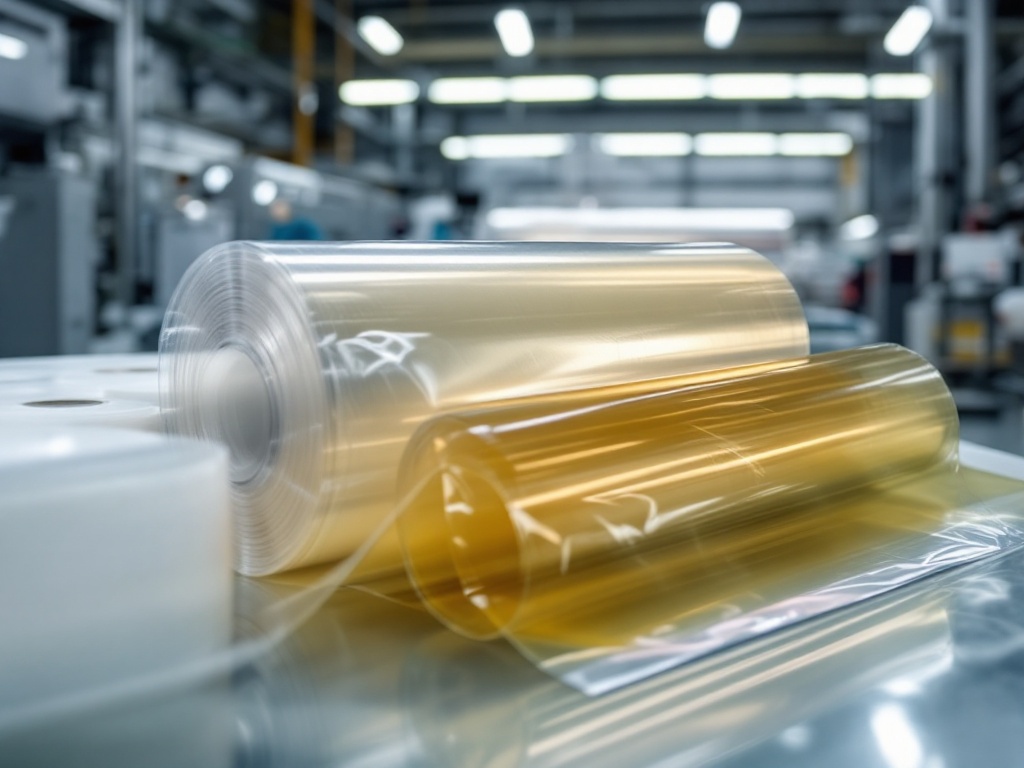
In the packaging industry the concept of ecology is sometimes used too broadly. For some it means material from recycled content, for others reduced thickness, and for others the possibility of being recycled after use. In practice these need to be distinguished. A film can be more environmentally friendly for several different reasons, but each works differently and has different technological consequences.
Less material for the same packaging function
One of the most sensible directions is reducing the mass of the packaging without worsening user parameters. If a manufacturer switches from a thicker film to a thinner one but still maintains adequate mechanical strength, tightness and packing stability, then it truly uses less plastic. In many processes this is more practical than a revolutionary change of material.
This is very evident in gastronomy. Film used for short-term protection of GN containers, portions of vegetables, semi-finished products or confectionery does not always require the same thickness as packaging for heavy or sharp products. A well-chosen specification reduces excess material without risking tears during staff handling.
Better design for recycling
The second direction is simplifying the packaging construction so that after use it is easier to include in the appropriate waste stream. In practice this means, among other things, avoiding unnecessary mixing of many layers and materials where it gives no real technological advantage. Not every package can be simplified, but where it is possible both the user and the sorting system benefit.
For simpler applications, solutions based on conventional plastics work well, provided they are correctly designed and used as intended. In this context it is worth knowing the properties of materials such as products made from LDPE film, which in many food applications provide good flexibility, transparency and predictable performance.
Reducing food waste as part of ecology
This point is often overlooked by those outside the industry. Packaging that extends a product’s shelf life, reduces contamination risk and limits damage in logistics improves the overall environmental balance of the process by itself. Especially for fresh, prepared and ready-to-eat products, even a small increase in spoilage means more organic waste, more energy wasted in production and more operational problems.
In practice, experienced companies do not only ask: “is this film ecological?”, but rather: “with this basis weight, this temperature, this storage time and this distribution method will the product still be safe and marketable?”. That is a much more mature approach.
Why choosing a food film must start from the process, not from a catalog of slogans
The same film can work very well in one facility and completely fail in another. The reason is simple: packaging works in a specific environment. The type of product, its moisture, fat content, packing temperature, exposure time, transport method, type of seal and how staff actually handle the packaging on the line or in the kitchen back area all matter.
An everyday example: a local eatery packs portions of sauces and chilled semi-finished products, but does so in a fast rhythm during service prep. If the film cuts poorly from the roll, doesn’t hold tension or easily wrinkles on the container rim, staff begin to use more of it. The company theoretically chose a “more economical” variant, but in real work it generates excess waste and slows down dispensing. There are many similar situations.
Operating temperature and contact with food
Not every film behaves the same when chilled, frozen or in contact with a warm product. In the food environment this matters not only for ease of use but also for packaging stability. Material that is too stiff at low temperature may crack under tension. Conversely, an ill-fitting film on hot dishes can lose tension or adhere poorly to the container rim.
Companies that package food in series quickly notice another thing: packaging must be predictable. One batch of film that behaves differently from the previous immediately results in internal complaints, problems on the sealing machine or the need to change settings. An ecological solution only makes sense if it provides repeatability.
Moisture, fat and the risk of leaks
Wet and fatty products are much more difficult to package than dry components. A small contamination of the sealing area or a poor fit of the film to the container is enough for leaks to appear. And a leak is not only an aesthetic problem. It is a risk of cross-contamination, poorer transport hygiene and a higher number of rejects at the recipient’s side.
That is why in many applications the basis is not the slogan “bio” or “eco”, but a properly selected PE film whose parameters are known, stable and matched to the process. Only on that basis can one seek environmental optimizations: reducing thickness, improving recyclability or limiting excess packaging.
The most common change directions in companies that want to package more responsibly
In practice a single big turnaround rarely happens. Much more often companies introduce several smaller changes that together produce a noticeable effect. This approach is sensible because it allows maintaining control over food safety and avoiding operational chaos.
Reducing thickness while preserving function
This is one of the first moves that makes technological sense. If a process analysis shows that the previous film was oversized, you can reduce basis weight or thickness without worsening product protection. This, however, requires an honest check of how the material behaves during manual packing, on the sealing machine and in internal logistics.
On paper many solutions look similar. Differences only emerge when confronted with real loads: when stacking containers, sliding boxes, moisture condensation in the cold room or quickly opening and closing packs in the kitchen. This cannot be assessed solely by the material name.
Better format fit to the product
Packaging waste very often results from simple dimensional mismatch. A bag that is too large, film that is too wide, unnecessary material allowance for sealing — all increase consumption without improving protection. A well-matched format usually brings more benefits than changing the raw material itself.
In plants packing bread, vegetables, confectionery or production components the benefits of such adjustments are particularly evident. If the packaging stops “carrying air”, it’s also easier to optimize collective packing, transport and space in the cold room.
Separating applications instead of one material for everything
It’s a common organizational error: a company wants to simplify procurement and use one film for all operations. The effect is often the opposite of intended. A material good for light protection in the back area may not be suitable for tight transport packaging. Conversely, a solution that is resistant and strong can be simply too heavy for simple, short-term applications.
Experienced companies separate functions. One film works for direct food contact, another for collective protection, and yet another for pallet or layer protection. That is why behind ecology there is always packaging process design, not just the purchase of a specific product.
Material differences matter in practice, not only technically
In talks about more responsible packaging material names often appear without user context. Meanwhile, for a restaurant, catering service or food manufacturer the consequences are more important than the name itself: flexibility, puncture resistance, transparency, stiffness, sealing behavior and ease of further separation.
LDPE and HDPE in real use
LDPE is valued where softness, flexibility and good formability matter. In many food applications it provides ease of work and predictable behavior during manual packing. HDPE, on the other hand, is stiffer, feels lighter and works well in certain technical solutions, especially where the required strength at low material mass is important.
From the user’s perspective one thing is important: the material should be chosen for the function, not for fashion. Even a very good raw material will be a bad choice if it does not match the working conditions. For some applications solutions based on products made from HDPE film are also helpful, particularly where specific stiffness and material efficiency matter.
Barrier, breathability and product durability
Not every product needs the same level of protection. Fresh vegetables, bread, prepared foods, meat or cheeses behave differently after packing. Some are sensitive to drying, others to condensation, and others to a lack of proper gas exchange. Therefore an ecological food film cannot be evaluated independently of the product physiology and distribution conditions.
Here a very practical limit appears. The more demanding the product, the more cautiously one should approach material simplifications. In simple applications there is a large margin for maneuver. In fresh, chilled products with a short shelf life the margin of error becomes noticeably smaller.
Ecology in food packaging starts on the shop floor, in the kitchen and in the warehouse
Most problems do not stem from the material itself, but from how it is used. Even a well-chosen film will not fulfill its role if rolls are stored improperly, exposed to high temperatures, humidity or UV radiation. Their functional properties then change, and staff start fighting the packaging instead of working efficiently.
The same applies to the organization of the workstation. If film is constantly put down anywhere, cutting knives are dull, and containers have uneven edges, consumption automatically increases. In many catering venues, only an analysis of daily work shows that the problem of “too much plastic” is partially a problem of a poor process, not solely a bad product.
Storage and parameter stability
Films and packaging should be stored under conditions that do not deteriorate their properties. Excessive heating, long storage in full sun or large temperature fluctuations affect flexibility, stretchability and ease of use. In practice this means a greater risk of damage and more waste already at the stage of use.
Companies that work with a larger number of packaging items quickly notice a correlation: the better organized the storage and rotation of materials, the fewer operational failures. This has a direct impact on film consumption and packing safety.
Repeatability of staff work
An ecological solution must also be convenient for people. If a film requires greater stretching force, is harder to tear off, or more often slips out of the guide when sealing, staff begin to compensate with additional layers or a larger allowance of material. In purchasing reports this looks like an increase in consumption without a clear reason, but on the floor the cause is obvious.
Therefore, packaging assessment should include not only laboratory parameters, but also ergonomics. In a catering environment, where speed and hygiene matter, small inconveniences very quickly turn into real operational losses.
An aware company does not look for “the most ecological film”, but for the best balance
In practice the best packaging decisions are rarely extreme. They are not about completely abandoning film at all costs nor about unreflectively keeping existing solutions. It is about balancing food safety, product durability, process hygiene, ease of work, material quantity and the possibility of further waste management.
Companies that approach the topic maturely analyze several layers at once. They check where packaging is necessary, where it can be reduced, where it is worth simplifying the construction, and where protection of the product must remain the priority. This is much more demanding than a simple choice of “eco” or “non-eco”, but such an approach yields lasting results.
In the food and HoReCa industry responsibility starts with specifics. Film must work. It must protect food, support hygiene and not complicate work. If it also reduces raw material use, fits better into recycling and reduces losses, then we are talking about a truly sensible solution — not just one that sounds good.
How a catering company reduced film consumption by 23% without worsening packing quality — a case study
Context and starting point
A catering company serving several companies and public institutions in a large city — packs between 800 and 1200 portions of ready meals daily. It does this in the back kitchen, with high staff turnover and limited time for preparation. The client requested help in optimizing purchases of film and packaging, motivated by rising costs and pressure from institutional customers who began to ask about suppliers' environmental policies.
At the start it was unclear whether the problem was material-related, organizational, or both. This is an important observation, because in such situations it is easy to immediately reach for a product change and end the analysis there.
What we found on site
During the first visit to the kitchen back area it turned out that the company used one type of film for almost all operations: securing GN containers, wrapping portions on trays, protecting finished dishes in transport and separating layers of products in the cold room. It was a thick, strong and clearly oversized material for simple applications — the kind of solution that “always works”, but in practice generates a constant surplus of consumption.
Staff complained about one thing: the film tore poorly from the roll during fast work. The effect was predictable — employees pulled pieces that were too long because they did not have time to struggle with the material during peak service. At 900 portions a day such a habit translated into a measurable excess of consumption.
At the same time we noticed that the bags used to pack sides and snacks were two sizes too large. Staff folded the excess and closed it with a plastic tape, which in itself generated additional waste. No one had previously compared the package size with the actual portion size.
The mistake that almost derailed the whole analysis
After the first round of measurements we proposed switching to thinner material for securing GN containers. The client agreed to a test. After a week a signal came from the kitchen: the film tore when stretched over larger containers and steam from hot dishes seeped under it. Staff reverted to the old material on their own initiative.
The mistake was simple: we did not check beforehand in what temperature conditions the film is used with the containers. Some dishes were covered immediately after portioning, when the container was still around 60–70°C. The thinner material lost tension when exposed to heat and did not provide a tight closure. We had to step back and run tests in real conditions, not only at room temperature.
Proper process analysis
After this incident we divided packing operations into four separate categories:
GN containers with hot dishes — high temperature, need for airtight sealing, transport to customers
Cooled portions and salads — lower temperature, short exposure time, aesthetics important for the end customer
Interleaving layers of products in the cold room — purely protective function, no sealing requirements
Bags for sides and snacks — hand packing, rapid turnover, various portion sizes
For each category we separately checked: packing temperature, storage time, mode of transport and the actual way staff used the material. Only this provided a basis for sensible recommendations.
Specific changes that were implemented
For interleaving layers of products in the cold room and securing dry products we implemented a much thinner material — requirements were minimal here and the previous thickness was unjustified. LDPE film products in lower grammage proved effective here: they sit well between layers, do not wrinkle excessively and do not cause problems when removed from the cold room.
For GN containers with hot dishes we kept a thicker material, but changed the workstation organization — rolls were placed on dedicated holders at each packing station instead of being set on the counter. Tearing time shortened enough that staff stopped compensating for difficult cutting by taking excessively long pieces.
For bags for sides we performed a simple measurement: we checked the 15 most popular portions and matched two formats instead of one. Moving to a smaller format for portions up to 150g eliminated wrapping the excess. Ready-made PE films in formats suited to actual needs proved useful here, instead of a single “universal” size.
For pallets and bulk transport of products we kept solutions based on HDPE film products — here material reduction was out of the question, because priority was stability and protection during loading.
Difficulties after implementation
The first three weeks were chaotic. Back kitchen staff, used to one material, reached for the wrong product several times. Once film intended for containers ended up being used to interleave layers in the cold room — no one noticed it was a different format. The problem was not technical but organizational: too many rolls with a similar appearance in the same storage spot.
We solved this simply: colored labels on the roll holders and a short instruction at each station with one sentence: what is here and what it is used for. It sounds trivial, but with high staff turnover such details have real significance.
Results after three months
Total film consumption per portion fell by 23%. This was not the result of one major change, but the sum of several smaller corrections: better format matching, elimination of excessive material in low-demand operations and improved workstation ergonomics. Monthly film purchase costs decreased proportionally.
The company obtained material for a report to institutional customers: concrete data on consumption reduction, without marketing packaging. That proved more valuable than general declarations about a “pro-environmental policy”.
Important practical note: none of the food products delivered by the company had worsened packing quality. No customer complaint concerned leakage or package damage in transport. That was the overriding goal and it was maintained.
What this means in a broader perspective
The case of this catering company shows several things that recur across various food sectors. First: film consumption is rarely a problem of the material itself — it is more often a problem of the process. Second: analysis that ignores temperature conditions and how staff work leads to wrong conclusions and costly reversals. Third: dividing by function instead of looking for one “ecological” solution for everything yields more lasting effects.
Companies that start by asking “what can we change?” before asking “what can we replace it with?” achieve better results and do not risk the safety of the food chain. Reducing material consumption is a good goal. But only if the food at the end of the process reaches the recipient in the condition it should be in.
FAQ – eco-friendly food films in the practice of a responsible company
Can an eco-friendly food film make it harder to meet the requirements of sanitary inspection or a client audit?
It can, if the change was made solely as an environmental slogan, without organizing documentation and rules of use. In practice the material itself is only part of the puzzle. During an inspection or audit what matters is whether the company can demonstrate that the packaging is approved for contact with food, used according to its intended purpose and does not introduce a risk of secondary contamination.
The most common problem is not that the film is “not eco enough” or “too eco,” but a lack of consistency between purchasing, warehousing and production. The company orders a new variant but does not update material data sheets, workstation instructions, batch labelling or rotation rules. At the first inspection chaos appears: staff do not know for which products a given film is used, the warehouse cannot quickly point to compliance documents, and the quality department has no clear path for material identification.
If the company supplies retail chains, public institutions or corporate clients, requirements can be even more specific. Recipients ask not only for a declaration of compliance for food contact, but also for repeatability of deliveries, batch traceability, material composition and how to handle waste after use. Then the ecological change should be implemented like a normal quality change, not as an image campaign.
Good practice looks simple: before implementing a new solution the company collects a complete set of documents, assigns the material to specific applications, trains the team and checks whether the packaging complicates hygiene at work. Such order works better than a general declaration about a “green direction.” That is why operational experience matters in packaging changes, not just the product description in a catalogue.
How to recognize greenwashing when buying food film?
This question comes up more and more often and rightly so. In the packaging industry it is very easy to encounter messages that sound responsible but say little about real use. Slogans like “environmentally friendly,” “greener” or “new generation” do not yet provide any useful knowledge for a company that packs food and is responsible for product safety.
The best test is simple: check whether there is something concrete behind the marketing term. Is it clear what exactly the film is made of. Is it stated for what application it is intended. Can the manufacturer or supplier explain what really changes from the user’s point of view: the mass of material, recyclability, share of a specific raw material, behaviour on the machine, conditions of food contact. If the answers are general, that is usually a warning sign.
Another issue is the language of promises. If a material is presented as a universal solution, good for everything and always better than standard film, caution is necessary. In food packaging there are almost no absolute solutions. A film that performs well in light hand applications may be completely unsuitable for a more demanding process. An honest supplier states limitations as clearly as advantages.
Also pay attention to whether environmental communication distracts from the basics. If it is unknown how the material behaves during sealing, cooling, contact with fat or longer storage, the company is buying a story, not a tool. Packaging must primarily work.
From the perspective of responsible purchasing it is safest to choose solutions that can be verified technically and organizationally. Sometimes a well-described PE film with predictable parameters is a more sensible choice than a product with a very attractive narrative but without hard information about practical usability.
Can more ecological packaging be reconciled with the aesthetic presentation of the product?
Yes, but it requires sensible package design, not just reducing the amount of material. Companies often fall into the trap of simple thinking: if they want to package more responsibly, the packaging should be as light and as unobtrusive as possible. However, in retail, premium catering or ready-meal production the appearance of packaging affects perceived quality as much as its technical parameters.
The end customer quickly notices creases, film clouding, lack of tension on the surface or uneven sealing. Even a fresh product begins to look worse if the packaging appears haphazard. This matters especially for desserts, sandwiches, salads, premium bread and chilled ready portions. In these segments aesthetics is not an extra; it affects sales and the number of complaints related to the “perception of freshness.”
Therefore a more responsible approach is rather about seeking balance: select the material and format to reduce excess without worsening presentation. Sometimes it is enough to improve clarity, adjust dimensions or the stability of how the product sits in the package. It also happens that changing thickness alone does not give a good visual effect, whereas correcting bag construction or choosing another type of film for the given packing form works better.
In small gastronomy another detail is often overlooked: aesthetics depend not only on the material but also on repeatability of work. If one person packs neatly and another leaves a large excess of film and an uneven edge, no ecological slogan will save the final effect. That is why companies that want to reconcile appearance with reduced consumption usually also tidy packaging standards at the workstation.
How to prepare the team for a film change so they don't revert to old habits after a week?
This is one of the most underestimated elements of implementation. Many material changes do not fail for technical reasons, but because staff did not receive simple rules for working with the new solution. If employees are to work faster, cleaner and with less material use, they must know not only what to use, but also why.
The most effective approach is a short, workstation-level implementation model. Not a general training about ecology, but a few very concrete messages: which film is for a given task, what length usually suffices, for which product exceptions are not allowed, where to place a started roll, how to recognize a mistake. The simpler the rules, the greater the chance the team will stick to them during peak load times.
Observing the first days after the change also helps. Real obstacles emerge then: an inconvenient place to put rolls, similar labelling, the wrong direction of material unwinding, lack of quick access to the correct format. Staff rarely report this directly. More often they simply revert to old habits because those give a sense of operational security.
Simple indicators that are easy to check on-site also work well. There is no need to build an elaborate reporting system right away. It is enough to monitor the number of open rolls, the frequency of reordering specific formats, the number of incorrect releases from the warehouse and internal complaints from production change or the kitchen. This gives a quick picture of whether the implementation actually works.
Companies that go through such a change calmly usually treat employees as part of the process, not as the final stage of the command “from tomorrow we use a different film.” In practice this is what determines whether the ecological change remains with the company permanently.
Is it possible to sensibly compare the environmental footprint of different films without a full LCA audit?
It is possible, but you must be humble about simplifications. A full life cycle analysis gives the most complete picture, but for many restaurants, caterers and smaller producers it is simply too costly and too complex for everyday purchasing decisions. That does not mean the company is doomed to guessing.
In practice you can build a working comparison based on several hard criteria. First: how much material is actually used per unit of product. Second: what proportion of operational waste occurs during packing. Third: whether the change affects food losses, returns or damage in logistics. Fourth: how easy it is to organise segregation after use. Such a set does not replace an LCA but provides a sensible basis for decisions.
A major mistake is comparing only manufacturers' declarations without reference to your own process. One company will use less material thanks to a change, while another using the same solution will increase waste because staff take larger allowances or discard more faulty seals. The environmental footprint does not end at the roll of film. It begins when the material enters real work.
A good intermediate step is also to compare solutions on a small scale over several weeks, not just a single shift or one day. Only then can you see seasonality, differences between employees, the impact of refrigeration, transport and work pace. Companies that only count catalogue parameters usually see too small a slice of reality.
What mistakes do companies make when segregating used films after food contact?
The most common assumption is that every used film is automatically suitable for simple recycling. That is too optimistic. In practice much depends on the degree of contamination with food residues, fat, sauce, moisture and whether the waste is material-homogeneous. The more contaminated the stream, the harder it is to find sensible recovery options.
The second common mistake is mixing production-clean waste with kitchen and municipal waste. Roll ends, cut-off pieces, clean interleaves or unused production elements have a completely different waste value than film removed from a container full of sauce. If everything goes into one bag, the company removes its own ability to better organise waste.
Another problem is the lack of clear division of responsibility. The kitchen assumes the warehouse handles the waste. The warehouse assumes it is production’s matter. The effect is simple: no one ensures stream cleanliness, containers are poorly labelled and staff choose the easiest path. As a result even a company that buys more sensible packaging does not exploit the potential on the waste side.
The solution does not have to be complicated. It is best to separate at least two streams: technologically clean waste and food-contaminated waste. Add a short instruction with examples and place containers where the waste is actually produced. In larger plants periodic checks of what actually goes into each bag also work. Without this segregation remains only a recorded obligation.
Does a small restaurant or bakery really need a packaging strategy, or is this topic only for large establishments?
A small company usually does not call it a strategy, but if it packs food daily it still operates according to some model. The question is whether that model is accidental or deliberately organised. Even a few simple decisions can strongly affect work hygiene, waste volume, staff convenience and purchasing consistency.
In small venues the problem may be less visible because the scale is smaller. However, with limited space and a small team every organisational mistake hits daily work faster. Too many formats pile up in the back. Too few formats lead to makeshift solutions. Unlabelled rolls lead to mistakes. Lack of a packing standard complicates training new staff. These are all operational costs, even if they do not appear in a separate table.
For a small restaurant a sensible strategy can mean simply three things: reducing random purchases, assigning specific packaging to specific tasks and establishing storage and rotation rules for materials. In a bakery there is also the matter of display aesthetics and protecting delicate products. In diet catering repeatability and order fulfilment speed are more important. Each work model requires a somewhat different set of decisions.
So it is not about creating an elaborate corporate policy. It is about ensuring packaging stops being an add-on bought “incidentally.” Companies that organise this area earlier usually have fewer problems later with growth, audits and team changes.
What significance does seasonality have for selecting eco-friendly food films?
Much more than many users assume. The same material can behave differently in winter, summer and transitional periods. It is not only about storage conditions. The product itself changes, the pace of its preparation, humidity levels in the back area, transport time and the temperature during customer pickup.
In summer condensation of moisture appears more often, the packing area heats up faster and some products are more sensitive to losing visual quality. In winter the problem can be stiffer behaviour of some materials after storage in a colder warehouse or during delivery. In seasonal gastronomy there is also a sharp increase in staff workload. Under time pressure even a well-chosen film may be used less precisely.
In companies working with fruit, vegetables, baked goods or seasonal offers the assortment itself also changes. Products differ in moisture, weight, delicacy and the way they are arranged in packaging. That means a solution proven for most of the year may not be optimal during a short but intense sales peak.
Therefore a responsible approach to eco-friendly films does not end with a one-time choice. It is good if the company does a short review before the season: check stock levels, storage conditions, typical complaints from the previous period and packaging compatibility with the current offer. Such a review often helps avoid panicked substitute purchases that are usually the least considered.
If materials are to be stored longer or in more difficult conditions, it is worth monitoring their usability stability. In practice temperature, light and storage method matter, which is also well illustrated by the topic of durability described in the article about factors affecting the durability of polyethylene film.
Do end customers really pay attention to the type of film, or is this mainly B2B pressure?
Both, but motivations differ. In B2B relations questions are usually more specific: about reducing plastics, how segregation is handled, the supplier’s environmental policy, data for reporting or compliance with chain and institutional requirements. The end customer more often looks through the lens of the shopping experience. They notice the amount of packaging, its appearance, ease of opening, sense of hygiene and whether the company communicates honestly.
Interestingly, consumers do not always expect the most radical reduction of material. They much more often expect consistency. If a restaurant declares a responsible approach but sends a dish in an excess of unnecessary film, there is dissonance. Conversely, if the packaging is economical but leaky or unaesthetic, the customer also perceives it negatively. For the end customer “eco” cannot mean “worse packed.”
Also remember that some customers judge a company by details the owner does not notice daily. Whether the packaging can be easily separated from food residues. Whether there are excessive layers. Whether the portion does not look crushed. Whether the description on the website or in the venue promises more than what is seen in practice. These little things matter in building trust.
Companies that handle this best do not promise revolution. They communicate specifics: they reduced packaging excess, organised formats, use materials chosen for function, care about food safety. Such a message sounds credible because it is based on real operational decisions, not just an ecological slogan.
When does a change to a more ecological solution require tests on the real product, and when is a technical analysis enough?
If the packaging has a direct impact on the seal, shelf life, appearance or product safety, a practical test is not an addition. It is a necessity. This applies especially to ready meals, chilled products, wet, fatty, delicate products and all those cases where the packaging works under logistical load or in contact with demanding assortment.
Technical analysis is sufficient more often for auxiliary and less critical applications: auxiliary protection, simple interleaves, packing items not in direct contact with the finished food product or where the packaging function is limited and easy to predict. Even then it is good to check work comfort and repeatability of use.
The best test model covers not only the product itself but the whole operational course. You need to see how the material behaves during packing, internal transport, storage, issuance and opening. Many problems do not appear immediately. They show up only after several hours, after cooling, after contact with steam or after a delivery route.
Experienced companies do not test only “whether it can be packed,” but rather “whether it can be packed repeatedly without loss of quality and without increasing the number of errors.” That is a much more mature criterion. And it usually best separates truly useful solutions from those that only look good on paper.
Most common mistakes when implementing eco-friendly food films
Most problems do not appear when a company "cares too little about the environment", but when it tries to act quickly, with slogans and without checking the effects on production. In practice, such decisions often end with the rollout being reversed, chaos at workstations, more waste or complaints from recipients. Below are the mistakes that regularly recur in gastronomy, catering and food plants.
1. Choosing film for communication rather than for real working conditions
This is one of the most costly mistakes. The company wants to show a shift to a more environmentally responsible approach, so it chooses a material described as eco-friendly, lighter or more modern, but does not test it in the specific process. This move is common because the pressure usually comes from outside: customers, the sales department, management or a tender. The decision is made quickly, and the packing operation is treated as a detail.
The outcome is often simple: the material looks correct on paper, but cannot cope with the real work pace, contact with moisture, pressure on a stack of containers or transport. I have seen situations where after changing the film the number of repackings increased because container corners pierced the thinner material. In another company the problem was not strength but slipping of the film during manual wrapping. Staff used more of it than before to "be sure". Formally it was supposed to be more economical. In practice it turned out the opposite.
How to avoid this? Don’t start with the environmental claim, start with a list of real stresses: pressure, sharp edges, stacking, storage time, type of transport, contact with fat and moisture. Only then compare material options. If the company needs simple auxiliary elements to separate layers or provide technical protection, matching the format and thickness is often more sensible than searching for the "only correct" solution. This is well illustrated by products such as plastic interlayers for layering, where the function is very specific and it is easy to assess whether the material is oversized.
From experience: if someone at the first meeting talks mainly about environmental communication and not about what happens to the packaging between the packing station and the recipient, you usually need to step back two steps. Because the problem is not about narrative, but the physics of the process.
2. Extrapolating results from a short test to the entire operation
Companies very often test a new film for one day, on one shift or on a small batch of product. If it "works quickly", they consider the matter closed. This is understandable because everyone wants to implement change efficiently. However, such a test rarely reveals the real problems.
Only after a few days do differences between employees, shifts, product deliveries or ways of arranging goods emerge. Add to that the work pace. On a calm shift the material seems convenient. In peak hour the same material starts to tear badly, curl, twist on the roll or require an extra touch when sealing. In catering and HoReCa this is enough to increase consumption and the number of errors.
The consequences are typical: the company orders a larger batch, and after a week begins to revert to the old solution. Opened packages remain, stock states get mixed up and the team is frustrated because they were told that "the new one would be better". Worse, after such an experience staff are much harder to convince to another change, even a sensible one.
How to avoid? The test should cover the normal work rhythm, not a controlled demo. It's good if it lasts at least long enough to cover different products, different people and typical operational overloads. You need to look not only at whether it is possible to pack, but whether it can be done repeatably without additional workarounds.
Practical note from implementations: the most telling thing is not the manager’s opinion after the first day, but employee behavior after a week. If they start putting the new roll "to the side" and looking for the old one, it means something in the process wasn’t worked out — even if nobody reported it directly.
3. Oversimplifying the packaging assortment too much
On paper it looks reasonable: fewer SKUs, simpler orders, less warehouse space. In practice some companies simplify too much and try to cover different uses with one type of film or one bag format. This is a common reaction after a period of chaotic purchasing. The problem is that excessive simplification quickly returns as makeshift solutions at the workstation.
When one size is supposed to handle small portions, larger sets and products of different volumes, staff start folding excess, making unnecessary pleats or adding extra layers. Then the company has "fewer SKUs" in the system but actually uses more material per unit of product. This is often not visible at the start because the problem is distributed across hundreds of small decisions during the day.
The consequences are twofold. First, operational waste increases. Second, the aesthetics and repeatability of packing worsen. In gastronomy this is especially visible with sides, bread, pastry portions and small elements of sets. An oversized package does not look neutral. It looks careless.
How to prevent this? Don’t multiply formats without reason, but don’t go to extremes either. A limited number of sizes assigned to specific product groups usually works well. Not "one for everything", but "as many as actually tidy up the work". For simple uses it’s worth comparing real size fit, for example using solutions like plastic bags of a specific format, instead of keeping one universal variant for every portion.
From experience: if a company claims that after simplification "everything is simpler", and at the same time scissors, tapes and improvised closures lie at the workstations, the simplification has gone too far.
4. Ignoring the cost of operational errors when evaluating a "more ecological" solution
Many companies look at the material itself: the mass of the film, the manufacturer’s description, sometimes the unit price. But in everyday work, errors caused by the packaging can be much more costly than the packaging itself. This is one of the most frequently overlooked elements of evaluation.
If the new film slows down packing, requires more frequent fixes, causes mistakes during issuing or increases the number of damages in transport, it stops being beneficial even if it uses less plastic. In plants that work on large numbers of short runs, every additional manual action matters. In a small restaurant it can mean a mess in the back. In mass catering — real delays and the need to repackage whole batches.
Why is this so common? Because the cost of errors is not listed next to the roll of film. It is dispersed: a few minutes longer on a shift, a few damaged containers, a few complaints, a few extra waste bags. When no one measures this, it’s easy to call the change a success just because it looks good in the declaration.
How to avoid this? When evaluating a new solution you also need to count: number of fixes, packing waste, incorrect issues from the warehouse, repackings and internal complaints. This does not require a complex system. A simple spreadsheet or a week-long observation at the workstation is enough.
Practical conclusion from working with clients: if after changing the film nobody can say whether the number of small fixes and rejections increased, the implementation has been assessed too superficially. In packaging it is precisely these "small things" that eat up the ecological effect the fastest.
5. Mixing environmental goals with hygiene goals without setting priorities
Some companies try to reduce the amount of film everywhere at once. The intent is good, but without distinguishing critical and auxiliary areas it ends badly. The biggest problem arises when material reduction conflicts with maintaining workstation cleanliness, protecting semi-finished products or safeguarding during internal transport.
This is common because from the outside different uses of film look similar. In practice their functions are different. It’s one thing to quickly cover a raw material in the cold room, another to provide a tight seal for a container with a finished product, and yet another to protect layers of goods at the logistics stage. If a company throws all this into one bucket under the slogan "less plastic", it starts saving where it shouldn’t.
The consequences are more serious than just increased waste. Secondary contamination, leaks, worse cold-room organization and more situations in which a product must be repacked or withdrawn from internal circulation occur. Then the material saving disappears immediately.
How to avoid this? First divide uses by risk and function, and only then look for reductions. It’s easiest to optimize auxiliary areas, interlayers, technical protections and oversized formats. Areas directly related to hygiene and product integrity require greater caution.
From practice: companies that really improve packaging balance do not start with the most sensitive places in the process. They first tidy up what is clearly excess. Only then do they tackle critical areas, and only after testing.
6. No control over what happens to opened rolls and partially used packaging
This is a less often described problem, but very common in practice. The company focuses on choosing a "better" film, but loses control over how much material is wasted after opening. Rolls end up at different stations, return to the warehouse without labels, lie loose, get soiled in the back room or are used interchangeably for other tasks.
Why is this so common? Because this area usually has no owner. Purchasing looks at orders, production at work pace, warehouse at receipts and issues. An open roll between these points becomes nobody’s. And that’s when uncontrolled waste is born.
The consequences are not limited to higher consumption. There is also mistaken use of inappropriate material, difficulty in batch rotation and uncertainty whether a given roll is still suitable for food contact after the conditions in which it was stored. In small venues this is sometimes trivialized, but with higher staff turnover it quickly leads to chaos.
How to prevent this? Every opened roll should have an assigned place, labeling and a return rule. No elaborate procedure is needed. A simple standard is enough: where it lies, what it is used for, who puts it away, when the material is considered withdrawn from use. Physically separating stations also works well, instead of keeping different rolls next to each other "for convenience".
Practical observation: in companies that claim that "the film runs out strangely quickly", very often the problem is not the product specification itself, but the lack of control over opened packages and surpluses at workstations.
7. Poor waste organization after changing the material
After implementing more responsible solutions some companies assume that the waste issue will "fix itself". This is a mistaken belief. Changing the material without changing waste organization very often does not deliver the full effect, and sometimes even complicates the situation.
The reason is simple: a different material, thickness or form of use changes the way offcuts, roll ends and packing waste are generated. If containers, bags and segregation rules remain the same, staff start throwing everything together. Then the company not only loses order, but also the ability to realistically assess whether the change improved anything.
Consequences? No data, more contaminated mixed waste, worse back-room logistics and frustrated employees who don’t know what belongs with what. I have encountered plants that boasted about reducing plastic, while at the same time having a completely disordered waste stream after production. Such an effect is hard to defend operationally.
How to avoid this error? Every material change should have its waste counterpart: what is produced after use, where clean process waste goes, where soiled waste goes, who controls correctness. Sometimes adding one extra container and a simple instruction at the workstation is enough. In larger operations clearly assigned technical bags are also useful, for example separately for clean film waste and separately for soiled fractions.
From experience: if after changing the film nobody checked what the bin at the workstation looked like after two weeks of normal work, the implementation was not closed. In packaging, waste is part of the process, not an add-on after the process.
8. No contingency plan when changing supplier or material batch
This error only shows up when there is a problem with supply continuity. The company implemented a new solution, reduced old stocks and considered the issue closed. Then a delay comes, a batch change, a slight difference in parameters or a temporary material substitution. Suddenly it turns out the whole process relied on one variant without backup.
Why is this common? Because after a successful rollout nobody wants to return to contingency scenarios. However, in food packaging a plan B is not a luxury. It is an element of operational stability. Especially where packing happens daily and there is no room for a break.
The consequences are painful: hurried substitute purchases, rollback of established standards, mistakes at workstations and a rapid increase in consumption as the team returns to improvisation. In the worst case the company starts using material "just to have it", without properly organizing documentation and rules of use.
How to avoid this? After rollout it is worth having an approved reserve variant or at least clearly described minimum substitute parameters. It’s not about multiplying stocks, but about operational readiness. It’s also good to leave practical knowledge in the documentation: for which uses the material worked well and where problems occurred.
Practical conclusion: the most mature companies are recognized not by never having disruptions, but by the fact that a batch change or temporary lack of one SKU does not destroy their entire packing system.
9. Expecting immediate results without organizing team habits
Some companies are convinced that simply replacing the film will automatically reduce consumption and improve environmental metrics. This is a very convenient assumption. Unfortunately it usually doesn’t work. If people work exactly as before, the new solution often just overlays the old habits.
The reason is simple: staff defend their work pace and safety. When the new material requires even a slightly different grip, a different length, a different way of tearing or placing, and no one has practiced it, employees return to what they know. They start taking too much stock, doubling layers or putting the correct roll aside and reaching for the "more reliable" one.
The consequences are predictable: consumption does not fall, metrics do not match, and management concludes that "this eco film did not work." Meanwhile the problem may not be the material, but the lack of workstation-level implementation.
How to avoid this? The change must be embedded in work practice: a short instruction, a simple workstation standard, observation during the first days and quick correction of what hinders. Not a lecture on sustainability, but specifics: how much to cut off, where to put it, when not to make exceptions.
From experience: if after rollout nobody stands for an hour at the workstation to watch how people actually use the new film, the company is guessing more than managing the change. And then even a good material can easily lose out to old habits.
10. Treating rollout success as a one-time decision rather than an ongoing process
The last mistake is very typical after the first successful stage. The company implements a new solution, sees improvement and closes the matter. No review after a month, no seasonal check, no verification whether the product is still well matched to changing assortment and load. This is when losses return, only quietly.
In gastronomy and food production working conditions are not constant. The menu changes, portion sizes, transport methods, team composition, order volumes and product rotation change. Material that worked well under one model of work may stop being optimal after a few months. Not because it is bad. Simply because the process changed.
The consequences are usually dispersed: slightly higher consumption, a few more offcuts, a bit more makeshift at workstations. Too little to trigger an alarm, but enough to lose the effect achieved at the start after a quarter.
How to prevent this? Establish a simple periodic review: which formats are used up fastest, where excess waste returns, whether new uses have appeared, whether the number of exceptions from the standard has increased. This doesn’t have to be a complicated audit. Regularity and someone responsible for drawing conclusions are enough.
Final practical observation: the best implementations of eco-friendly films do not look spectacular. They are rarely a revolution. Usually they are a series of smart adjustments that hold up over time because they were embedded in the team’s actual work. And that is what distinguishes a lasting change from one that only sounds good.
Myths about eco-friendly food films that often lead companies to poor decisions
There are many simplifications surrounding eco-friendly packaging for gastronomy and the food industry. Some come from marketing messages, some from procurement pressure, and some from attempts to quickly compare solutions that in practice are not comparable. The problem is that such mental shortcuts very easily turn into wrong operational decisions. Below are the most common beliefs that seem reasonable only until they collide with real food packaging.
Myth 1: "The less plastic in the packaging, the more eco-friendly the solution automatically is"
This belief is particularly persistent because it sounds good in communication. Less material is associated with a lower environmental burden, so many companies assume that any reduction in thickness or weight of the film is a step in the right direction. The source of this myth is looking only at the raw material itself, without taking into account the consequences for the product.
In practice, such thinking is too narrow. If a lighter film protects food worse, there are more leaks, drying out, package deformation or shortened shelf life, and the environmental balance stops being favorable. Food loss, repackaging, return transport and additional waste can negate any benefit from material reduction.
The industry reality is less flashy but much more honest: reducing material makes sense only where the packaging function remains preserved. Experienced companies do not ask how much plastic can be removed, but where it can be removed without compromising safety and process stability.
In practice: the biggest material savings rarely occur in the most demanding applications. They are more often found in auxiliary areas, with poorly chosen formats, redundant folds, or in packages used out of habit "just in case". There reduction makes sense. With sensitive products one must act more cautiously.
Myth 2: "Recycled film is always suitable for food contact"
This misunderstanding stems from equating two different things: the ecological nature of the material and its approval for a specific food application. For those outside the industry it sounds logical — if the material has been recovered and reused, it should be a good choice for food as well. The fact is that in food packaging the idea of recycling alone is not enough.
Why is this wrong? Because for food contact not only the origin of the raw material matters, but also its cleanliness, stability, compliance with requirements for the given application and full control over the material chain. Not every material containing recyclate can be used in the same way as virgin material, and certainly not in every layer of packaging or with every type of product.
In real work the industry distinguishes solutions approved for direct food contact from those that work well in technical, transport or waste applications. That is a fundamental difference. Companies that try to bypass it with the slogan "it's still a film" usually create quality and documentation risks for themselves.
Practical observation: if a packaging supplier talks a lot about the environment but little about material compliance, declarations and specific intended use, a red flag lights up. In the food industry a general assurance that the solution is "more eco" is not enough. It must also be unequivocally suitable for food contact.
Myth 3: "Compostable packaging is the best choice for gastronomy"
This belief grew on the back of a very simple association: if something is compostable, it should by definition be better than conventional film. The problem is that many people do not distinguish between laboratory or industrial conditions and the actual waste management system in which a restaurant, catering service or food producer operates.
The myth is incomplete for two reasons. First, the compostable label alone does not solve functional issues: resistance to moisture, fats, temperature, storage stability or compatibility with the packaging process. Second, such packaging still has to reach the proper waste stream. If it ends up in mixed waste or goes to a facility that does not handle such fractions, the claimed environmental advantage remains mainly a label.
Industry reality is more demanding. A good solution must be not only theoretically environmentally friendly but also compatible with the client's waste logistics, product requirements and the way staff work. In some applications compostability can make sense. In many others a better effect comes from reducing excess material and organizing the waste stream after use.
From experience: companies most often overestimate the value of the word "compostable" itself and underestimate the importance of subsequent waste collection. If the kitchen backroom does not have a simple and realistic way to correctly separate such material, implementation quickly loses operational sense.
Myth 4: "The end customer expects primarily eco-friendly packaging, not product durability"
This myth comes from a simplified interpretation of consumer trends. Consumers do pay attention to environmental impact, but that does not mean they accept a deterioration in packaging quality. In practice a retail customer, a catering recipient or a business partner expects two things at once: responsibility and reliability.
The falsehood of this belief becomes apparent quickly. When packaging leaks, sweats, deforms or looks sloppy after delivery, a complaint does not disappear just because the material had an eco label. For the end customer the condition of the product comes first. Only then do they judge whether the packaging meets their environmental expectations.
The market reality is quite harsh: companies are praised for responsible solutions when those solutions do not shift the cost of that responsibility onto the convenience and safety of the recipient. Poor packaging under the banner of ecology does not build trust. It builds irritation.
Practical conclusion: if a company wants to communicate a packaging change, it should first check whether the product arrives just as well, just as clean and just as presentable after the change. Without that even the best environmental narrative starts to look like an excuse for lowering standards.
Myth 5: "An eco-friendly film should be universal — one for everything"
The source of this myth is understandable. Simplifying the assortment seems convenient: fewer SKUs, less ordering, less training. However, in the area of eco packaging this way of thinking often leads to a paradox. A company wants to streamline the process and ends up with a material average at everything and optimal at nothing.
Why is this wrong? Because different operations have different environmental and usage loads. Protecting a dry component has different requirements than packing a moist product, and different again are the needs of logistical protection. Looking for one "green" solution for all applications usually results in excess material in some places and insufficient performance in others.
In practice the industry goes the other way: it selects solutions according to function, not catalog convenience. Sometimes this means separating formats, sometimes using a different type of bag, and sometimes keeping a classic solution where the product is particularly demanding. A good example are simple technical applications where a precisely chosen format, like bag 170x350, is sufficient instead of using one larger variant for every portion.
In practice: companies that truly organize their packaging do not have one material "for everything". They have a clear logic of use. And that logic delivers a better environmental effect than apparent simplicity.
Myth 6: "If the packaging looks thinner and lighter, it must be worse"
This is a myth from the opposite end of the scale. Many production and kitchen teams automatically distrust lighter materials because over the years they have become accustomed to the rule: thicker means safer. This approach originates in experiences with previously used lower-quality films that indeed tore or performed poorly during manual handling.
Today that simplification often no longer holds. The quality of a solution is not decided by the impression of "massiveness" alone, but by the relationship between material properties, product construction and the specific application. A lighter package can be sufficient if it has been well designed for its function. Heavier can simply be excess.
In the food industry one regularly encounters situations in which staff reject a sensible solution only because it "feels too thin" in the hand. After a week it turns out, however, that in everyday use the material works correctly and the only difference was the change in user habit.
Practical note: the staff's first reaction to a lighter material can be misleading. It is worth observing not the comments from the first 10 minutes, but the real results after several days: the number of damages, packing speed and amount of waste. That is a much better test than the mere "feel of solidity".
Myth 7: "Eco packaging solutions are only good for large companies with elaborate procedures"
This belief often appears in small restaurants, bakeries, local processors and catering companies. It comes from the perception of a market where large brands shout the loudest about ecology. Smaller entities then assume that without a quality department, extensive reporting and complicated specifications nothing sensible can be implemented.
This assumption is wrong because many valuable changes do not require a complicated system. At a small scale it is often easier to spot the source of excess: oversized bags, unnecessary double packing, improper use of technical bags, lack of separation of packaging by function. Such corrections are available to smaller companies as well, if someone looks at the process carefully.
The reality is that small companies even have some advantages: they implement simple standards faster, test changes over shorter periods and notice effects at the workstation more easily. They do not need an extensive transformation project. They need an accurate diagnosis and discipline in daily material use.
From experience: in small venues the biggest losses rarely come from "lack of modern technologies". More often from disorganized habits, randomly chosen formats and using technical packaging where a simpler solution would suffice.
Myth 8: "If the supplier provides eco declarations, the company doesn't need to analyze its own process"
This is a very convenient myth, which is why it is so popular. If the manufacturer or distributor describes the solution as more environmentally responsible, some companies consider it sufficient proof to implement it. In practice this confuses information about the material with an assessment of one's own process.
Why is this insufficient? Because even a correctly described film can be used wrongly. The same product can work well in one organization and poorly in another, depending on portion size, load, storage method, type of containers, work rhythm and waste organization. A supplier's declaration does not replace checking what happens on site.
Industry practice is simple: a responsible packaging choice always combines supplier data with one's own observation of use. Without that the company buys a promise, not a solution. This applies to contact films as well as to technical or transport elements, such as pallet pad 900x1300, which have a very specific function and must be assessed in the real flow of goods.
Practical conclusion: a good supplier helps narrow the choice, but will not relieve the company of responsibility for evaluating its own process. Those who skip this stage usually return to square one sooner than they expected.
Myth 9: "Ecology in food films is mainly a matter of material, not hygiene and work discipline"
This belief is particularly misleading because it shifts attention to purchasing and away from use. It's easier to replace a product than to tidy up practice at the workstation. Hence the temptation to treat the change of film as the main driver of environmental change.
This is an error because packaging used sloppily, out of order, without cleanliness control and without a standard for storing, quickly loses its advantage. Even a sensibly chosen solution will not defend itself where staff grab a roll with dirty gloves, leave it anywhere, mix intended uses of materials or apply excess "for peace of mind".
In the realities of gastronomy and processing, process hygiene and predictable work are part of ecology, not a separate topic. Every repack, every workstation mistake, every soiled section of material is additional waste and additional resource use.
From practice: companies achieve the best results not when they buy the most ambitiously described film, but when staff know exactly what a given material is for, how to use it and when not to make exceptions. It's less spectacular than ecological slogans, but yields a more lasting result.
Myth 10: "A conscious company should completely abandon film"
This is perhaps the most ideological myth in the whole discussion. It appears when the topic of packaging is reduced to a simple division: film is bad, no film is good. Such thinking may work well in general debate, but in the food industry it is simply too primitive.
Not every protective function can be safely eliminated. Film is sometimes needed not because companies don't want to change anything, but because the product requires a barrier, protection against contamination, logistical security or seal control. Attempting to completely abandon film without considering these functions usually results in increased losses, worsened hygiene or shifting the problem to another material that is not better across the whole use cycle.
The industry reality is more pragmatic: responsibility does not mean a symbolic "getting rid of plastic", but reducing unnecessary packaging and keeping what is necessary where it protects food. This approach looks less impressive as a slogan but works better in practice.
From experience: the most mature companies do not ask how to completely eliminate film at all costs. They ask where film is really needed, where it can be thinned, and where excess can be replaced by better organization. That approach builds credibility — also with customers who expect reason from a company, not gestures for show.
So if we are to speak honestly about eco-friendly food films, not as a simple choice between "good" and "bad" material. The real test begins much later: with product compatibility, logic of use, packaging quality, order at the workstation and whether the environmental claim withstands a collision with daily work.
Comparison of approaches to eco-friendly food films: what really works in different types of companies
Companies that want to package food more responsibly usually face not a single choice but a series of decisions. It's not only about which material to buy. Equally important is whether it's better to change the raw material, reduce gauge, simplify the package construction, or maybe leave the material unchanged and improve how it's used. Below it's worth looking at these solutions as different strategies rather than competing slogans.
Lighter film of the same polymer vs switching to a different material type
This is one of the most common comparisons in purchasing practice. The first approach involves sticking with a well-known material but in a thinner or better-tailored version. The second assumes changing the base material itself because the company wants to clearly communicate a more environmental direction.
In catering and food applications the first route is often simply operationally safer. If the team knows how to work with a given polymer, machines are set up for it, and the product has repeatable requirements, reducing thickness or changing the format often delivers a faster effect without upsetting the process. This direction works well where packaging is repetitive and it's easy to assess the actual loads on the packaging.
Changing to another material makes sense when the current solution truly limits further optimization or hinders subsequent waste management. However, you must be prepared for the new material to behave differently when tearing, folding, sealing, or storing. In practice this is not a cosmetic tweak but a change that affects the workflow rhythm.
Who should choose which approach? Smaller restaurants and catering companies more often benefit from cautious downsizing of a proven solution. Larger plants that have time for a series of tests and can compare production batches are more often able to sensibly carry out a material change.
The limitation of the first approach is obvious: it doesn't give a strong image effect if someone expects a spectacular communication change. The limitation of the second is more practical: the risk that an improvement on paper will not translate into packaging stability.
From industry experience: companies that start by changing the raw material without checking whether the current PE film is simply oversized very often overpay for the complexity of implementation. In many processes the largest reserve lies not in a "revolution" but in fine-tuning what already works.
Monomaterial and simpler construction vs more functionally complex packaging
From an environmental perspective simpler constructions are easier to sort in the waste stream. That's their real advantage. If the packaging only needs to perform a basic protective function and doesn't require a specialist barrier or multilayer structure, simplification makes sense and usually also tidies up procurement.
On the other side are more complex solutions that don't always look "eco" but can be technologically justified. This applies especially to products sensitive to moisture, pressure, contact with fat, or longer transport. In such situations a simpler construction may prove too weak, even if it performs well in environmental declarations.
This is best seen in the distinction between simple technical protection and packaging meant to maintain the commercial quality of a product. For separating layers, protecting dry elements, or briefly shielding a semi-finished product, simpler solutions often suffice, such as appropriately selected film interlayers. There an excess of construction usually improves nothing. But for finished chilled products the margin for error is smaller.
Who benefits most from simpler packaging? Companies that have many auxiliary and technical applications where the film is not responsible for long-term quality protection. Who should be cautious? Producers of fresh food and plants where the packaging is an integral part of product shelf-life.
In industry practice simpler construction is a good direction only where it genuinely simplifies the process. If it requires additional workarounds at the workstation, it loses its point. Too often one sees a company simplify packaging and then "dress it up" with extra layers or manual fixes. Formally the construction is leaner. In reality consumption increases.
LDPE vs HDPE in applications where ecological balance and usability matter
This comparison makes sense only when you look at function, not the material acronym itself. In practice LDPE film products usually perform better where flexibility, better conformity to the product shape, and convenience in manual packaging are needed. The material works softly, is more amenable to stacking and often gives a better sense of "control" during fast work.
HDPE film products, on the other hand, have a different advantage: in some applications they allow good functionality with lower material mass and greater stiffness. This matters where lightness, predictable shape, and technical function are important rather than soft adhesion to the product.
In practical use LDPE often wins in kitchen backrooms, for manual packing, bags, pouches, and interlayers where staff need a material that "forgives" quick movements. HDPE is better suited for certain protective and collective applications, for example where form stability or a technical element like pads or transport shields is important. A good example is pallet pads made of HDPE, which work in completely different conditions than film intended to wrap a single product.
Which choice is more ecological? It depends on the application. If the material is well-matched and does not cause excessive consumption, both directions can be justified. The problem starts when a company selects HDPE for operations requiring high flexibility or LDPE where rigidity and lightness of construction matter. Then compensation appears: more layers, greater safety margin, more waste.
The industry observation is fairly constant: the simple choice between LDPE and HDPE rarely decides success. Success depends on whether the material matches the mode of use. Two plants can have the same product and completely different environmental outcomes simply because one uses it according to its function and the other treats it as a universal solution.
One universal solution vs several films assigned to specific applications
From a procurement perspective one solution looks tempting. Fewer SKUs, simpler ordering, easier storage. Except that operationally such a model works well only in very simple processes. In most food and catering companies one kind of film quickly begins to handle tasks it was not created for.
An approach based on several material types but assigned to clear functions usually yields a better balance. A separate solution for light protection, another for the actual packaging, another for collective transport. This is not excessive complication if the division is sensible and limited to real needs.
In practice this is especially important in catering, prepared-food production and back-of-house HoReCa operations. Film behaves differently for portioned condiments, differently for protecting layers of products, and yet differently for internal logistics. For small portions it may be simply more ecological to better fit the size of the bag, for example by moving away from one oversized format in favor of two realistically used variants, such as smaller plastic bags and larger counterparts used only where needed.
Who should use one solution? Small operations with a small number of repetitive applications. Who should use several solutions? Any company where packaging plays different roles and staff perform several types of packing during the day.
The limitation of the multi-material model is organizational: you need to clearly label workstations and enforce assignment of applications. The limitation of the universal model is practical: a "do-it-all" material very often turns out to be over-specified for half the operation.
In the market the most stable companies have neither one solution for everything nor a dozen random SKUs. They have a short, ordered set of packagings, each with a clear function. That gives a better result than chaotically searching for one "most ecological" product.
Ready-made bag and sack formats vs cutting or packing "from stock"
This comparison is often underestimated, although in practice it has a large impact on the amount of waste. Ready-made formats are less flexible to procure but allow maintaining repeatability and limiting excess material. Conversely, packing from a roll or using one large bag "just in case" gives freedom, but very often ends in uncontrolled surplus.
Ready bags and sacks are best where the portion or group of products has a predictable size. In gastronomy this concerns condiments, bread, snacks, portioned semi-finished products, and parts of components prepared in series. If a company knows that most loads fit into two or three ranges, matching the format usually brings more benefits than further material experiments.
Cutting from a roll or packing in a larger format makes sense where product variability is truly large. This applies to some production plants, irregular goods, or situations where dimensional flexibility is more important than perfect fit for each piece.
The practical difference is simple: a ready format limits improvisation, and improvisation is one of the main sources of excessive consumption. This is clearly seen when comparing small and larger bags, such as a 170x350 bag or bag 470x600. If a small product is constantly placed into a large package, the company is not buying safety. It is buying empty volume and additional waste.
From experience: where the team works quickly and manually, a ready format almost always improves consumption discipline. In more variable processes excessive attachment to fixed sizes can hinder work. Then it's better to accept a certain range of flexibility than to multiply formats endlessly.
Environmental effect through material reduction vs environmental effect through reducing product losses
This comparison is particularly important for companies that want to make mature decisions, not just communicative ones. Reducing the amount of film gives a quick, measurable result. Less polymer in circulation, lower packaging mass, a simpler metric to show in reports. But this model works well mainly where the product is undemanding and does not lose quality with lighter protection.
The second approach focuses on reducing food losses, even if it does not lead to maximum reduction of the packaging itself. In many food categories this is the wiser choice. If better protection means fewer damages, less drying out, fewer leaks, or a smaller number of rejections upon delivery, the total environmental balance can be more favorable than with aggressive film lightweighting.
The first approach works best for auxiliary, technical and short-term applications. The second is more appropriate for finished, fresh, sensitive products that are transported further than "around the corner." The limitation of the first is the risk of losing protective function. The limitation of the second is that it's harder to sell in a simple message, because the effect is not always visible from the packaging mass alone.
In the food industry companies that most often succeed are those that do not oppose these approaches but separate them by application. Where film can be reduced without harming the product, they do it. Where packaging protects the real value of the food, they allow a larger safety margin.
Custom solutions "tailored to the process" vs standard catalogue products
Larger-scale companies often consider whether to go for more tailored solutions or rely on standard formats. Standard products have one big advantage: they are predictable, more readily available and easier to implement. In most small and medium enterprises this is sufficient, provided the selection was made sensibly.
More tailored solutions make sense when the process is atypical, consumption scale is high, and the gap between need and a standard product actually generates a constant loss. This may concern specific dimensions, work with non-standard assortments, or the need to reconcile several parameters simultaneously.
For a small catering outlet tailoring everything to the process is usually unnecessary. Better results come from organizing applications and choosing sensible standard products. For a plant that daily packs large volumes of one type of product, even a minor dimension or construction correction can have a real operational impact.
From market experience: many companies reach for non-standard solutions too early. Meanwhile the problem more often stems from mismatched use of a standard product than from the lack of an ideal product. Only when the process is organized is it worth checking whether a non-standard variant will truly bring more than additional complexity.
Solutions for small, medium and large companies — where the differences really matter
The same environmental strategy will not be equally good for everyone. A small restaurant needs simple solutions, easy for the team to master and resilient to staff turnover. For it the best model is usually: a small number of well-chosen formats, clear applications and materials that do not complicate work.
A medium catering company gains most from separating packaging functions. It is precisely in this segment that the temptation to use one solution for everything most often appears, and then hidden losses grow. Here ecological progress usually comes from tidying the process and matching formats.
Large food plants have greater room to maneuver. They can test material variants, compare batch results and seek more technical optimizations. At the same time, errors scale fastest there. If the material choice is wrong, the effects are immediately visible in waste volume, line speed and supply stability.
The practical observation is that the larger the company, the more beneficial precise data becomes. The smaller the company, the more beneficial simplicity of implementation is. This is important because some enterprises copy solutions from entities of a completely different scale and then wonder why the effect is not comparable.
What usually turns out to be the best choice
The best direction rarely involves one radical move. In practice the most stable results come from combining three things: limiting excess material where it does not perform a critical function, matching format to the real portion or application, and leaving a larger safety margin where packaging is responsible for protecting food quality.
If a company honestly seeks a "more ecological" food film, it should compare not only materials but the full consequences of the choice. Will the solution make work easier or slow it down. Will it reduce waste or merely shift it elsewhere. Will it improve the environmental balance without risking the product. Only such a comparison allows making a decision that will withstand the test of daily work, not just look good in a description.
What no one tells you about eco food films before you sign the order
The "eco" certificate does not always mean the same thing in every offer
In the packaging industry the word "eco" is sometimes used to describe materials that in practice differ radically from each other. One company calls a film eco because it has a smaller thickness. Another — because it contains a portion of recycled content. Yet another — because it is theoretically recyclable, provided it reaches the correct stream, in the right state of cleanliness, in the right region of the country. Those are three completely different things, but in a commercial offer they look similar.
The practical problem is that buyers often do not know what to ask. They ask for an "eco food film" and receive an offer they cannot fairly compare with another. Only after several weeks of use does it turn out that the material behaves differently than expected, because the product base was completely different from the previous solution. Not due to the supplier's bad intent — simply the definition was not standardized.
A mature question to the supplier should not be "is this ecological?", but: what is the composition of the material, what portion of it comes from recycled content, what are the requirements for separation after use and under what conditions can the film actually be sent for reprocessing. Answers to these questions immediately show what you are really dealing with.
Recycled content in food film composition is an area with very specific legal restrictions
Here is something suppliers rarely say outright. Not every food application allows the use of material with recycled content. Regulations on food contact — both EU and national — precisely define what type of recycled content, from what process and under what conditions can have direct contact with the product. In practice many commercially available films with added recycled content do not qualify for direct contact with food and may be used only for outer or transport packaging.
Companies that want to introduce "green" packaging for direct food contact often run into this wall. They either give up, or — which can be more dangerous — use the material without fully verifying its approval. This is a risk that at the first sanitary inspection or commercial audit can cause serious problems.
A mature approach is to request a current declaration of conformity before purchase and check whether the material has the appropriate approval for food contact for the intended application. This is not bureaucracy for the sake of it, but real protection of product safety and the company's legal responsibility.
The ecological effect of a film depends on the local waste system — not on the film itself
This is an observation companies only come to after some time. A chosen film may be theoretically fully recyclable. It may be produced from a single material, without mixing fractions, with excellent environmental documentation. But if it enters the waste stream contaminated with food residues, or if the local waste processing facility does not accept that fraction, the environmental effect is practically zero.
Few people discuss this at the procurement table. Yet this element is what determines whether the manufacturer's claim has any bearing on the reality of the company buying it. In gastronomy and catering, packaging leaves production smeared with sauces, fats and moisture. In that state it very rarely reaches recycling — regardless of how good the environmental properties of the clean film were.
The practical consequence is this: for internal, technical and transport applications, where the packaging remains clean, the recycling effect is real. For direct contact with ready-to-eat food the whole argument of recyclability often dissolves in operational reality. This is not a reason to give up good materials, but a reason for a realistic assessment of where the ecological value actually lies.
Biopolymer-based film behaves completely differently than classic PE and this only becomes apparent in production
Films made from plant-based raw materials or with compostable properties are gaining more supporters. But in food environments problems arise that salespeople rarely mention at the first meeting. The behavior of this material under changing temperature, humidity and stress is different from classic PE. Biobased film may lose flexibility faster, work worse with standard heat-sealers, or require different machine parameter settings.
For a restaurant working by hand this may be a minor inconvenience. For a plant with an automated line it is a serious change that requires time and machine trials. Companies that order biobased film without technical consultation with the manufacturer or machine supplier often end up either reverting to the previous material or incurring expensive line setting corrections.
Another thing that is too rarely discussed: compostable film requires specific composting conditions — usually industrial, at appropriate temperature and humidity. It will not biodegrade in a home composter or in a standard bio-waste bin within the declared time. If a company tells customers that the packaging is "compostable" but does not provide the possibility of its proper disposal, it builds a message that does not match practical reality.
Switching to a lighter film can worsen the environmental footprint due to changes in logistics
This paradox arises from the fact that packaging is only one variable in a much larger system. A company decides on a thinner stretch film for pallets — it reduces packaging mass and promotes the result. But if the new film has poorer wrapping properties, more wraps are required, the pallet is less stable in transport, the number of damages in delivery increases or additional securing is needed — the material balance is not necessarily better and may be worse.
A similar situation occurs with sealing film. If a thinner material requires a longer sealing time or higher temperature, the machine's energy consumption increases. The environmental cost of that energy is hard to see when buying a roll, but on an annual scale it can be significant.
The industry rarely talks about this because these effects are difficult to measure and spread across many points in the chain. In practice this means it is worth observing not only film consumption after every major material change, but also the number of damages, packing time and process stability. Only the combined picture gives a reliable answer as to whether the change was really beneficial.
A product offered as "made from recycled content" can have unpredictable batch variability
Materials with recycled content — especially post-industrial and post-consumer — are not as homogeneous as primary materials. The properties of film with recycled content can vary between batches to a degree that is marginal for technical applications but significant for food packaging, particularly in sealing. Differences in melting temperature, flexibility and transparency can be noticeable and affect process repeatability.
This is not a reason to avoid materials with recycled content — many applications do not feel these differences at all. But companies that run serial production and require very narrow parameter tolerances should consider this before implementation. The most sensible approach is to check with the supplier how large typical deviations are between batches and whether the supplier has quality assurance procedures that control those deviations.
In gastronomy and catering, where packaging is more manual and less automated, this variability rarely poses a problem. But for plants using PE film on automated lines the difference between batch A and batch B may necessitate recalibration and additional quality trials — which has a real impact on time and operating costs.
The term "monomaterial" is sometimes used as a marketing argument without full technical justification
Simplifying the package structure to one type of polymer makes recycling easier — that is true, but an incomplete truth. The problem is that merely being monomaterial is not enough for effective recycling. The film must be accepted by the appropriate installation, must reach a clean stream, and must be free of contaminants and additives that block processing.
Moreover, some films sold as monomaterial contain layers with different melting properties, barrier additives or slip agents that formally fall under the definition of a single polymer but technically complicate recycling. Facilities that accept such materials often have their own quality criteria for incoming feed and not every "monomaterial" on the market meets them.
For the buyer this means one thing: ask the supplier about specific recycling installations the film works with, and do not treat the word "monomaterial" as a guarantee of ecological effect. A food film that after use ends up in a mixed stream due to a lack of a real waste alternative does not differ environmentally from a multilayer film, even if it is built from a single type of polymer.
Coloring and prints on "eco" films have an environmental cost that is often ignored
Companies that want to combine ecological communication with branding often opt for colored or printed films with "bio" labels or green visual elements. Few check how the dye or ink affects recyclability. In reality some paints and pigments hinder or prevent the production of high-quality recyclate. Newly produced recyclate from colored material is often darker and has limited applications — it returns to the cycle as a lower-grade material.
This is important when deciding whether to print information about a film's ecological character. Paradoxically the "eco" label on a printed film may reduce its actual recycling potential. This is most visible when comparing clear films, which return to good-quality recyclate, with colored or printed films, which are more difficult to process in the same installations.
From a practical point of view: if a company wraps products in colored film mainly for visual or communication reasons, it is worth considering whether the same effect can be achieved with a label or print on the outer packaging — so that the film itself remains clear and easier to manage after use.
Seasonality affects film properties in ways not visible on the data sheet
This observation comes exclusively from practice and rarely appears in sales talks. Film stored in a warehouse over winter and film used at the height of summer behave differently — even if they come from the same roll and the same batch. Differences in storage temperature, air humidity and exposure during transport affect flexibility, stretchability and ease of tearing.
For a company implementing a material change in late autumn and evaluating results over the first two months, spring and summer may bring different product behavior. Film that was exceptionally flexible in winter may become somewhat harder to use on a hand wrapper in summer. A material that performed well in sealing in a cooler room may require temperature adjustment during summer service when the packing area is warmer.
This is not a defect of the material — it is a property of all polymer films. But precisely for this reason the evaluation of a new, "more ecological" solution should include at least several months of use in real conditions, not just a short test. The season and the warehouse microclimate are variables that matter and that should be taken into account in the assessment — especially for more sensitive next-generation materials.
Checklist: What to check before implementing eco-friendly films for food
The checklist below is intended for people who already have a general understanding of eco-friendly films and are facing a concrete purchasing or implementation decision. Each item concerns a different dimension of the process and helps avoid mistakes that are costly in practice but easy to overlook during planning.
☐ 1. Check whether the supplier's environmental declaration applies to the finished product or only to the base raw material
Many suppliers describe a film as ecological based on a raw material certificate, not the finished product. In practice there are many processing stages between the raw material and the film ready to be used in catering, which can change the composition and properties of the material. A raw material certificate is not the same as approval of the product for a specific food application.
Consequence of omission: The company implements a film believing in its ecological nature, and at the first supplier audit or sanitary inspection it turns out that the document does not cover the finished product in the form in which it is used on the packing line.
Practical tip: Ask for a declaration of compliance for the finished product (not the raw material), not just the technical data sheet of the base material. These two documents should be read together.
☐ 2. Verify whether the film has been tested with your specific type of sealing, not just under standard laboratory conditions
Technical data sheets state seal parameters under ideal conditions — constant temperature, clean edges, a specified time. In real food production the seal is made on surfaces that may be slightly greasy, moist, or uneven. New-generation ecological films, especially those with modified composition or recycled content, can be sensitive to variations in sealing conditions and may give leaky closures without an obvious visual signal.
Consequence of omission: Packages look sealed, but during transport or in the cold room it turns out the seal has failed. With wet or fatty products this always results in leakage and complaints.
Practical tip: Before implementation test the seal under deliberately adverse conditions: slightly damp edge, slightly reduced machine temperature. This simulates what happens during the busiest working hours.
☐ 3. Determine who in the company is responsible for the ongoing evaluation of the implementation's effects — and whether that person has access to operational data
Implementations of ecological films often end with the purchasing decision. No one assigns responsibility for monitoring results in the first weeks. The effect is that small problems accumulate unnoticed: slightly higher consumption, more waste when tearing off, minor staff complaints that do not reach decision-makers.
Consequence of omission: After a quarter the company has no data to fairly assess whether the implementation was successful. The decision to continue or change is made intuitively, not based on facts.
Practical tip: Before starting implementation record three measurable baseline indicators: weekly film consumption, amount of waste generated during packing, and any internal complaints. Then compare every two weeks for the first two months.
☐ 4. Check whether the storage conditions for the new film require changes compared to the previous solution
Films with modified compositions — especially those with biopolymer additives or special layer constructions — may be more sensitive to temperature and humidity during storage than classic PE. If the warehouse is not climate-controlled or rolls are stored near entrances exposed to temperature fluctuations, the material properties may change before first use.
Consequence of omission: Staff report that the film "behaves differently than at the beginning" — it is harder to tear, less flexible, or more prone to curling. The cause is not the production batch, but the storage conditions that no one verified.
Practical tip: Ask the supplier for recommended storage conditions and compare them with the actual conditions in your warehouse — not only in theory, but by checking the actual temperature in the warmest week of summer and the coldest week of winter.
☐ 5. Assess whether your recipients or suppliers have consistent expectations regarding the packaging — before you change the material
In the food supply chain packaging is evaluated by many parties: packing staff, warehouse workers, drivers, recipients. Each group has different priorities. A change in film that looks neutral from a purchasing perspective can be a problem for a recipient used to a certain transparency, thickness or way of opening. This is particularly important for deliveries to retail chains or catering services with demanding institutional clients.
Consequence of omission: The recipient files a complaint not because the product is damaged but because the packaging looks different than in the contract or specification. This type of complaint is very difficult to resolve in practice.
Practical tip: If you have written packaging specifications in contracts with recipients, review them before implementing the new material and check whether the change requires prior notification or an addendum.
☐ 6. Verify how the film behaves with repeated removals from cold storage and return to room temperature
In gastronomy and catering film often works in a variable temperature cycle: the product is packed at kitchen temperature, goes to the cold room, is taken out, and cooled again. Most material tests are done under static conditions. However, cyclic temperature changes affect the material differently — particularly its flexibility and adhesion to the rims of GN containers or trays.
Consequence of omission: A film that adheres well to the container after the first packing may start to detach from the edges after removal from the cold room and return to a warm environment. For ready meals this is a risk of secondary contamination.
Practical tip: Test the new film in a real cycle: pack a container, put it in the cold room overnight, take it out in the morning and leave it at room temperature for an hour. Check the seal only after this cycle, not immediately after packing. Many films available in the PE category have different adhesion characteristics in such cycles — it’s worth verifying empirically, not only from the data sheet.
☐ 7. Make sure staff understand why the change is being introduced — not just how to pack with the new material
A technical instruction without context causes staff to revert to old habits at the first inconvenience. If employees know why the change is being made and what it achieves, they have more reasons to adapt their behavior and report problems instead of quietly returning to the previous solution.
Consequence of omission: The formal implementation is completed, but in practice the new material is used only in the presence of a supervisor. During peak hours staff reach for the "old, trusted" film from stock or use twice as much of the new one "to be safe."
Practical tip: A five-minute conversation in the back room or at the workstation is enough — concrete, without slogans. What is changing, why it is good, what to report and to whom. Kitchen staff can very quickly evaluate material in practice — and that is valuable feedback that no internal test can replace.
☐ 8. Check whether the new film is compatible with existing accessories — knives, dispensers, roll guides
A change in thickness, hardness or roll width often requires small adjustments at the packing station. Too hard a film cannot be easily cut by a standard dispenser knife. Too thin a film slips off the guide when torn quickly. These are things you can't see in a product photo or technical sheet, but they immediately affect work ergonomics and material consumption.
Consequence of omission: Staff either damage the film when tearing it off or waste time fighting the dispenser. Both scenarios generate excess waste and slow down work — the ecological effect of the implementation is the opposite of intended.
Practical tip: Before ordering a larger batch request a sample and physically test it on the same dispenser and the same packing table that operate daily. Pay special attention to how the film behaves during a quick, one-sided pull — as staff do in practice, not how it looks in a calm demo.
☐ 9. Assess whether the planned change does not invisibly shift the environmental footprint to the transport stage
A lighter or thinner film can reduce the package mass, but if the change causes worse product protection in transport, the number of damaged deliveries increases. Each damaged delivery is not only a loss of food but also emissions from return transport, repacking, disposal. This effect is dispersed and hard to see at the level of a single roll, but over a month it can outweigh the material savings. This particularly concerns LDPE films used for collective and pallet wrapping — where mechanical strength directly affects load stability.
Consequence of omission: The company improves the film consumption metric while the number of transport complaints and food waste increases. Both effects are real, but only one is measured and reported.
Practical tip: For the first month after implementing a lighter film for collective or pallet packing monitor the number of damaged shipments. If it increases, this is a signal to correct the specification, not to abandon the whole change.
☐ 10. Verify whether you have documentation sufficient to defend the packaging decision during an audit or inspection
Environmental claims without documentation are a risk, not an asset. If the company communicates the use of "responsible packaging" to clients or trading partners, it must be able to document it. Lack of an up-to-date declaration of food-contact compliance, missing certificates cited in marketing materials, or outdated approval documents are the most common gaps that come up in supplier audits in retail chains and processing plants. It is worth remembering that HDPE and LDPE films have different approval specifications — documentation for one type does not automatically cover the other, even if both are used in similar applications. Detailed information can be found in the HDPE film product sections and LDPE film product sections.
Consequence of omission: An auditor asks for a certificate, the company searches for the document, and it turns out to be three years old or related to a different product variant. This is not necessarily disqualifying, but it always creates unnecessary tension and may call the entire packaging specification into question.
Practical tip: Keep packaging documentation in one place, with expiry dates and assignment to specific uses. With every change of supplier or batch, check that the new documents are up to date and correspond to the product in the configuration in which it is used — not the catalog configuration.
Eco food films: where the market is headed and what it means for companies
Regulatory pressure is accelerating, but not everyone will manage to prepare
EU packaging rules are changing faster than most companies have been able to factor into their purchasing plans. The PPWR regulation (Packaging and Packaging Waste Regulation), which is nearing completion, introduces new requirements regarding recycled content, design for recycling and the gradual elimination of certain formats. This is not a distant prospect — the deadlines for the first obligations are counted in years, not decades.
The practical consequence is this: companies that treat “eco” as a communication option today may face the need for an abrupt operational change under compliance pressure in two years. And sudden changes in food packaging always cost more than planned changes. Companies that start systematic testing and implementations earlier will gain a real advantage — not a marketing one, but an operational one.
It is also worth watching changes in the requirements of large retail chains and HoReCa customers. Environmental documentation clauses for packaging are increasingly appearing in tenders and commercial contracts. This is market pressure that operates independently of regulators and is often faster than law.
Technologies to improve recyclability are entering the mainstream
A few years ago, sorting film packaging from municipal and industrial waste streams was technically limited. Optical sorting facilities did not cope well with transparent films or thin fractions. That is changing. Installations equipped with improved NIR systems (near-infrared spectroscopy) increasingly and more efficiently identify the type of polymer, which translates into higher recovery rates for polyethylene films from various applications.
What does this mean in practice? Film that a few years ago ended up as mixed fraction now has a more realistic chance of entering the correct stream — provided it meets purity and composition criteria. For companies packaging food this changes the calculation: packaging from a dry, technical stream that has no contact with the product has much higher recycling potential than a few years ago. This is a real argument for separating protective and technical films from those having direct contact with food — because the former can already realistically be recycled.
Increasing importance of traceability — tracking material provenance
More and more food and HoReCa sector companies are receiving questions from their customers about environmental documentation of packaging. Questions go beyond a food contact certificate: where the raw material comes from, what the share of recyclate is, and where and how the packaging can be processed. This phenomenon, which a few years ago concerned only corporations with large ESG departments, is now reaching medium-sized companies and well-established premium restaurants.
The market is beginning to expect documentation from packaging suppliers that previously did not exist as part of the standard offer. Companies that already collect such data from their manufacturers and can provide it to the customer will be better positioned in upcoming tenders. Suppliers who lack this information become harder to qualify.
Lighter constructions — a direction that will not slow down
Lightweighting, i.e. reducing the mass of packaging while maintaining function, is one of the most enduring technological trends in film. Advances in extrusion technology allow production of films with a thinner profile while maintaining mechanical parameters comparable to thicker versions from a few years ago. This is not marketing — it is the result of real investments in production lines and material formulations.
For users this means that in a few years standard PE films for food applications will on average be lighter than today, without worsening packaging quality. basis weights that now seem minimal will become the market norm. Companies that test lower basis weights today and teach their teams how to handle lighter material properly are building competence that will translate into real savings and less waste.
An important caveat: lightweighting only makes sense if it is accompanied by appropriate quality. A thinner film that is uneven, tears easily under stress, or is unstable on a sealer is not progress — it is a problem. The market clearly sees this and increasingly prefers to pay for production quality, not just for the unit price per gram of material.
Change in purchasing behaviour: from price to TCO
For years purchasing decisions regarding food film were dominated by the price per roll. This is slowly changing, at least in more mature operations. Companies that went through chaotic implementations of “cheap substitutes” began to see that the material cost is only part of the bill. The calculation now includes: packing time, number of corrections, operational waste, supply stability and complaint costs.
TCO (total cost of ownership) as a way of thinking about packaging is not new, but it is only now reaching smaller and medium-sized catering and foodservice companies. You can see it in how procurement conversations change: questions increasingly focus on technical parameters and repeatability of supply, not just price per kilo. This is a good sign, because this shift in thinking creates conditions for truly effective environmental implementations.
Bio-based raw materials — growing interest, but slow adoption in food
Films made from plant-based feedstocks (e.g. sugarcane as a base for bio-PE) are attracting growing interest among companies seeking alternatives to fossil fuels in the supply chain. Bio-PE behaves almost identically to conventional PE, which makes it much easier to implement than compostable films — it does not require machine setting changes, does not alter weld properties and offers the same predictability in use.
The barrier is economic: the price of bio-PE remains noticeably higher than that of conventional material. However, with growing demand and expanded production capacity by major manufacturers, this gap will gradually narrow. Companies that test bio-PE now in selected applications are learning the implementation process under relatively low market pressure — and will be better prepared when customer questions and regulatory requirements accelerate the topic.
For food plants that use PE film as the basis of their packaging process, bio-PE is one of the easiest pathways to decarbonize packaging — without changing the process, only by changing the raw material. It is an option worth watching.
Digitization of packaging management and consumption control
In larger production plants and mass catering, systems that monitor the consumption of packaging materials in real time — linked to production data and orders — are slowly being introduced. Today this is still a niche, but technology is moving toward accessibility for medium-sized companies. In a few years such tools will be the norm in every serious gastronomic facility.
The practical consequence: companies that now build the habit of measuring film consumption per production unit will naturally be ready to implement digital tools. Companies that have no data today will start from scratch — and that is a problem given reporting requirements that will grow alongside PPWR regulations. Lack of data on material consumption is an invisible cost that in a few years may become a real problem during audits and ESG reporting.
Regionalization of packaging supply chains
The pandemic and recent logistical disruptions accelerated one lasting phenomenon: companies began shortening supply chains and looking for packaging suppliers closer geographically. In the food film industry this is visible as increased interest in European, and particularly Central European, manufacturers — at the expense of imports from distant markets.
This trend has an environmental dimension: shorter transport means a smaller carbon footprint in logistics, and this is an element increasingly included in product environmental documentation. But it also has a practical dimension: lower risk of disruptions, easier technical communication and faster response to quality problems. For HoReCa and food sector companies that operate with short supply planning horizons, regional stability increasingly wins out over import price.
The market for eco food films today is a place where sincere intentions very easily collide with harsh operational reality. Companies that have gone through a few unsuccessful implementations know one thing: the problem rarely lay in the material itself. More often it lay in making a decision too quickly, without checking what actually happens between the packing station and the product recipient.
It is also worth seeing the broader industry context. The regulatory pressure related to the PPWR regulation, rising requirements from retail chains and institutional customers mean that responsible packaging is ceasing to be an image issue. It is becoming an operational requirement. Companies that today test lighter basis weights of PE films, check material behavior in real temperature conditions and build coherent documentation for each application will simply be better prepared for requirements that will come in two or three years. Those that wait until the last moment will have to act under pressure and without time for sensible tests.
From the perspective of daily practice — both in small gastronomy and in a medium-sized food plant — the most durable results are not produced by a one-off product change, but by consistent work with the process. Matching format to the real portion, separating uses, controlling consumption at the workstation. These are actions that do not require large investments, but require discipline and observation. That is precisely why operational experience has such value here: it is not about knowing a catalogue, but about the ability to recognize where the root of the problem really lies.
For companies looking for proven solutions in this area — both flexible LDPE film products for manual and back-of-house uses, and more durable HDPE film products for logistics and collective protection — the starting point should always be a question about specific function, not about the material label. The wide range of applications includes PE film, which, when the basis weight and format are properly matched, remains one of the most predictable and verifiable solutions in the food industry.
Responsible food packaging is not about choosing the material with the best environmental narrative. It is about selecting packaging that protects the product, supports hygienic work, does not complicate logistics and can be documented at every inspection. If it also reduces the amount of plastic and supports recycling in the real conditions of the local waste system — that is exactly what every serious company in this industry is looking for.