Table of Contents
- Why the choice between LDPE and HDPE has a real impact on cargo safety
- LDPE and HDPE – differences that only become visible on the pallet
- Comparison of user parameters that really matter
- Where LDPE performs better than HDPE
- When HDPE is the more sensible solution
- Most common situations where the material alone doesn't solve the problem
- How to assess liner suitability from the warehouse and transport perspective
- Practical case: when simply changing the film on the pallet didn’t solve the problem
- Starting point: HDPE in the specification, LDPE in the trial practice and no clear answer
- What exactly wasn’t working
- Analysis: not only the raw material, but also the contact zone and behavior of the first layer
- How we approached the solution
- Step-by-step actions
- Difficulties along the way
- What solution was ultimately implemented
- Results after implementation
- Conclusions from this project
- FAQ: pallet film liners – LDPE vs HDPE
- Most common mistakes when choosing pallet film liners: where companies lose out due to wrong decisions between LDPE and HDPE
- LDPE or HDPE on a pallet: which solution better fits a given process
- Checklist before choosing pallet film liners: how to practically assess whether LDPE or HDPE will be better
The choice of the plastic liner for a pallet is very often treated as a minor detail in load assembly. In practice, it is precisely this detail that determines whether the bottom layer of goods will arrive at the recipient in a state...
Choosing a film pallet liner is very often treated as a minor detail of load assembly. In practice this detail determines whether the bottom layer of goods arrives at the recipient in merchantable condition, or whether there will be abrasions of packaging, moisture, layer slippage, or a claim for damage to the entire pallet unit. The problem usually does not stem from the mere lack of a liner, but from a mismatch of the material to the actual conditions of transport and storage.
When it comes to film liners, two raw materials are most often compared: LDPE and HDPE. Both belong to the polyethylene group, but in everyday use they behave differently. The differences are not limited to the "film thickness" alone. Stiffness, slip, puncture resistance, the way they are laid on the pallet, contact with the unit packaging, and whether the load is only to be separated from the wood or additionally stabilized all matter. It is at this stage that purchasing mistakes are most often made.
If a company uses PE film in several processes at once, it's easy to assume that one type of material will be sufficient for all applications. That assumption looks good only on paper. In the warehouse and in transport the difference quickly appears between a film that conforms well to the surfaces of cartons and bags, and a film that has to hold its shape, limit folding, and work repeatably with a large number of pallets.
Why the choice between LDPE and HDPE has a real impact on cargo safety
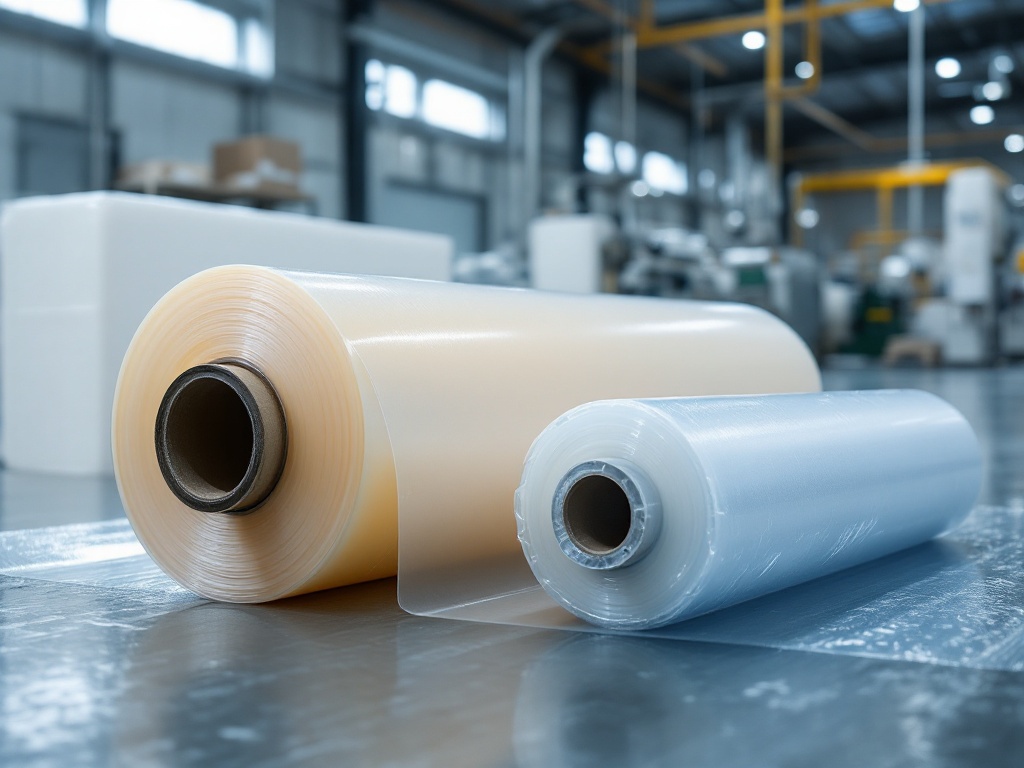
A film liner serves several functions at once. It isolates the goods from dirt and moisture from the pallet, reduces abrasion of packaging against the wood, improves separation between layers and in some configurations affects friction between cargo elements. When the material is poorly chosen, one of these functions begins to fail. The effect doesn't have to be spectacular immediately. More often it's a sum of small problems: folded-under corners, shifting bags, damaged bottom labels, deformed cartons in the bottom layer.
In warehouse practice the liner works from the moment of palletization until unloading. It is pressed by the weight of the goods, exposed to forklift movements, vibrations in transport, temperature changes, and sometimes also contact with a wet floor or condensate. This means that the nominal parameter alone is not enough. You have to look at the behavior of the material in motion. A film that looks good on the specification may perform worse during rapid placement of cartons, while another may be less visually impressive but more stable in operation.
That's why comparing LDPE and HDPE should start from the process, not from the price per pack or the thickness in microns alone. Two films with seemingly similar applications can produce completely different results on the same packing line.
LDPE and HDPE – differences that only become visible on the pallet
LDPE: greater flexibility and better conformity to irregular goods
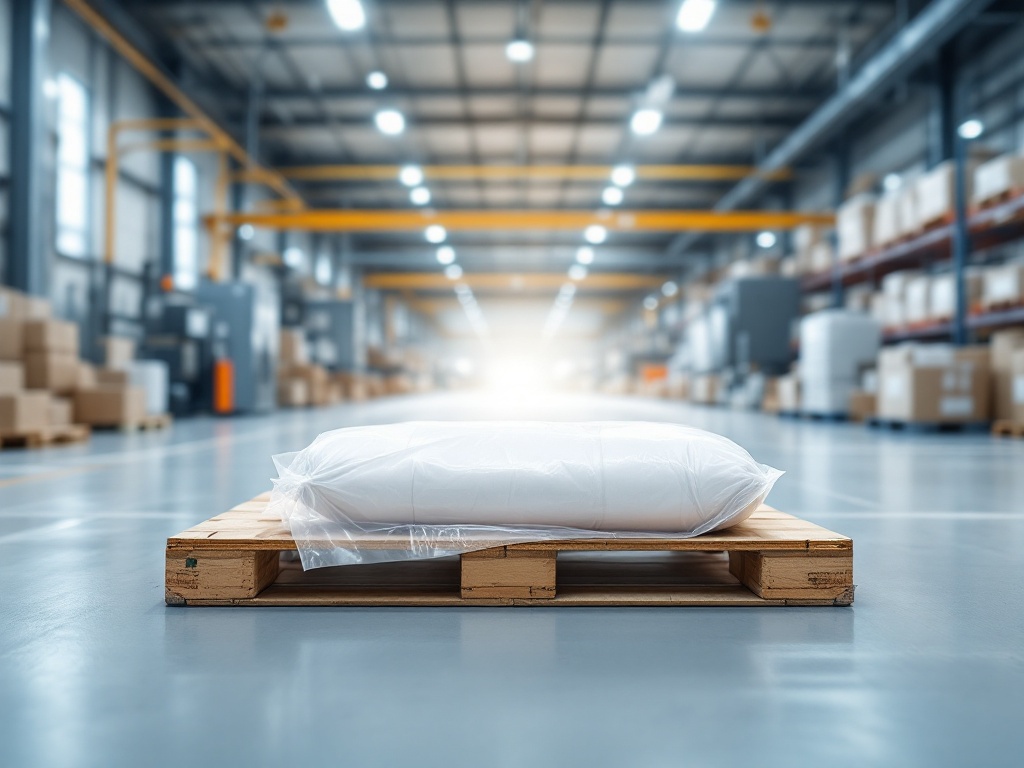
LDPE, i.e. low-density polyethylene, is a softer and more flexible material. In liners and interlayers this means better conformity to the surfaces of packaging, especially when the load is not perfectly even. This concerns, among others, bags, shrink-wrapped bundles, collective packaging with slight bulging, or cartons with variable geometry after filling.
In practice LDPE performs well where it's important for the film to "settle" under the pressure of the goods. The material is less likely to tear under point loads and usually copes better with situations in which the bottom layer of packaging does not stand perfectly evenly across the whole surface. This is important for pallets assembled manually, where placement repeatability is often lower than on automatic palletizers.
It must be said honestly, however: greater softness is not always an advantage. If the process requires very fast feeding of liners, precise formatting and stable placement of the sheet without waviness, a material that's too pliable may perform less predictably. This is one of the typical points where logistics and purchasing departments look at the same product completely differently.
HDPE: greater stiffness, lower mass and predictability with high repeatability
HDPE, i.e. high-density polyethylene, is a stiffer material and feels more "dry" to the touch. It holds the sheet format well, which is why HDPE liners are often used where quick, repeatable stacking and dimensional stability matter. In logistics centers and production plants with a high volume of pallets this has practical, not theoretical, significance.
HDPE stiffness helps with separating the goods from the pallet surface and maintaining an even layout of the liner under the load. In many applications it also allows good functionality with a relatively small film thickness. This is important where unit weight, number of pieces per pack and operational convenience in manual retrieval of liners matter.
On the other hand HDPE is less plastic than LDPE. With packaging that has sharper edges or under strong point load you must choose thickness and format very carefully. A stiff material, but too thin, does not forgive as much as its elastic counterpart. That's why an HDPE liner chosen "to the limit" can work very well in one process and noticeably worse in another.
Comparison of user parameters that really matter
Stiffness and sheet behavior during palletization
If the liner is fed manually, the operator usually appreciates a material that does not stick excessively, separates easily and does not roll up at the corners during placement. With automatic feeding format stability matters even more. Here HDPE often fares well because the sheet behaves more predictably and "works" less during handling.
LDPE has the advantage where the goods do not create a perfectly flat surface. Under pressure it conforms more easily to packaging and reduces the risk of local voids between the liner and the load. It's a detail, but during transport vibrations such voids can increase movement of packages relative to each other.
Puncture resistance and point load
In practice liner damage rarely results from the uniform pressure of the whole layer of goods. Much more often the problem is point loads: a corner of a carton, a package weld, a protruding tray element, an uneven pallet board. In such conditions the type of polyethylene alone does not provide a full answer. You have to look at the combination of the material, film thickness and the nature of the load.
LDPE usually tolerates deformation before tearing better, so with irregular contact it can work without sudden rupture. HDPE, on the other hand, can be very effective with the right parameters and an even process, but reacts worse in extreme situations if the liner is too thin relative to the actual load. This is not a flaw of the material, but a consequence of its characteristics.
Slip and impact on load stability
One of the most often overlooked issues is the coefficient of friction. In the warehouse this is rarely discussed until the pallet starts to "float" in transport. The liner cannot be analyzed in isolation from other packaging layers: the carton, stretch film, interlayers and the pallet surface itself. A material with too little friction can facilitate uncontrolled movement of the bottom layer, especially during sudden braking or on an uneven route.
For light but tall loads this parameter is of particular importance. Stretch film alone does not always compensate for an overly slippery layer arrangement. In such applications the choice of liner should take into account not only protection against dirt but also the behavior of the entire load unit during accelerations and vibrations.
Film thickness and actual functionality
At the purchasing stage thickness is often treated as the main comparison criterion. It's convenient but overly simplistic. A thinner HDPE may perform better in a given application than a thicker LDPE if the priority is sheet stiffness and stability. Conversely, where there are point loads and irregular package shapes, the more flexible LDPE may have a greater advantage.
That's why the assessment "we'll take a thicker film, it will be safer" does not always lead to a better operational effect. Sometimes it ends with a heavier, less convenient liner that doesn't solve the actual problem. From a logistics point of view, matching the parameter to the way it's used matters more than simply raising one value in the specification.
Where LDPE performs better than HDPE
LDPE should be considered primarily for goods with an irregular base and where the unit packaging is prone to deformation. This applies, among others, to bags of raw materials, packages with loose products, partially soft shrink-wrapped bundles, or cartons that do not hold a perfectly flat geometry after filling. In such conditions a more flexible liner collaborates better with the load.
It is also a good choice when the liner is to serve not only a separating function but also protection of more delicate package bottoms. If the company uses LDPE film products in other packaging areas, it is easier to maintain consistency of contact parameters between the material and the packaging and predictability of behavior across different types of goods.
In practice LDPE is often chosen by plants where one pallet does not always look identical to the previous one. Lower process repeatability usually favors a material more tolerant of operational deviations.
When HDPE is the more sensible solution
HDPE performs well in large-scale, highly repeatable environments: mass production, distribution centers, shipping warehouses where each pallet has a very similar layer layout. In such conditions sheet stiffness, ease of handling and dimensional stability provide tangible process benefits. Operators work faster and liners behave predictably with a consistent pattern of stacking goods.
HDPE is also often chosen when the liner's primary role is to separate the load from the pallet surface and provide a clean, repeatable intermediate layer without the need for much conformity to the shape of the packages. This concerns many applications with cartons with stable bottoms, machine-arranged shrink-wrapped bundles or transport packages with an even base.
If high warehouse throughput matters in the process, it's worth analyzing HDPE not only through the prism of the material itself but of the whole operation: packing, storage, order picking and transport. In a well-set-up process the difference in workflow smoothness is often more noticeable than the differences visible on the product's data sheet.
Most common situations where the material alone doesn't solve the problem
It happens that a company switches LDPE to HDPE or vice versa, and complaints still occur. The reason is simple: the source of the problem lies elsewhere. Often at fault is a damaged or uneven pallet, a poorly chosen layer layout, too much overhang of cartons beyond the outline, improper stretch wrapping, or lack of interlayer sheets. The film liner is an element of the securing system, not a standalone cure for every load problem.
In practice a well-chosen material shows its full effectiveness only when the palletization process is orderly. If the bottom layer of cartons is poorly laid out and generates high point loads, even a very good liner will operate at the edge of its capabilities. Similarly with wet wooden pallets: the film alone will improve separation but will not replace quality control of the carriers in the warehouse.
Therefore, when comparing LDPE and HDPE, you need to look beyond the raw material name. The type of goods, packaging geometry, palletization method, number of transshipments, storage conditions and route length matter. Only in such a configuration does the choice of material cease to be a "gut-feel" decision and begin to genuinely reduce losses and improve stability of pallet units.
How to assess liner suitability from the warehouse and transport perspective
The most useful assessment is not done at the desk but on the finished pallet. You need to check how the liner behaves during placement, whether it maintains the proper format, whether it doesn't roll under the weight of the first layer, how it reacts to irregularities and whether after wrapping the whole remains stable during shifts. These are observations that quickly show whether a given variant is right.
In logistics the "strongest" material in isolation from the process does not win; rather the one that gives a repeatable effect at real working pace. Sometimes this means choosing LDPE because it works better with irregular loads. Other times HDPE is more sensible because it fits better with an automated setup and stable packaging formats. The difference between one and the other variant then translates into the number of damages, product cleanliness, transport safety and warehouse workflow smoothness.
If a specific liner dimension for a standard application is being analyzed, it can be helpful to compare parameters with ready-made solutions, such as 900x1300 pallet liner made of HDPE. Such a reference point makes it easier to assess whether a given process requires greater material flexibility or rather the stiffness and lightness typical of HDPE.
Practical case: when simply changing the film on the pallet didn’t solve the problem
This case concerned a client in the food industry who was shipping goods to distribution networks domestically and abroad. The loads were only seemingly repetitive. On the documentation everything matched: the same pallet type, similar unit height, similar total mass. In reality some pallets were assembled automatically, some manually, and the bottom layer of packages behaved differently depending on the product batch and the cardboard moisture.
The client approached us not because they were looking for a "better film", but because they began to have recurring losses at the final stage of the chain. Complaints did not concern completely toppled pallets. The problem was less spectacular but costly: abrasion of the bottoms of cartons, soiling from underneath, local collapse of the bottom layer, and shifts of the first layer of packages after unloading from the truck. Such damages do not always result in a return of the entire delivery, but they regularly generate repacking, additional inspections and disputes with the recipient about responsibility.
Starting point: HDPE in the specification, LDPE in the trial practice and no clear answer
At the start the client used a thin HDPE underlay chosen several years earlier for a fast palletizing process. The solution worked properly as long as the load structure was more uniform. Over time the type of outer packaging changed, the number of transshipments increased, and some deliveries began going to warehouses with clearly poorer pallet handling culture. Purchasing considered a simple change: switching to LDPE, because the assumption arose that a more flexible material would "absorb" the issue from below.
This was the moment when it was easy to oversimplify. The raw material name alone did not provide the answer. The client had already run their own trial. On one line a softer LDPE sheet was tested and the first operator feedback was positive, because the material laid better on uneven pallet boards. After a week another problem appeared: with quick manual placing some sheets rolled under the first row of cartons, and on the night shift the number of poorly arranged pallets increased. Meanwhile on the automatic line the same material caused less predictable feeding.
After the first conversation it was already clear that the topic did not boil down to a simple comparison "LDPE or HDPE". It was necessary to check at which point in the process the material actually worked in favor of the load and where it began to interfere.
What exactly wasn’t working
The client pointed out three symptoms that initially looked like separate problems:
damage to the lower surfaces of cartons after transport,
local shifts of the first layer of goods relative to the pallet,
sporadic tears of the underlay when in contact with a more aggressive board or package edge.
There was a fourth sign on the warehouse side, often overlooked in such analyses: operators did not work the same way on all shifts. One crew placed the sheet centrally and manually pulled it to the corners. Another placed the underlay faster, leaving a slight offset that with stiffer material did not matter much, but with a softer one began to affect the start of the entire pallet.
Analysis: not only the raw material, but also the contact zone and behavior of the first layer
Instead of starting from another specification, we asked for samples of the damaged pallets and photos from unloading. Then we went on site to see the process from the beginning. That produced several important observations.
First, the problem did not occur evenly across all SKUs. Most of the damage affected two groups of products: cartons with a thin bottom that, when filled, slightly flexed under load, and outer packages placed with a slight axial offset relative to the pallet boards. In other words, not every load unit required the same underlay, even though they were assigned the same standard in the warehouse system.
Second, the damage did not mainly result from a one-time puncture of the film. Far more often we saw traces of prolonged friction and the "working" of the carton on the underlay during transport. That's an important difference. If the problem is puncture, people usually think about greater thickness. If the problem is micro-movement of the first layer during several hours of travel and multiple transshipments, you need to look at stiffness, sheet placement, cooperation with the package bottom and behavior after stretch-wrapping.
Third, some wooden pallets had an uneven top surface. Not bad enough to reject them outright, but uneven enough that a thin, stiff material worked pointwise. On paper the pallet was "full value". In practice, at larger shipping scale this created repeatable weak spots.
How we approached the solution
Instead of proposing a single universal replacement, we split the issue into two use-case scenarios. That was an important moment, because previously all pallets were treated the same from the underlay standpoint.
Scenario one covered loads with a stable carton bottom, high repeatability of layout and a high packing rate. Here the priority was smooth feeding, maintaining the sheet format and no line problems. For this group keeping the HDPE solution made sense, but not in the previous configuration. We changed the underlay format to better cover the critical contact zones with the boards, and at the same time corrected the method of placing it.
Scenario two concerned products with a more sensitive package bottom and pallets assembled less repetitively. Here we tested a variant with LDPE, but not as a simple "one-to-one" swap. The aim was to use the material’s flexibility where it actually helped, without transferring its weaknesses to a fast operational process.
The client initially wanted to avoid two warehouse standards, because that means extra labeling and greater discipline on the assembly side. From experience we knew, however, that one poorly matched standard can be organizationally more expensive than two well-defined ones.
Step-by-step actions
1. Mapping complaints to specific SKUs and warehouse shifts
We did not analyze complaints collectively. We matched the damages with package type, route, production shift and pallet type. Only then did it emerge that two specific goods configurations had the largest share of the problem. Without this the client would have continued comparing materials across too broad a product group and would have received conflicting conclusions.
2. Trial runs on both materials in real warehouse operation
We organized tests not in demonstration conditions, but during a normal shipping week. This was deliberate. In controlled trials many solutions perform better than later on the afternoon shift, when pace increases and no one adjusts every sheet by hand. The trials used both the HDPE variant and an LDPE variant functionally similar to solutions used for interleavers and protective sheets. In such applications a more conformable material, similar to LDPE film products, performs well.
3. Monitoring underlay behavior after 24 and 72 hours
This was an element the client had not done before. After packing the pallet we evaluated not only the start of the process, but also how the underlay looked after standing in the warehouse and after internal transport. Some problems revealed themselves only after time: corner roll-up, shift of the first layer by a few millimeters, local creasing in the area of highest pressure.
4. Correction of the sheet placing instructions
It sounds minor, but it mattered. On one shift operators grabbed the underlay by two corners and placed it centrally. On another they slid it along the board. With HDPE the difference was hardly noticeable. With LDPE it became significant, because the material more quickly picked up unevenness and could roll on the edge. We introduced a simple procedure change and a marking for the placement location.
5. Selection of pallets for the most sensitive shipments
This was not about replacing all carriers, but rejecting those pieces that had a clearly aggressive top surface. The client previously assumed the underlay should "fix the issue". In practice even a well-chosen film will not neutralize every irregularity if the first layer of goods is itself prone to deformation.
Difficulties along the way
There were mistakes. The first LDPE trial gave mixed results because the warehouse treated it as a standard HDPE substitute. Sheets were picked and placed in the same rhythm, without adjusting the way of working. As a result some crews rated the material negatively, although the problem was not the raw material itself but the way it was used in a fast process.
The second difficulty concerned interpreting complaints. The client's quality department initially classified all bottom-layer damages as "the underlay’s fault". After joint analysis it turned out that part of the damage resulted from cartons being pushed excessively beyond the pallet outline. That did not change the fact that the underlay was an important element of the system, but it clarified responsibility and allowed drawing the right conclusions.
There was also resistance to splitting the material standard. That is a common situation. From purchasing’s perspective one SKU is more convenient. From a process perspective it is not always wiser. Concrete data from specific shipments, not a general discussion about film properties, helped convince stakeholders.
What solution was ultimately implemented
After several weeks of trials the client did not switch entirely to LDPE, nor did they remain unchanged with the previous HDPE. We implemented a mixed model:
for repetitive pallets with cartons with a stable bottom the HDPE underlay was retained in a better-matched format, functionally similar to solutions used in this group, such as a 900x1300 HDPE pallet underlay,
for more sensitive load units a variant based on a more conformable material was introduced, used where reducing friction that damages the package bottom and better cooperation with uneven surfaces matters,
additionally the client organized rules for qualifying wooden pallets into two shipping groups.
It was not a change that looked impressive in a presentation. Operationally it made sense because it eliminated the most costly cases without rebuilding the entire process.
Results after implementation
Three months after standardization the client reported a clear drop in complaints related to the bottom layer of packages. It was not reduced to "zero", because some damages still resulted from errors in goods placement and the quality of individual pallets. However the number of reports concerning abrasions and soiling from underneath decreased enough that the issue stopped coming up weekly in operational meetings.
Equally important was something else: the warehouse stopped compensating for the problem with additional ad-hoc actions. Previously operators sometimes added a second sheet, manually adjusted the bottom layer or tightened the stretch more to "just in case" stabilize the pallet. Such improvisations increase handling time and blur the standard. After implementing the proper material split the process became more repeatable.
The client also noticed reduced consumption of auxiliary packaging in the most problematic shipment group. Not because the underlay did all the work itself, but because it stopped provoking further process adjustments. This is, in practice, a common, underestimated effect of a well-chosen material.
Conclusions from this project
The most important observation was simple: comparing LDPE and HDPE only makes sense when it is known for which load arrangement and in which part of the process the material is intended to work. In this case HDPE won where sheet predictability and rapid stacking mattered. LDPE proved better where the package bottom and the pallet surface did not provide a stable, even contact.
The second conclusion concerns the testing method itself. A trial on a single line and a single shift very easily leads to a misleading conclusion. The material must be tested in warehouse operation, after standing and after transport. Only then does it become clear whether the problem concerns feeding, point pressure, or the performance of the entire first layer on the pallet.
Third thing: if a company uses different PE solutions for packing and protecting goods, it's worthwhile to view underlays as part of a broader system, not as an individual product. Sometimes the best decisions don't come from choosing a „stronger film”, but from better matching the material to the specific task. In such analyses, it can be helpful to compare available groups of solutions, for example HDPE film products and more flexible variants, and then narrow them down to real pallet applications.
From our perspective, this project was a good example of something that happens regularly in logistics: a problem attributed to a single material turns out in practice to be the sum of several small mismatches. Only after separating them can one fairly answer when to choose LDPE and when to choose HDPE. And it is usually not a universal answer for an entire warehouse.
FAQ: pallet film liners – LDPE vs HDPE
Can a film liner on a pallet affect the receipt of goods by retail chains and distribution centers?
Yes, and it happens more often than would be apparent from the transport packaging specification alone. The recipient usually does not analyze the type of film under the first layer of goods, but assesses the final effect: cleanliness of the bottoms of packages, absence of abrasions, absence of dampness, readability of logistic labels and the overall stability of the unit during acceptance. If the liner performs poorly, the consequences show up at this stage.
In practice the problem is not only spectacular damage. Much more often goods end up in the complaints area because of small but repetitive nonconformities: soiled carton bottoms, marks from rubbing, delamination of the outer packaging from below, or deformation of the lower edge. For the recipient’s warehouse this is a signal that the unit was poorly secured, even if the product contents remained intact.
Predictability of handling is particularly important in retail chains and large logistics centers. The pallet must be possible to unload from the vehicle, set down, move and break down safely without additional intervention. If the bottom layer “sticks” to the pallet too aggressively, or conversely shifts at the first contact with a pallet truck, the risk of classifying the delivery as problematic increases. You won’t see this in material data, but you will see it in operations.
Therefore, for deliveries to demanding recipients it is worth viewing the liner not as a technical add-on but as an element of the overall quality compliance of the logistics unit. A well-chosen material reduces not only physical losses but also disputes over responsibility between the sender, the carrier and the recipient’s warehouse.
How to choose a film liner for a high-bay warehouse and longer pallet storage?
The focus of the assessment shifts here. With fast warehouse turnover many liners perform similarly because their job ends quickly. In a high-bay warehouse and with longer pallet dwell times other factors matter: how the material behaves under constant pressure for several days or weeks, whether the lower layer undergoes secondary deformation, and whether the liner starts to “work” with temperature changes.
With longer storage a phenomenon often appears that a short production test will not catch. The bottom layer of packages gradually settles and the material beneath changes its stress distribution. If the liner is poorly matched to the weight and geometry of the load, local indentations, weakened carton corners or loss of even support may occur. The problem does not have to be visible immediately after packing. It appears only when the pallet is taken from the rack or after moving to the shipping area.
In such an environment it is worth evaluating three things simultaneously: dimensional stability of the sheet over time, behavior under constant pressure and the influence of warehouse temperature. If the facility has variable conditions, it is also helpful to check how the film reacts to cold and periodic warming. The issue of material durability in tougher conditions is well complemented by analysis of environmental factors described here: factors affecting the durability of polyethylene film.
For a high-bay warehouse it also makes sense to test the liner not only at the level of a single pallet but across the entire cycle: palletizing, dwell, rack pick, internal transport and loading. Only then can you see whether the material still supports the process or becomes its weak point.
Does the type of liner matter for export and international transport?
Yes, because in export the number of variables beyond the sender’s full control increases. There are more transshipments, longer transport times, climate changes, and sometimes stops on outdoor ramps or in terminals. This means the liner must be assessed not only for the start of the process but for the resistance of the whole system to changing conditions.
On domestic routes a load often travels a shorter distance and reaches the recipient faster. In export one material error can multiply. A slight abrasion of the carton bottom, which locally would not matter, can after another transshipment turn into a full complaint. The same goes for moisture. If the liner does not provide adequate separation from the pallet and the floor, and the goods stand en route in an area with increased condensation, the bottom layer of packaging begins to lose its commercial properties.
Repeatability is especially important in export because it is harder afterward to reconstruct the cause of damage. A recipient abroad usually will not analyze the nuances of the packing process at the manufacturer; they assess the condition of the delivery. For this reason companies that ship regularly abroad often move away from simple decisions like “the same film for all pallets” and build standards for specific product groups or shipping directions.
If goods go to regulated industries, material compliance and orderly documentation also matter. This concerns especially companies working for food, pharmaceuticals or household chemicals. In such cases the choice between LDPE and HDPE is only the beginning; repeatability of material deliveries from the supplier and the ability to maintain the same quality across batches are equally important.
How to test film liners before implementation so the result is reliable?
The most common mistake is limiting the test to a short trial with one pallet or one shift. Such a result can be misleading. The material may perform well in calm conditions but poorly under normal warehouse load. A reliable test should cover not only the moment of placing the liner but the whole cycle of the load unit.
A simple four-stage scheme works well. First, operational observation: sheet pick-up, placement, work pace and susceptibility to operator error. Then inspection after packing: whether the liner held position, whether there were tuck-ins, whether the bottom layer sits evenly. The third stage is warehouse dwell, preferably at least 24–72 hours. The fourth is verification after real transport, even on a shorter trial route.
It is also worth keeping an observation card. Not complicated. Concrete columns are enough: product index, pallet type, shift, palletizing method, number of transshipments, condition of packaging on delivery. Without this companies often end up with opinions like “this material is better” but do not know for which setup and why.
At larger scale it makes sense to run parallel tests on two or three groups of loads rather than one aggregated conclusion for the entire warehouse. That’s how it’s done in practice: you do not choose film based on declarations, but based on behavior in conditions that actually generate damage.
Does LDPE or HDPE liner matter for packaging automation and line operation?
Absolutely. Even if both films look similar on the finished pallet, their impact on the line can be completely different. Automation does not “forgive” materials that sometimes behave correctly and sometimes change the way they feed. Problems appear faster than in manual work: double pick-up, sheet misalignment, incomplete placement, folding when entering under the first layer of goods.
In an automated process you evaluate not only the raw material but also repeatability of cutting, quality of stacking, dimensional stability and edge behavior of the sheet. A material with good mechanical parameters can still cause downtime if individual pieces are not sufficiently even or have a tendency to electrify and stick during pick-up.
This is one reason companies with large pallet volumes pay attention to the supplier’s experience. The mere declaration “PE film” is not enough. What matters is whether the liner maintains consistent parameters batch after batch and whether it does not generate hidden operational costs in the form of small line stoppages.
If a plant runs on automated stations it is good to compare solutions available in organized material groups, for example HDPE film products and LDPE film products, but base the final decision on a technical trial on the specific machine. That gives far better conclusions than analyzing the product sheet alone.
What purchasing mistakes most often lead to a bad choice between LDPE and HDPE?
The problem most often starts with too simple a comparison of offers. Companies compare thickness, dimension, number of pieces in a pack and unit price, and omit how the material will be used. As a result they buy material that formally “matches” but in practice increases the number of damages, improvisations in the warehouse or complaints from the recipient.
The second mistake is treating all pallets as one group. On paper this may look logical, but operationally differences are large: different carton, different mass, different carrier, different number of transshipments. One material standard may be administratively convenient but not always good for the process.
Another trap is assuming that because a material works in another PE application it will be equally good as a pallet liner. That does not have to be the case. A protective sheet, an interleaf and a bottom liner work under different pressure and friction conditions. For example, solutions in the PE film group may be materially similar but functionally behave completely differently depending on form and application.
There is one more practical mistake: changing the material without changing the work instructions. A purchase introduces a new liner, and the warehouse still places it the same way as the previous one. Then the opinion appears that “the film didn’t work out,” although the real cause was a lack of process adjustment to the new material.
Can film liners help with hygiene requirements and in the food industry?
Yes, but their role must be viewed realistically. A liner does not replace warehouse hygiene rules, pallet quality or correct unit packing. However, it can effectively reduce contact of packaging with a dirty or damp carrier surface, and that in the food sector matters not only aesthetically but organizationally and in terms of quality.
In practice the greatest value appears when goods go to recipients who pay close attention to the condition of external packaging. Even if the product inside is protected, a soiled carton bottom can be treated as a nonconformity in the supply chain. A liner helps reduce such situations, especially with wooden pallets of variable surface cleanliness.
For food it is not only about “keeping it clean.” It is also about reducing the risk of secondary damage to packaging during handling. When the bottom of a carton is weakened by moisture or abrasion, it deforms more easily during picking and unloading. This later translates into extra inspection or repacking on the recipient’s side.
For companies in this sector a broader view of packaging as an element of process safety, not just transport, is useful. This context is well developed in the material: food packaging is an element of safety, not just logistics.
When is it better to change the liner format or add an interlayer instead of switching from LDPE to HDPE?
Very often exactly when damages concentrate in specific zones rather than across the whole pallet surface. If the problem appears at corners, on selected boards or under a certain type of packaging, simply changing the raw material may not yield the expected result. Sometimes a better move is to correct the sheet dimensions to better protect the critical area, or to use an additional interlayer where pressure is unevenly distributed.
This is particularly important with cartons that have thin bottoms, trays with point supports and outer packages that have stiff edges but weaker central surfaces. In such cases switching from HDPE to LDPE or vice versa can be too general. The source of the problem is not the material characteristic itself but the way forces are distributed on the first layer.
In practice a “damage map” analysis works well. If damages are linear or repeat in the same layout, it is a sign that you need to look at the protection geometry, not just the type of polyethylene. In some processes an additional interlayer of a more flexible material gives a better effect than replacing the entire bottom liner standard. An example of a solution used in such roles can be interlayer 600x645, but the sense of using it always depends on the specific load arrangement.
At this stage practical experience gives an advantage. Theoretically you can compare two raw materials. Operationally you also need to know whether the problem is material, format, contact with the pallet or the distribution of pressure from the goods.
Most common mistakes when choosing pallet film liners: where companies lose out due to wrong decisions between LDPE and HDPE
At the stage of offers and specifications, the choice between LDPE and HDPE often seems simple. In practice this is precisely where the most costly simplifications occur. The problem is not that one film is "good" and the other "bad." Trouble begins when the material is chosen according to the wrong criterion or implemented without checking how it behaves in the real pallet flow. Below are the mistakes we most often see when working with warehouses, manufacturers and logistics operators.
1. Reducing the decision to price per piece or per kilogram
This is one of the most recurring purchasing mistakes. The procurement department compares offers by unit price, thickness and dimension, but ignores how the material performs under a specific load. Such a shortcut is common because the liner appears to be a technical add-on with low unit value. On paper the differences look insignificant. In operation they do not.
The consequences usually do not appear immediately as spectacular damage. Much more often the number of minor losses increases: abrasion of the bottom of cartons, soiling from below, fixes during palletizing, additional stretch wrapping, repacking at the receiver. Ultimately a cheaper liner can generate a higher total cost than a more expensive, but better-suited material.
How to avoid this? Compare not the product itself, but the cost of operating the pallet in the process. If changing the material reduces complaints, limits fixes in the warehouse and decreases damage to the bottom layer, that should be the basis for the decision.
From practice: at larger volumes companies very often notice the difference not in the purchase cost of the liner itself, but in the number of operational exceptions. And those exceptions are what most disrupt warehouse efficiency.
2. Choosing film based on thickness alone, without looking at the nature of the load
Many companies assume that thicker film automatically solves the problem. It's convenient because numbers are easy to compare. But liner damage rarely results from even pressure. Much more often the problem is local points: sharp edges of packages, uneven pallet boards, too much pressure at corners, or prolonged friction during transport.
Therefore a thicker sheet does not always produce a better effect. It happens that after switching to a "stronger" film the damage persists, because the cause was not insufficient thickness but the wrong material characteristics for a specific contact. Stiffer HDPE behaves differently than more compliant LDPE. Under point pressure and an uneven base the mere number of microns often says too little.
To avoid this mistake, you must first determine whether the damage is caused by puncture, abrasion, folding, slip or settling of the bottom layer. Only then select the material and parameters.
In practice a simple rule works well: if complaints have the same pattern on the bottom of packages, the problem is usually not "too thin a liner" but a specific pressure point or a repetitive geometry of contact with the pallet.
3. Treating all pallets in the company as a single application group
Administratively it's convenient. Operationally often wrong. The same warehouse can ship cartons with rigid bottoms, sacks, shrink-wrapped bundles, tray-packaged goods and manually picked items. Nevertheless many companies try to maintain one liner standard for everything because it's easier to order and describe in the system.
The result is predictable: the material works correctly for some SKUs, while for others it becomes a source of complaints or additional work. The worst part is that the problem remains invisible for a long time because the average result looks "acceptable." Only analysis of specific damages shows that the harm concentrates on selected product groups.
The solution does not always have to be high complexity. Often two standards instead of one are enough: one for repetitive pallets and one for more sensitive units. That's still orderly, but based on real risk rather than documentation convenience.
From experience: resistance to two standards usually disappears once the warehouse calculates how much time operators lose on manual fixes with the "universal" solution.
4. Switching LDPE to HDPE or HDPE to LDPE without adjusting the work process
This is a classic implementation mistake. The company changes the material but keeps the same way of picking up, placing and arranging the sheet. Then a quick conclusion appears that "the new film doesn't work." Often unjustly.
Different materials behave differently in manual and automated handling. One holds the format better, another reacts more to sliding on the board, another requires more precise placing. If the warehouse works as before while the material is new, the test result can be skewed.
The consequences are twofold. First, the company rejects a solution that could work well with a small procedure change. Second, it reinforces the belief that the problem lies solely in the raw material, while the real cause is in the way it is used.
How to prevent this? With every liner change you must check three things: the method of picking up, the method of placing, and the material's behavior after the first layer of goods is pressed down. This is not theory. Even a slight difference in operator handling can decide whether the sheet stays in place or begins to fold.
In real implementations the most erroneous assessments occur in the first week of tests, when it was assumed the new material should "work exactly the same as the previous one."
5. Evaluating the liner only during palletizing, without checking what happens after 24–72 hours
Many tests end too early. The pallet looks good right after building, so the material gets a positive rating. The problem is that some damages only appear after storage in the warehouse, after retrieval from the rack, or after the first transport.
This is a common mistake because a short test is easier to organize. It does not require batch tracking, photos from receipt or cooperation with the receiver's warehouse. But such a test says little about the actual behavior of the liner under sustained pressure and vibrations.
Result? Implementation of a material that looks good at the start but over time causes settling of the bottom layer, shifts in the first layer of packages or corner creasing. Then the company feels that "the problem appeared suddenly," though in reality it was overlooked during trials.
A proper approach is a full-cycle test: palletizing, standing time, internal transport, loading and receipt. Without that it is hard to fairly assess whether a given variant is suitable for longer storage or more demanding distribution.
From practice: many materials pass the line test and fail only after a night in the warehouse. That moment most often reveals whether the bottom layer actually has even support.
6. Ignoring the quality of the pallet itself and shifting all responsibility to the liner
This is a very common mistake in complaints. When abrasions or punctures appear, the film is the first suspect. Meanwhile in many cases the source of the problem is an uneven, aggressive or damp pallet surface. A liner should limit the risk, but it will not neutralize every defect of the carrier.
Why do companies omit this? Because pallet inspection is dispersed and the liner is easy to replace. It is much harder to admit that carriers of variable quality enter the process. As a result, further attempts are made with different films, and the problem returns.
The consequences are costly: successive material changes, mistaken conclusions from tests and no improvement where action is actually needed. Some warehouses "test film" for months while the main cause lies in pallets with damaged top decks.
How to avoid this? When analyzing damage you must always examine not only the damaged package and the liner itself, but also the carrier surface. If the damage marks match the layout of the boards or repeat with a specific type of pallet, the material is not the sole culprit.
In practice even simple selection of the most problematic pallets can yield a greater effect than switching from one type of polyethylene to another.
7. Ignoring the impact of slip on the stability of the bottom layer
Companies very often look at the liner mainly through the prism of protection against dirt and moisture. Yet equally important is how the material affects movement of the first layer of goods. If the system has too little friction, the bottom layer begins to shift during driving, braking or dynamic handling with a forklift.
This phenomenon is often underrated because it does not always end with a pallet overturning. More often it shows less dramatic symptoms: slight shifts, deformation of bottom cartons, loosening of the unit after removal from the truck. The recipient sees an unstable pallet even if it looked fine at dispatch.
To avoid this mistake, you cannot evaluate the liner independently of the bottom of the package, the type of stretch and the method of banding the load. A material that isolates well from wood can at the same time worsen the behavior of the whole unit in transport.
From experience: slip problems appear more often with light, tall pallets than with heavy, low ones. There the margin of error is simply smaller.
8. Trying to solve every problem by changing the raw material, instead of correcting the liner format
If damages appear pointwise, many companies immediately ask whether to move from HDPE to LDPE or vice versa. That is not always the right direction. Sometimes the source of the problem is the wrong sheet dimension, insufficient coverage of critical zones or lack of protection where the carton actually contacts the board.
This mistake is common because changing the raw material seems more "technical" and concrete than adjusting geometry. In practice a well-chosen format can do more than simply changing the type of polyethylene.
The consequence of a wrong diagnosis is a series of misguided tests. The company checks successive material variants, but because the contact area is still poorly protected, complaints do not disappear. Time is wasted and conclusions become less clear.
How to prevent this? It's worth analyzing the damage map. If marks are linear, repetitive or concentrated at the same points, first check the coverage and layout of the liner, and only then discuss switching from LDPE to HDPE.
In many projects correcting the format closed the issue faster than another discussion about which raw material is "stronger."
9. Testing the material on one shift or with one crew
This is an organizational mistake, but it has a large impact on the result. One shift may stack pallets very carefully, while another works faster and more "to tempo." If the liner test is conducted only with one crew, the result can be unrepresentative.
Why is this so common? Because it's easier to run a trial where there is order and cooperation. The problem is that the material must work not only in the best conditions but in the normal, everyday operation of the warehouse.
The consequences are obvious: after implementation conflicting opinions begin to flow in. Some say the new liner works very well, others report folding, shifts or problems when placing. The company then concludes the material is unstable, though the testing method was actually unstable.
The solution is simple though it requires discipline: spread the trial across different shifts, different product layouts and different work rhythms. Only then can you see whether the material is tolerant to operational deviations.
From practice: if the liner only works when the operator places it perfectly, it is most likely not a good standard for a large-scale warehouse.
10. Failing to separate transport damages from palletizing errors
When analyzing complaints companies often throw everything into one bag: damaged package bottoms, shifted layers, torn film, excessive overhang of the carton beyond the outline. Then they try to draw a single material-related conclusion. This leads to bad decisions because not every damage has the same cause.
This mistake is common because aggregate analysis is simpler. You don't have to list cases by SKU, package type, route or picking method. But without that you cannot fairly assess whether the problem really concerns the selection of LDPE or HDPE.
Result? Changing the material does not bring full improvement, and the team loses trust in tests. Some damages disappear, some remain because their source lay elsewhere. Then the wrong conclusion is made that "no liner works."
To avoid this, complaints should be separated into at least three groups: damages from contact with the pallet, damages from load movement and damages resulting from incorrect loading of the goods. Only with such organized data can the material be sensibly evaluated.
In client work this stage most often puts the matter in order. Not because a new theory suddenly appears, but because decisions made on the basis of overly general labels come to an end.
11. Assuming a material tested locally will be equally good in export
With domestic shipments the margin for error can be larger. Shorter routes, fewer transshipments and faster receipt mean certain imperfections do not have time to reveal themselves. In export the same liner may already be working at the edge of its capacity.
This is a common trap because the company relies on its own domestic market experience and assumes the material is "proven." Then with longer routes problems return: settling, abrasions, dampening of the bottom layer or loss of stability after several transshipments.
How to prevent this? For international routes you must separately assess standing time, number of manipulations and variability of conditions. A material that works with quick turnover may not be a good choice for a long supply chain.
From experience: most misunderstandings arise because companies test the liner "at home" rather than at the point where the damage actually appears — after unloading or after longer storage on the recipient's side.
12. Not documenting tests and basing decisions on impressions like "seems better"
This may sound trivial, but in practice it makes a sensible choice between LDPE and HDPE very difficult. Without recording for which goods, on which shift, with what type of pallet and after what route the material was evaluated, every subsequent discussion turns into a series of conflicting memories.
Why is this so common? Because warehouses operate quickly and the liner is not usually treated as a subject requiring a formal protocol. But with repeated complaints lack of data means a constant return to square one.
The consequences are costly organizationally. Tests drag on, suppliers receive imprecise information, and purchasing decisions are made more on opinion than evidence. This usually leads to choosing the "least controversial" solution, not necessarily the best one.
How to avoid this? A simple observation card is enough: type of load, pallet type, liner material, shift, palletizing method, result after standing and result after transport. No elaborate bureaucracy. But with data that allow comparing facts.
In practice companies that start documenting tests reach a correct standard faster and less often return to the same problem after a few months.
If repeated damages to the bottom layer appear in the process, it's not worth starting from the question of which material is "generally better." A much better question is: at exactly which stage of the process does the current liner stop working. Only then does comparing LDPE and HDPE make operational sense, not just catalog sense. With a more ordered approach a helpful reference point can also be a specific material standard, such as a pallet liner 900x1300, because it allows the conversation to relate to actual use rather than theory alone. If the problem concerns not the entire pallet surface but selected pressure zones, it's often better to also analyze the role of additional protective elements rather than just changing the raw material.
LDPE or HDPE on a pallet: which solution better fits a given process
When choosing a film underlay it makes more sense to compare not the material itself, but the way the entire load unit operates. The same sheet can perform well on a line with a consistent carton layout, and noticeably worse with mixed picking, frequent transshipments or an uneven pallet surface. Therefore the comparison below is not based on a general “which is better”, but on real warehouse and transport scenarios.
1. HDPE underlays vs LDPE underlays with cartons on a stable base
If the bottom layer rests on cartons with an even, rigid base, HDPE usually has an operational advantage. The sheet holds its shape better, is easier to set down quickly, and with high pallet repeatability the process is simply more predictable. In such applications companies often choose products from the HDPE film group because they fit well with the rhythm of serial palletizing.
LDPE can also work satisfactorily in the same setup, but it does not always bring additional benefits. If the packaging itself stands stably, greater material compliance can be neutral or even hinder rapid sheet placement. This is especially visible where the operator must maintain a high pace and has no time for manual corner adjustments.
For whom: HDPE is more often suitable for serial production, distribution centers and shipping warehouses with low format variability. LDPE makes sense here mainly when, despite stable cartons, there is an issue with a delicate underside of the package.
Limitation: with HDPE it’s easy to over-simplify and assume that because the carton is “rigid”, any arbitrarily thin sheet will do. In practice, with more transshipments or poorer quality pallets, that assumption quickly backfires.
Practical observation: in high-volume warehouses the difference between LDPE and HDPE is often less visible on the pallet itself and more in the work rate and the number of minor corrections performed by operators.
2. LDPE vs HDPE with sacks, bundles and packages on an uneven base
Here the balance of forces changes. If the bottom layer does not create an even contact surface, LDPE usually provides better cooperation with the goods. The material adapts more easily to local irregularities, so the contact between the load and the underlay is more uniform. This matters with sacks of raw material, partially soft packaging or cartons that slightly “work” after filling.
HDPE can still be useful in such conditions, but requires more careful selection. If the sheet is too stiff relative to how the goods sit on the pallet, point pressure zones appear more quickly. This does not always end in tearing, but more often causes uneven behavior of the bottom layer during transport.
For whom: LDPE is better suited to plants where pallets are not perfectly repeatable and each load has some margin of deviation. In such applications it is helpful to look more broadly at LDPE film products, because the same material type is often used where greater compliance for fitting is needed.
Limitation: LDPE’s flexibility does not mean the material will “fix” a poorly arranged first layer. If the load has an unstable geometry or too much overhang beyond the outline, the underlay alone will not stop further pallet movement.
Practical observation: with soft packages operators often intuitively prefer LDPE because the load “settles” on it more gently. This is usually a correct assessment, but only when the process does not require a very stiff and quickly supplied sheet.
3. One universal material standard vs two standards for different load groups
From a warehouse organization perspective one type of underlay looks attractive. Fewer SKUs, simpler ordering, fewer mistakes at issuance. The problem arises when a company ships goods with clearly different requirements: some on stable cartons, others on packaging more sensitive underneath.
In such situations one standard usually works well only for the average. It is not a catastrophe, but it generates repeated exceptions: extra corrections, local complaints, ad-hoc addition of a second sheet or unnecessary reinforcement with stretch. Two standards are more demanding organizationally, but more often tidy the process.
For whom: one standard makes sense with a very homogeneous shipping profile. Two standards are worth considering where, within a single warehouse, there are different types of package bases and varying levels of risk for damage to the bottom layer.
Limitation: a larger number of SKUs requires operational discipline, labeling and clear rules for qualifying goods. Without this it is easy to create more chaos than with a universal solution.
Practical observation: companies often defend one standard for administrative reasons, but after a few months it turns out the warehouse has created an “informal second standard” through manual workarounds.
4. Changing the raw material vs adjusting the underlay format
When comparing LDPE and HDPE it is easy to focus solely on film properties. However, in some projects a greater difference is made not by the raw material itself, but by the sheet dimensions and the way support zones are covered. If damage marks always appear in the same places, the problem is often geometric, not material.
Switching from HDPE to LDPE makes sense when the trouble is adapting to irregularities or the material’s behavior under pressure. But if the goods contact the boards in a poor arrangement, a well-corrected HDPE format can give a better effect than an arbitrary change to a softer material. A good reference point can be a ready-made dimension used in repeatable applications, such as a 900x1300 pallet sheet in HDPE, provided it matches the actual contact area in the given process.
For whom: format correction is particularly important in warehouses where damages have a repeatable pattern and do not affect the entire pallet surface.
Limitation: a better format alone will not help if the problem mainly stems from the nature of the packaging or the palletizing method. Then changing geometry without changing the material provides only a partial improvement.
Practical observation: in claim analysis the influence of PE type is often overestimated, while the simple fact that the underlay does not protect the spots that actually bear the highest pressure is underestimated.
5. HDPE and LDPE in manual processes vs automated processes
On a manual line greater material tolerance can be an advantage, but only up to a point. LDPE forgives goods irregularities better, but during fast placement it responds more to an inaccurate grip or sliding on the board. HDPE is more “readable” to the operator in this respect: the sheet reveals its shape faster and is usually easier to position without corrections.
In automation the advantage of HDPE is often even more visible because format stability facilitates repeatable feeding. LDPE can also be used successfully in automated setups, but generally only when the machine and the process are tuned to its behavior, not treated as a simple substitute for a stiffer material.
For whom: HDPE is more often chosen by plants focused on efficiency and a steady line rhythm. LDPE performs better where part of the work still depends on manual correction and variable goods.
Limitation: neither material should be judged by a single test on one shift. Differences between crews can completely change the result of an implementation.
Practical observation: the same warehouse can have wildly different opinions about one underlay simply because one shift places the sheet “on point”, while another drags it across the pallet surface.
6. Film underlay vs film interlayer between layers
In some applications the problem is not only the contact of the goods with the pallet, but also the behavior of consecutive load layers. Then the bottom underlay alone does not solve everything and it is necessary to consider adding an interlayer. This is a completely different function than isolation from wood. The underlay protects and separates from the carrier, the interlayer helps organize contact between packaging layers.
If damages appear not only on the bottom but also from localized abrasion or settling of higher levels, it is wiser to compare several elements of the protection system rather than just LDPE with HDPE. In practice thin auxiliary solutions, such as LDPE film interlayers, are useful where layers need to be separated without adding a lot of material mass.
For whom: this approach suits tall, mixed pallets or pallets with packaging prone to inter-level shifts.
Limitation: an additional interlayer will not replace a well-chosen bottom underlay. It is a complementary, not a substitute, solution.
Practical observation: some complaints attributed to the underlay disappear only when the company separates two phenomena: protection of the bottom layer and stability of the entire load column.
7. Film underlays vs the alternative of “stronger” stretch wrap
This comparison regularly comes up in discussions with logistics: instead of changing the underlay, isn’t it better just to wrap the pallet more tightly? In practice stretch wrap and the underlay solve different problems. Stretch is mainly responsible for tightening the unit, while the underlay concerns the contact zone of the first layer with the pallet. If damages or micro-movements start from the bottom, increasing the number of wraps usually only limits the symptom, not the cause.
There are situations where stronger wrapping does indeed stabilize the bottom layer, but this makes sense primarily when the support point itself is correct. If the material underneath is working poorly, additional stretch can even increase pressure on problematic spots.
For whom: the comparison matters to companies trying to reduce losses without rebuilding the entire process and looking for the simplest operational move.
Limitation: replacing a material problem with “more stretch” often raises the consumption of auxiliary packaging and does not provide lasting improvement on more demanding routes.
Practical observation: if a warehouse regularly compensates for a weak underlay with extra wrapping, it is most often a signal that the protection standard is set incorrectly from the start of palletizing.
8. Local solution vs solution for domestic transport and export
The same choice between LDPE and HDPE can yield different results depending on the length of the supply chain. With fast domestic distribution HDPE can be sufficient even in applications that at first glance look “borderline”. However, when a pallet travels further, undergoes more transshipments and longer dwell times, the advantage of a more tolerant solution may only reveal itself over time.
LDPE more often shows its strengths where the unit must work under load for longer and pass through less predictable handling conditions. HDPE wins when the chain is well organized and repeatability of the sender’s process is more important than tolerance for deviations.
For whom: companies shipping both locally and abroad should approach a single standard for all destinations cautiously.
Limitation: there is no simple rule “export = LDPE” and “domestic = HDPE”. What matters is not the direction itself but the number of manipulations, dwell time and handling quality across the chain.
Practical observation: some materials judged acceptable at the plant only fail after unloading at the recipient. That is why the comparison should cover the full pallet cycle, not just the packaging moment.
9. When to choose a mixed approach instead of the “LDPE or HDPE” debate
In many warehouses the most sensible solution is not a full switch to one material, but a separation of applications. HDPE remains with repeatable loads and fast palletizing, while LDPE goes to groups more sensitive to irregularities and bottom abrasion. Such a model is less impressive in a specification, but often the most operationally stable.
This approach makes particular sense when a company already uses various solutions based on PE film and can maintain a simple division of applications. The gain is not the “better material” itself, but a smaller number of exceptions in the process.
For whom: for warehouses with a diversified product portfolio, where one standard ceases to be fair to all product groups.
Limitation: a mixed solution requires well-documented rules. Without a simple assignment of material to load type it starts generating mistakes and loses its advantage.
Practical observation: where the shipping profile is broad, the dispute “which material is better” usually ends only when the company accepts that the answer may be: both, but not for the same task.
Practical conclusion
If the priority is a fast, repeatable operation and a stable sheet format, HDPE more often proves the more sensible choice. However, if the pallet has irregular contact with the bottom layer, packages are more prone to deformation or the process has greater variability, the advantage usually shifts to LDPE. In practice the best decisions rarely come from comparing material names alone. The outcome only emerges from matching the material to the specific load type, palletizing method and transport conditions.
Checklist before choosing pallet film liners: how to practically assess whether LDPE or HDPE will be better
If the decision is to be made operationally, it's not worth ending the comparison at the material data sheet. The list below helps check the elements that most often determine whether the liner will actually reduce losses, or only formally "match" the specification.
Check what the actual bottom of the packaging looks like, not how it is described in the system
On the label the item may be listed as "carton", but in practice its bottom can be soft, slightly bulging after filling, or unstable due to the way it is glued. It is the contact of the underside with the pallet liner that determines whether the material should behave more rigidly or rather conform to the pressure. If you don't physically verify this on the finished product, it's easy to choose HDPE where the packaging needs more compliance, or vice versa.
Skipping this step usually ends with an incorrect qualification of the entire product group. On paper everything looks like a single standard, but in the warehouse the same damages recur: scuffs on the bottoms, localized deformations, or the local collapsing of the bottom layer.
From practice: it's best to look at not just one piece but at least several packages from different batches. For many products the difference between the "sample" and the actual item from the line is greater than purchasing or planning assumes.
Verify whether the bottom layer stands on the entire surface or only on a few support points
This is one of those elements that decides the choice of material, and it is often omitted. If the packaging rests evenly, the liner behaves completely differently than when the weight is concentrated on corners, edges, or welds. In the latter case the information "PE film" alone says nothing. You have to assess whether the liner should take point pressure or only separate the goods from the wood.
If this stage is skipped, the company often later concludes that the material is "tearing for no reason". In reality the problem was visible from the start: the load didn't distribute evenly, so the sheet worked under extremely difficult conditions.
Practical tip: place an empty sheet on the pallet, set the first layer of goods and after a few minutes lift 1–2 packages from the places where you expect the highest pressure. The imprint marks quickly show whether the contact is full or point-like.
Assess whether the problem concerns protection against moisture and dirt, or primarily the mechanics of the load
Not every operation requires the same from the liner. In some warehouses the most important thing is a clean separation of the goods from the pallet. In others the key becomes the interaction of the liner with the packaging under load and during transport. This distinction matters, because a material chosen solely for separation will not always be good where the first layer also needs to remain stable under pressure.
If these two goals are mixed, the decision quickly becomes random. The team picks the variant that solves one problem but leaves the other. Then there is the impression that the liner "works only partially".
From experience: when complaints concern dirt on the underside, the conversation should look different than when the recipient reports a shift of the bottom layer. It is worth separating these two scenarios from the start, because they lead to different material conclusions.
Compare storage conditions before shipment, especially the dwell time of the finished pallet
Some liners behave correctly immediately after palletization, but after several or a few dozen hours under constant pressure they start to behave differently. This matters especially when pallets stand in a shipping buffer, in the picking area, or in a high-rack warehouse before loading.
If you evaluate the material solely on a "fresh pallet", you may miss phenomena that appear only over time: bottom dents in cartons, sheet curl at the edge, or loss of even support. This is a common cause of later disputes between the warehouse and transport, because each side sees a different stage of the problem.
Practice suggests a simple thing: the test should include not only pallet construction but also at least one day of standing. Only after such time is it visible whether the material behaves stably under everyday working conditions.
Check the quality of placing the liner on the first layer, not just the film's parameters
Many wrong decisions come from evaluating the material in isolation from how it is used. Meanwhile a liner that theoretically fits the application may perform poorly if the operator places it offset, stretches it during feeding, or leaves curled corners. Then even a well-chosen LDPE or HDPE does not work in the conditions for which it was intended.
The consequence of skipping this point is simple: the blame is assigned to the raw material, while the real source of trouble is the placement method. This leads to unnecessary material changes and chaos in test evaluations.
From warehouse practice: it's worth asking to observe several operators, not just one. If the material only works with the most experienced person, it's a sign that the standard may be too intolerant of everyday operational variability.
Verify the effect of moisture on the liner's contact with the pallet and packaging
In some processes most damage doesn't come from pressure alone, but from the combination of moisture, friction and long dwell times. This applies to chillers, transition zones, warehouses with large temperature swings, and situations where the pallet may become temporarily damp. In such conditions the sheet's behavior can differ from a dry test on the shop floor.
If this element is ignored, a liner chosen "for dry conditions" may later fail to limit dirt and dampness as assumed. Worse, the problem often only appears at the recipient, where it's no longer easy to recreate the conditions.
Practical note: if the company experiences condensation or contact with a wet floor, it's good to compare the material test conclusions with observations regarding the durability of the PE film itself in changing conditions. A useful resource here is material on the environmental impact on polyethylene: factors affecting the durability of polyethylene film.
Determine whether the pallet passes through locations where the liner may be locally shifted
This concerns all stages where the load unit receives additional impulses: rehandles in the warehouse, sudden braking of the truck, rotation on the wrapping machine, sliding on rollers, docking or quick maneuvers on the ramp. At such points the material no longer works only under static pressure. Movement occurs, which can reveal the difference between a stiffer and a more compliant solution.
Lack of this verification means the test looks good when the pallet is set aside calmly, but fails during normal warehouse circulation. Later the complaint seems like a transport problem, although the source lay earlier, at the internal handling stage.
From practice: if damages appear irregularly, it's worth checking whether they mainly occur after a specific zone of the process, for example after transport through a particular section of the hall or after turning on a tight curve.
Check that the liner's dimensions match the actual contact area of the load, not just the pallet dimensions
This seems like a small detail, but very often it's here that theory and practice diverge. A sheet can be chosen correctly for the carrier and still be wrong for the goods themselves. If the packages contact the pallet in a different area than assumed, some loads fall outside the area of actual protection. Then swapping LDPE for HDPE or vice versa won't provide full improvement, because the material still isn't working where it should.
Omitting this check results in seemingly unexplained damages: the liner is present, yet the marks still return in the same places. This is especially common with non-standard carton layouts or when the goods do not utilize the full outline of the pallet.
In practice it's useful to compare the current layout with a concrete, ready format used in repeatable processes, for example a 900x1300 pallet liner. Such a reference point makes it easier to assess whether the problem is the material or a mismatched sheet dimension.
Check whether the bottom layer requires additional zonal protection instead of changing the entire standard
Sometimes damages do not occur across the whole surface but in a few repeatable spots. In that case a full material change for all pallets is not always the best decision. Sometimes it makes more sense to reinforce a specific section of the process or add an auxiliary element where the load is greatest.
If this option is not considered, the company may unnecessarily complicate the entire material standard, even though the problem was local. The result is longer tests, a larger number of exceptions, and no clear improvement.
From experience: when the damage marks form a repeatable pattern, first draw a pressure map on the pallet. This usually shows more quickly whether you need to change the entire liner or just protect a specific zone.
Assess whether the process requires just the bottom liner or also an interlayer element
In some operations the source of instability doesn't start at the contact with the pallet but higher up — between successive layers of goods. If the bottom layer is well separated from the wood, yet the entire column of cargo still "moves", choosing between LDPE and HDPE on the bottom alone won't solve the issue. You need to look at the layout of the whole pallet.
Omitting this point, it's easy to reach the incorrect conclusion that the bottom liner is ineffective. In reality it performs its function, but there is a lack of stabilization between layers of packages.
Practical tip: if the problem worsens with pallet height, it's worth simultaneously analyzing the use of thin interlayers, such as LDPE film interlayers. In many warehouses only such a separation brings order to the complaints.
Verify that the team has a clear criterion for choosing the material for new SKUs
Even a well-set standard quickly stops working if, when introducing new products, no one knows by what rule to assign them to LDPE or HDPE. The problem usually doesn't appear immediately. At first the warehouse manages "by feel", then the number of exceptions grows, and after a few months no one can say why a given item received one liner or another.
Lack of a clear criterion results in repeated mistakes, additional corrections and unnecessary mixing of materials across shifts. This affects not only load security but also the smoothness of dispatch.
From practice a simple qualification sheet works best: type of packaging bottom, susceptibility to deformation, number of rehandles, storage conditions and result of the last test. Such a document is much more useful than the general slogan "HDPE for heavier items, LDPE for delicate ones".
Check whether the warehouse is mixing batches of liners that look similar but behave differently
This problem is more common than it seems. To an operator two packs can look almost identical yet behave completely differently in use. If there is no clear marking of the material type in the warehouse flow, tests and later observations become unreliable. One shift works with HDPE, another unknowingly takes LDPE, and then both describe the same SKU as "verified" or "problematic".
Skipping this point has a very practical effect: the company draws conclusions from mixed data. As a result it is hard to determine whether a complaint stemmed from material characteristics or from incorrect issuance.
In daily work a simple distinction of packs by label, color of the bulk print, or storage location works well. If HDPE and LDPE products are present in parallel, the marking should be readable from several meters, not only after reading the full specification.
Finally, compare not the material itself but the number of interventions at the pallet after implementation
The most practical indicator is rarely found in the technical table. It's about how many times an operator has to adjust the liner, add a second sheet, correct the positioning of the first layer, or additionally "save" the pallet before shipment. These are the interventions that show whether the standard actually fits the process.
If you focus only on the material name and basic parameters, you may miss the fact that one variant generates far more minor corrections than the other. And it's these corrections that take time, reduce productivity and increase the risk of error at high volume.
From experience: warehouses rarely have a problem with material that is "a bit less convenient". The real problem begins when the same liner regularly forces additional actions on the shift. If there are many such interventions, the decision needs to be reverified regardless of how well the material looks in the specification.
A well-conducted assessment usually leads to a simpler conclusion than a discussion about the material's name: one material must suit the specific way a pallet is handled, not the general idea of a “stronger” or “more universal” film. It is precisely then that the slip sheet begins to actually limit losses, instead of being just another auxiliary packaging element.
In warehouse practice the effectiveness of a slip sheet is rarely determined by the material's name alone. What decides the outcome is whether the material was chosen for the actual behavior of the load: pressure, friction, moisture, the order-picking method and the pace of the operators. That is why comparing LDPE and HDPE only makes sense when it refers to a specific pallet path — from placing the first layer to unloading at the recipient.
From an operational perspective the best solutions are those that are repeatable, predictable and easy to maintain in daily work. If a slip sheet reduces complaints, does not force constant corrections in the warehouse and does not destabilize the packing process, it fulfills its role better than a material that looks good only on paper. This is where the difference between a purchasing decision and a process decision most often appears. The former ends on a parameter. The latter begins with the question of what actually happens to the pallet under load and in motion.
The market clearly shows that companies are moving away from thinking about a single “universal” standard for the entire assortment. With rising pressure on delivery quality, compliance with retail chain requirements and reduction of transport losses, fit matters more than simplification at all costs. Sometimes the right choice will be a stiffer HDPE sheet, especially in fast and automated processes. Other times a more pliable LDPE material or changing the slip sheet format rather than the raw material produces a better effect. In practice it is precisely such adjustments that bring the most lasting improvement.
The quality of the process organization itself also matters. Even a well-chosen material will not compensate for a faulty pallet, an unstable arrangement of goods or a lack of work standards across shifts. On the other hand, a well-conducted test and consistent implementation of simple rules can quickly reduce losses, improve quality inspections and tidy up warehouse operations without unnecessary ad hoc measures. Experience shows that this is where it is easiest to regain control over the costs of damage that previously seemed a “natural” part of logistics.
Therefore, when choosing plastic slip sheets it is worth viewing them as an element of the load securing system, not a minor addition to the pallet. If high dimensional repeatability and stable line operation are required, solutions based on HDPE film will be the point of reference. If the priority becomes adapting to irregular bases, damping friction and greater tolerance to variable working conditions, materials from the LDPE group are the natural direction. And when the problem concerns not only the contact zone with the pallet but also the stabilization of successive layers, parallel support in the form of thin interlayer sheets is often needed.
Ultimately, a well-chosen slip sheet is not the one that has “better” parameters on paper, but the one that reduces damage in real product circulation. In logistics it is repeatability and predictability that build quality. And these are usually the result not of a one-off purchase but of a consciously designed and tested solution.