Table of Contents
- Why most companies overpay for stretch film for no reason
- How stretch film works – what actually provides load stability
- Where film really disappears – analysis of common losses
- Pre-stretch – a technology that changes the cost balance
- Process parameters that have a real impact on consumption
- Effect of temperature and storage conditions on film efficiency
- Measurement and control as the foundation of lasting optimization
- Context of the situation
- Client problem
- Situation analysis
- How the measurement looked before changes
- Actions step by step
- Difficulties along the way
- Which solutions ultimately proved effective
- Results obtained
- Practical takeaways from this implementation
- Summary
- FAQ – practical questions about optimizing pallet wrapping with stretch film
- Most common mistakes when optimizing pallet wrapping with stretch film
- Comparison of solutions: how to reduce film consumption without worsening pallet stability
- Practical checklist before reducing stretch film consumption by 60%
# Optimization of pallet wrapping with stretch film – how to reduce film usage by 60% and maintain stability Why most companies overpay for stretch film for no reason Stretch film is one of t...
Optimization of pallet wrapping with stretch film – how to reduce film consumption by 60% and maintain stability
Why most companies overpay for stretch film for no reason

Stretch film is one of those materials in logistics that almost no one pays attention to – until the bill becomes noticeably large. More rolls are ordered, pallets are wrapped as always, and it is assumed that if the cargo reached the recipient without damage, everything is fine. The problem is that this reasoning completely ignores the question of how much film is actually needed to safely secure the load and how much is wasted due to bad habits, inappropriate equipment, or simply a lack of process standardization.
In warehouse practice, the difference between a company using 150 grams of film per pallet and a company using 380 grams for the same type of load does not stem from a difference in the quality of securing. It results from a lack of process control. Pallet wrapping optimization is not a purchasing department issue – it is an issue for those responsible for warehouse operations and outbound logistics.
How stretch film works – what actually provides load stability

Before we move on to specific reduction methods, it is necessary to understand what actually makes stretch film hold a load. Most warehouse operators intuitively think of it as “binding” the goods – the more layers, the safer. This belief leads directly to excessive consumption.
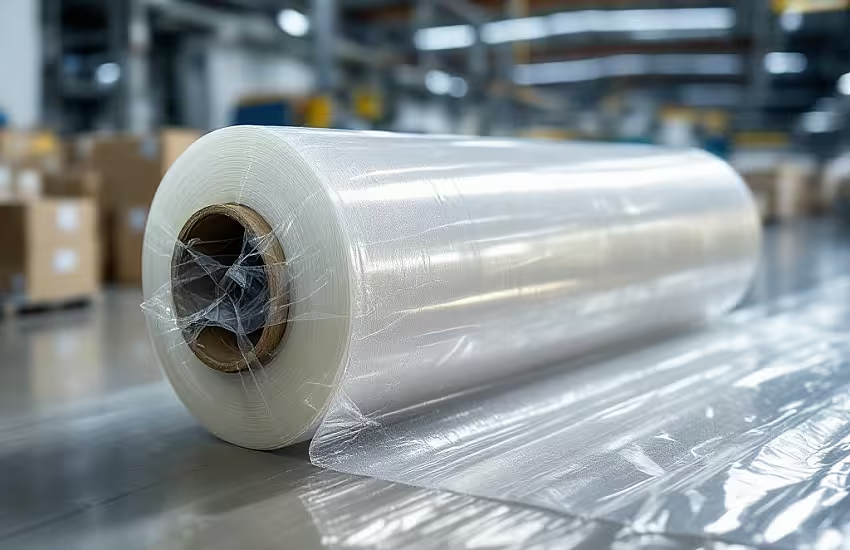
The holding force of the load comes primarily from the film tension, not the number of layers. Stretch film is made of linear low-density polyethylene (LLDPE), which, after being stretched, tends to return to its original shape. It is this “elastic memory” effect that generates compressive force squeezing the load. Properly tensioned film works like a tightened strap – it holds firmly with a relatively low material weight. Film applied without tension resembles a loosely wrapped rag – it has less holding force with significantly higher consumption.
Standard hand stretch film allows a stretch of about 10–30% without risk of tearing. Pre-stretch machine films achieve stretches of 150–300% – a roll weighing 2 kg secures the same area as several kilograms of standard film. This is one of the fundamental differences worth considering when calculating the real cost of wrapping.
The importance of pads and interlayers in the context of wrapping
Load stability on a pallet depends not only on the film. Film can work efficiently only when the pallet itself is properly prepared. Goods placed directly on a wooden pallet without any protection of the bottom layer are exposed to horizontal displacement – especially during braking in road transport. Operators try to compensate for this instability by adding more film, which increases its consumption but does not solve the root problem.
Using pallet pads eliminates this problem at the source. The pad engages in friction with the pallet surface and the bottom layer of the goods, limiting their lateral movement without the need to “close” the load with excessive amounts of film. The effect is twofold: lower film consumption and better real stability, because the load is secured in more than one way.
The same principle applies to using interlayers between layers of goods – especially for cartons with slippery surfaces, products in foil packaging, or loads with irregular shapes. Interlayer introduces friction where it is naturally lacking, which directly translates into the possibility of reducing the number of film wraps without losing safety.
Where film really disappears – analysis of common losses
Every kilogram of film that does not perform any stabilizing function is a cost incurred irretrievably. Observations of warehouse processes in various industries reveal three main areas of loss.
Faulty wrapping scheme
The lack of an established wrapping program is the most common problem. The operator wraps the pallet “by eye” – however many turns, that many turns. In practice this leads to a chaotic number of wraps ranging from 4 to 12 depending on the shift, the operator, and the current work pace. With an automatic wrapping machine this problem can be eliminated by programming a strict scheme: number of lower, middle, upper wraps, pre-stretch tension level, spiral incline. With manual wrapping, the solution is training and supervision supported by a simple instruction at the workstation.
The optimal wrapping spiral usually overlaps by 50% of the film width. A larger overlap means doubling the material in a place where a single layer would be entirely sufficient. Many companies wrap with overlaps of 70–80%, which translates to consumption 40–60% higher than the optimal variant – with no improvement in stabilization parameters.
Incorrect selection of film for the application
Stretch film is available in many thickness variants – typically in the range of 17–35 micrometers. Using thicker film where a thinner one would suffice is a simple way to overpay. At the same time, using film that is too thin for heavy or sharp loads leads to tears and the need to rewrap, which paradoxically increases total consumption.
Thickness selection should stem from the characteristics of the load: its weight, shape regularity, surface type, planned number of transshipment operations, and storage time. Light homogeneous cartons can be wrapped with 17–20 µm film with high tension. Heavy pallets of metal components require a different approach – both thicker film and a different wrapping scheme.
Excessive wrapping as a substitute for correct loading
When goods are poorly arranged – protruding beyond the pallet outline, having voids inside, uneven layers – operators compensate with extra film. Such a pallet looks solidly wrapped, but the film actually works without proper support, which still does not guarantee safety in transport. Better results come from improving the arrangement itself, or using corner boards or corner systems that even out edges and give the film something it can actually tighten against.
Pre-stretch – a technology that changes the cost balance
Pre-stretch technology involves mechanically pre-stretching the film before applying it to the load – in the wrapping head or in a special handheld holder. The film reaches the load already stretched, which means that far less is needed to cover the same area than with standard wrapping.
Films designed for pre-stretch systems have a different molecular structure than standard films – they are optimized for even stretching while maintaining adequate cohesion strength after application. With a 250–300% stretch, a 2 kg roll provides as many linear meters of film as a 5–6 kg roll in a standard system. The math is simple: the roll cost rises slightly, but the number of rolls needed drops dramatically.
Implementing a pre-stretch system in a place that previously used manual wrapping requires investment in wrappers with the appropriate head or purchase of handheld adapters with a pre-tension system. The payback time for the investment with high pallet turnover is measured in weeks, not months.
Process parameters that have a real impact on consumption
Optimizing film consumption means working with several variables at once. Each of the parameters below, improved individually, provides a few percent improvement. Together they create a difference on the order of 40–60%.
Film tension – the basic parameter. On wrapping machines set as a percentage value or as a force in newtons. Too little tension means loose film with little compressive force. Too much leads to tears and deformation of unit packaging. Optimal tension is determined empirically for each type of load and adjusted after analysis of transport claims.
Wrap feed speed relative to rotation speed – the ratio of film feed speed to pallet rotation speed determines the spiral incline and thus the overlap of successive layers. On machines with adjustable feed speed, optimizing this parameter is a direct route to reducing consumption without changing the quality of securing.
Wrapping the base and the top – critical zones where the load is most susceptible to collapse. Standard practice is to make more wraps at the lower part (the first 200–300 mm from the base), rather than spreading the same number of wraps evenly across the entire height. This raises securing effectiveness and allows reducing wrapping of the middle section of the pallet.
Type of wrap finish – manually adhesive sticking of the film tail to the load, without pressing and proper overlap, is a common source of unpeeling and the need to rewrap. A proper finish – with a few “reverse” wraps or a mechanical clamping system – eliminates this problem and reduces film waste.
Effect of temperature and storage conditions on film efficiency
Stretch film loses its elastic properties under extreme temperature conditions. When wrapping in cold warehouses (below +5°C) the film becomes more brittle and harder to stretch – operators instinctively reduce tension, which lowers securing efficiency and at the same time increases material consumption. The solution is to store rolls at room temperature and issue them to wrapping stations as needed.
Long-term storage of film exposed to UV radiation and high temperatures degrades its mechanical properties, particularly for polyethylene film – this phenomenon has been described in detail in the context of durability of PE film. Film that looks fine but was stored incorrectly will tear during wrapping or lose tension faster than it should – which directly leads to higher consumption with lower efficiency.
Measurement and control as the foundation of lasting optimization
A 60% reduction in film consumption will not happen through a one-off equipment change or a single training. It is a process that requires a system of measurement and reaction to deviations. The basic metric is grams of film per load – calculated as the mass of used film divided by the number of wrapped pallets. Monitoring this metric weekly, broken down by individual packing lines or shifts, provides information on where uncontrolled increases in consumption are occurring.
Companies that have implemented regular wrapping process audits – even in the form of a quarterly review of machine parameters and observations of operator work – consistently maintain film consumption at 20–30% lower than before implementing any equipment changes. Measurement alone changes the behavior of operators and managers responsible for the station.
Equally important is the analysis of transport damage. Every complaint related to pallet collapse or damaged goods should be analyzed in terms of the wrapping scheme, not only the transport conditions. In practice a significant portion of damage results from insufficient film tension or skipping wrapping the lower zone of the load – and not from the carrier's fault.
Context of the situation
We started this project with a food industry company that shipped from several hundred to over a thousand pallets daily to retail chains and regional warehouses. The goods were varied: multipacks of cartons, shrink-wrapped packs, packages with fairly slippery surfaces, plus several pallet formats and frequent repacking between picking zones. On paper the process looked correct. In practice the warehouse regularly returned to the same problem: film consumption increased, and transport complaints did not disappear.
The client approached us not because they wanted to "use less film at all costs." The starting point was more operational. The warehouse manager noticed that on one shift pallets were wrapped noticeably more tightly than on another, yet goods on delivery could be skewed, with a crushed bottom layer or a crushed corner. They were looking for a way to organize the process and reduce losses without worsening load stability.
Client problem
The main problem was not the material cost itself. The cost of film was only a symptom. The real trouble looked like this:
very large differences in film consumption between shifts,
unstable pallets during long-distance transport,
frequent "rescuing" of poorly arranged loads with additional layers of stretch,
downtime at wrappers caused by film tearing,
lack of a single procedure for different pallet types.
Initially the client assumed that changing the film alone or adjusting the wrapper settings would be enough. After the first inspections it was clear that this assumption was too simple. The problem lay simultaneously in pallet preparation, in the wrapping itself, and in how the load behaved after leaving the packing line.
Situation analysis
We started with an audit on the floor. Not from an Excel table, but by observing the process live. We stood by the picking area, at the pallet formation station, at the wrappers and in the staging area. This usually reveals more than just analyzing consumption from documents, because you immediately see where the process "escapes" the operators.
In this case four things quickly emerged.
First, pallets were not homogeneous. For the logistics department "a pallet of cartons" was one category, but on the floor these were in practice at least three different cases: a rigid and even load, a load with empty spaces, and a load with a very slippery bottom layer. Each was wrapped almost the same way.
Second, some problems started from the bottom. The bottom layer of cartons on a wooden pallet could slightly "shift" already at the first movement by a forklift. In response operators added additional film turns at the base. That improved the pallet's appearance, but did not remove the cause of the slip. In such implementations pallet slip sheets work well here, because they stabilize the bottom layer before the film begins to take the loads.
Third, the client had the wrapper set for the "difficult case", and then used the same program to secure most standard pallets. This is a common scenario. Once complaints appear, the plant reacts conservatively: more turns, tighter, slower. The problem is that such a setting becomes permanent and after a few months no one remembers why it was introduced in the first place.
Fourth, on some pallets the layers of goods moved relative to each other. There was no dramatic separation, rather small shifts between cartons that grew during transport. In these places the outer film itself was not the best tool. It worked better to separate and stabilize the layers from the inside. For several product groups we trialed polyethylene interlayers between carton levels, which reduced mutual sliding of layers.
How the measurement looked before changes
So as not to rely on impressions, for several days we collected data for selected pallet groups. We were not interested in the average for the whole warehouse, because that often masks the problem. We separated results by load type, shift and operator.
The measurement included:
mass of film used per pallet,
number of wraps in the lower, middle and upper zones,
time to wrap one pallet,
number of film breaks per shift,
cases of pallet rework after wrapping,
notes from unloading and customer complaints.
This was an important moment, because the data showed something that warehouse staff previously considered "normal". For similar pallets the difference in film consumption reached several dozen percent. Even more interesting was that the most heavily wrapped pallets did not have the best transport results. Some of them even more often showed deformations, because excessive compression worsened the geometry of the cartons and the distribution of forces.
Actions step by step
1. Division of pallets into real groups, not general "light" and "heavy"
We did not create a lengthy instruction that no one would read. In practice a simple division into four types of load units worked well:
pallets even, rigid and full,
tall pallets with a compliant top,
pallets with a slippery bottom layer,
mixed pallets after picking.
For each group we defined a separate preparation and wrapping standard. This organized the work more than simply changing machine parameters.
2. Stabilizing the base of the load
In groups where goods shifted relative to the pallet already during internal transport, we introduced anti-slip pads under the first layer. This element does not automatically reduce film consumption simply by being used. However, it provides the possibility to safely reduce the number of additional base wraps that were previously applied as a precaution.
After implementation it turned out that some pallets no longer required "pressing" to the pallet with the same force as before. The load began to behave more calmly, and operators stopped adding film just in case.
3. Aligning the operation of layers inside the pallet
For cartons with a smooth surface, especially in taller pallets, we used interlayers between selected layers. Not on every pallet and not between all levels. Only where transport trials showed mutual shifting. Thanks to this it was possible to reduce the intensity of wrapping the middle part without losing the stability of the whole column.
This is an important practical difference: we did not fight the outward symptom with more film, but limited movement where it actually originated.
4. Changing the wrapping program for specific pallet zones
In the previous setting the client had a too "dense" scheme almost over the entire height. We shifted greater emphasis to those places that actually required it: the base and the top zone for lighter, less compact loads. The middle of the pallet was lightened materially, but not mechanically, rather after a series of trials with control of load behavior after 24 and 48 hours.
This is significant, because some pallets look good immediately after wrapping, and problems only appear after storage or after an overnight stop in a cooler shipping area.
5. Reducing manual operator adjustments
One of the less obvious sources of losses was manual adjustments. After the cycle ended an operator would often add one or two more turns "for certainty", especially for pallets going further than usual. This did not result from carelessness. Rather from a lack of trust in the settings and from experiences with earlier complaints.
We solved this not by forbidding it, but through joint tests. We chose several routes and compared pallet behavior before the change and after the standard change. When foremen saw that lighter wrapping did not mean worse protection, the number of manual interventions clearly decreased.
6. Control of storage conditions for auxiliary materials
During the work another problem emerged that the client initially did not associate with wrapping at all. Some film materials were stored near the gate and in an area with variable temperature. At morning shifts the material behaved differently than in the afternoon. This topic is often downplayed, yet it matters for process repeatability. In similar cases we also pay attention to the durability of plastics in different warehouse conditions; this is well described in the article about the impact of UV and temperature on polyethylene film.
Difficulties along the way
This was not an implementation that went smoothly from the start. Most problems appeared in three areas.
The first was operator resistance. When for years one hears that a complaint usually means "insufficient protection", the natural reflex is to add material, not reduce it. In the first week after the changes some of the crew returned to old habits, especially under time pressure.
The second problem concerned non-standard pallets from manual picking. Here results were not as spectacular as for repetitive pallets. It had to be accepted that not every load group allows the same material reduction. For two product categories we consciously left a larger margin of protection, because the risk of damage was too high.
The third difficulty surfaced during inter-shift tests. One shift adhered to the new standard very well, another began to modify it. The reason was prosaic: different foremen judged differently when a pallet was still "acceptable" and when it required correction. Only the introduction of a short, pictorial instruction at the workstation and a weekly review of deviations stabilized the process.
Which solutions ultimately proved effective
After about six weeks the client was already operating on a simplified but much more predictable model:
four types of wrapping standards instead of one program for everything,
slip sheets on pallets where the problem began with sliding of the bottom layer,
interlayers between levels in selected tall pallets,
limiting manual "tuning" of film after the cycle,
constant measurement of consumption not at the warehouse level, but at the load group level,
a simple reaction procedure when a pallet required deviation from the standard.
The last point was particularly important. Instead of improvising, the operator had a clear path: if a pallet falls outside the established pattern, mark it as an exception and apply the indicated securing variant. Thanks to this exceptions stopped breaking the whole system.
Results obtained
Three months after implementation the client achieved a reduction in film consumption of about 60% in the most repeatable pallet groups. In the whole warehouse process the average decrease was lower, because it also included mixed loads and those that were operationally more difficult. That is normal. Claiming the same result for all pallets would be hardly believable.
The most important effects looked like this:
in homogeneous groups the reduction in film usage reached about 55–60%,
in the entire warehouse the average drop in usage was noticeable, but more moderate,
the number of manual adjustments after the wrapping cycle decreased,
the number of pallets requiring repacking before shipment decreased,
complaints related to shifting of the lower layers of the cargo were reduced,
the process became predictable between shifts.
Importantly, not everything improved immediately. In the first month deviations still occurred, and two product groups required the standard to be reset. Only after another round of observations did we establish the target model that the client was able to maintain operationally without daily external supervision.
Practical takeaways from this implementation
Experience from this project yields a few things that also repeat with other clients.
First, a large reduction in film usage rarely results from a single change. If someone looks for one "magic" machine setting, they usually end up with a half-hearted effect. The biggest savings occur when the entire logic of pallet preparation is organized.
Second, excess film often masks a stability problem but does not solve it. If the bottom layer slides on the pallet or individual layers of goods move relative to each other, additional wrapping only increases material consumption. In such situations it is better to first stabilize the base and the layers, and only then reduce wrapping.
Third, not every pallet should be treated the same. It sounds trivial, but in practice many plants still operate on a single program for the entire production because it's more convenient. However, operator convenience does not always mean process efficiency.
Fourth, if a company wants to maintain the effect, it must measure deviations at the operational level. The monthly information about the number of rolls used alone explains nothing. Only breaking the data down by load type, shift and station shows where usage reverts to old habits.
Summary
This case showed well that reducing film usage even by 60% is possible, but not as a simple procedure of "wrapping with fewer layers". For the client it only worked after combining several actions: organizing pallet types, stabilizing the base, limiting movement between layers, correcting the wrapping program and working with the warehouse team.
From a practical perspective the most valuable aspect was that the improvement did not come at the expense of transport safety. Quite the opposite. When the process was organized, loads were more predictable and the film stopped serving as an emergency "band-aid" for errors that had occurred previously.
In similar projects this is what yields the best effect: don't add material where the process is unstable, but remove the cause of the instability and only then optimize wrapping.
FAQ – practical questions about optimizing pallet wrapping with stretch film
Is it possible to reduce film usage when pallets are non-standard and look different every day?
Yes, but not by looking for one universal setting for everything. With mixed pallets the biggest mistake is that a company tries to impose a single wrapping scheme on loads that differ in height, weight distribution, packaging rigidity and susceptibility to shifting. In such a situation reducing film consumption does not start with the wrapper itself, but with organizing operational decisions.
In practice the simplest system that works best is a pallet qualification system before wrapping. Not an elaborate form, but clear criteria for the warehouse: does the load protrude beyond the footprint, are there voids, is the top layer prone to sagging, is the center of gravity high. Based on that the pallet is assigned to one of several securing variants. Such a model gives much better results than operator improvisation at the station.
With non-standard load units the stretch film very often works beyond its real capabilities. If cartons are of different heights or layers do not have full support, the film starts bridging empty spaces instead of stabilizing the goods. Then you need to help it with other elements: corner protectors, interlayer sheets between levels or a base sheet under the first layer. For loads that "float" from the bottom, a pallet pad works well because it limits movement before the film takes up tensions.
One must also accept one fact: with mixed pallets not every reduction will be as spectacular as with repetitive production. If someone promises identical results for every product group, they usually oversimplify the matter. A well-set process allows reducing material consumption even with mixed picking, but the effect comes from better selection of exceptions and fewer unnecessary "touch-ups", not from aggressive parameter cuts.
How to check whether the problem is too little film or poor stabilization of the load itself?
Simply: stop evaluating the pallet solely by how it looks immediately after wrapping. That misleads many warehouses. A pallet can leave the station neat and tidy, yet after a few hours of standing or after the first harder braking it can start shifting. If the deformation appears only later, the culprit is often not the amount of film but the way forces are transmitted within the load.
A good test is to observe pallet behavior at three moments: immediately after wrapping, after a few hours of standing and after a controlled trip through the warehouse with typical maneuvers. If the bottom layer starts sliding relative to the pallet, the problem is at the goods–pallet interface. If layers shift relative to each other, the external stretch masks the symptom but does not stabilize the interior. If the top part tilts despite a compact base, work on packing geometry and stiffening the top zone is needed.
In practice this is quite visible. When there is too little film, the load most often loses cohesion overall: the film does not press, the tail peels off, layers "breathe". When the problem lies elsewhere, operators usually respond by adding more rotations, but complaints do not disappear proportionally to increased consumption. This is one of the clearest signals that the material is being used as a patch for pallet preparation errors.
In such cases analyzing photos from unloadings and comparing damage by type of deformation helps a lot. Raw complaint counts are too imprecise. If a company wants to make sound decisions, it needs to distinguish whether it is dealing with slipping, settling, corner collapse or layer separation. Only then is it clear whether to change the wrapping scheme or rather add a stabilizing element, for example film interlayers between carton levels.
When does film reduction start harming the goods instead of helping?
This happens sooner than many realize. Excessive slimming of the process usually does not immediately end in spectacular pallet collapse. Far more often subtle symptoms appear: a slightly skewed column of cartons, slightly bulged single-pack packages, recurring fixes during loading or an increase in pallets set aside "for extra securing". These are warning signs that the process has entered a zone with too small a safety margin.
Another risky scenario is when a company reduces the number of wraps but does not change work organization. As a result every non-standard pallet ends up with manual correction. On paper material consumption from the program drops, but in practice film comes back through the side because operators finish the cycle and make extra turns manually. Such a model can be hard to spot if no one measures waste and consumption outside the machine itself.
There are industries where excessive optimization can affect product quality, not just transport stability. This concerns particularly delicate outer packaging, lightweight low-rigidity cartons and food products with sensitive package geometry. Too little pressure in one area may mean lack of stability, but too much point pressure elsewhere leads to crushing and loss of commercial shape. For such loads it is not enough to ask "how many layers less". You must look at force distribution.
Safe optimization is always based on retention and stability tests, not only on reducing grams per pallet. If after reducing material the number of exceptions, quality complaints or interventions in the shipping area rises, that is a sign the process was slimmed down too much. Experienced teams then do not judge only the savings result, but the balance of the whole operation: whether less film does not generate more work, losses and instability elsewhere.
How to approach wrapping pallets shipped for export or stored longer than a few days?
Local standard often stops being sufficient here. A pallet that goes a few hours to a domestic recipient operates under very different conditions than a load passing through terminals, long stands, variable temperatures and multiple transshipments. With export it is not only about stronger wrapping. It is about predictability of the load unit's behavior over a longer time and across more contact points with personnel and equipment.
First of all you need to separate two cases. The first is fast-rotating export where the pallet is mostly on the move and resistance to maneuvers and transshipments is key. The second is extended storage or transport combined with waiting in logistics hubs. In the latter case maintaining the load geometry over time is more important, because even small settling of layers accumulates over hours or days.
For such shipments it works well to control not only the wrapping itself but also the compatibility of auxiliary materials with ambient conditions. If the unit will stand longer or pass through variable environments, you must monitor film quality and stabilize the load from the inside. In some cases it makes more sense to add an interlayer or a pad than to add more external layers of stretch. That gives a more stable effect over time.
If the sector involves food, pharmaceuticals or another quality-sensitive industry, hygiene and safety of the packing process also come into play. It's not only about preventing load collapse. You need to ensure the securing method does not create secondary operational and quality problems. In this context the article showing that food packaging is an element of safety, not just logistics illustrates the point well.
For export it is particularly important to predefine which pallets have "long-haul" status and require a separate standard. Many complaints do not stem from a company not knowing how to wrap well, but from a pallet prepared for ordinary local distribution ending up in far tougher conditions without changing its securing method.
Do pads and interlayers really reduce film consumption, or do they just add another material to the process?
It depends on whether they are used in the right place. If a company introduces them "just in case" for every pallet, it can end up with more materials and no clear effect. However, if a pad or interlayer solves a specific mechanical problem, their impact on stretch consumption is very real.
A pad under the first layer does not replace the film. It changes the working conditions of the whole load. When the bottom layer has greater friction and does not slide on the pallet during forklift movement or braking, the need for precautionary "weighting" of the base with additional turns disappears. The same applies to interlayers inside the pallet. If carton layers do not slide over each other, you can reduce external pressure without losing column stability.
Economically you need to look broader than the price of a single component. In the warehouse the cost of the whole error counts: extra film, fixes, repacking, damages, complaints, operator time and blocking the shipping area. Often a small auxiliary element reduces several of these costs at once. For this reason experienced logisticians evaluate pads and interlayers not as an "additional expense" but as a tool to take some load off stretch film.
In practice it's best to implement them selectively. For pallets with a stable, rigid load there is usually no need to use them. For slippery, tall, mixed or frequently repacked loads they can make a big difference. If someone wants to assess this fairly, they should compare not just the weight of film used, but the full operational outcome: number of fixes, pallet behavior after internal transport and percentage of damages after delivery.
In such applications choosing the right material for the task also matters. HDPE gives different properties than LDPE. When greater stiffness and a stable pad form are needed, solutions from the HDPE film products group make sense. Where interlayer flexibility and conformity to carton surfaces are more important, LDPE film products are more often suitable.
How to talk to the carrier and recipient when complaints concern "poorly wrapped pallets" but the problem isn't always on the warehouse side?
The worst thing you can do is accept the simplification: a transport complaint equals too little film. That's a very convenient narrative because it quickly closes the topic with one instruction for the warehouse. But afterwards the company consumes more material and complaints still return. To get to the cause you must separate damage resulting from improper securing from damage caused by transport conditions and handling after leaving the plant.
Documentation is the basis. Photos of the pallet after wrapping, photos at loading, record of vehicle type and pallet placement method, and on the recipient side photographs from the moment of opening the trailer or unloading. Only comparing these stages allows assessing whether the load left unstable or was damaged later. Without this the warehouse often takes responsibility for a problem it did not actually create.
The wording of the complaint is another issue. The phrase "the pallet was poorly wrapped" means little. You need to specify what exactly happened: the bottom layer shifted, the top part collapsed, cartons separated, the film failed in one spot, a corner was pressed by an adjacent load. Only such a description provides material to improve the process. A vague remark usually leads to one reaction: more film. And that is not always the right answer.
A common damage assessment standard between the warehouse, logistics department and carrier works well. Even a simple table of non-conformity types organizes communication. Companies with a larger shipping scale often reach a point where without such standardization each complaint becomes a dispute over interpretation. Then the wrapping optimization process lacks stable input data.
If complaints recur on specific routes, it's worth comparing not only pallet types but also transport conditions: route length, number of delivery points, stacking method, intermediate transshipments. Experience shows that some problems attributed to stretch actually result from accumulation of transport loads that the domestic standard simply was not designed to handle.
How to implement a new wrapping standard so the warehouse doesn't revert to old habits after a month?
Most often people revert not to old machine settings but to old human reflexes. Therefore lasting optimization does not end with a technical parameter. If an operator does not trust the new standard, they will circumvent it: add a manual wrap, change the finishing method, hold the pallet for correction or choose a "safer" program at the first atypical load.
To prevent this the instruction must be quick to use. Not an elaborate quality document, but simple material at the station: photos of typical pallets, assigned securing variants, rules for handling deviations and a short list of situations where the supervisor must be notified. The less room for discretion, the greater the repeatability.
The second element is shift-level responsibility. If each team interprets the standard in its own way, the process will drift within weeks. Therefore short periodic reviews of deviations work well: not a long audit once a year, but a brief analysis every week or two. It's enough to check a few pallets from each shift, compare consumption, number of exceptions and manual fixes. Such checks quickly show where the standard begins to blur.
It also helps to clearly separate what is standard from what is an exception. If an operator feels every difficult pallet requires improvisation, they will revert to their own methods. If they know that for deviations there is a ready procedure, maintaining process discipline becomes much easier.
In practice the effect is best sustained by companies that treat wrapping as a quality process, not just a material issue. Changing film or settings gives a short-term result. Only combining a standard, operational control and response to exceptions makes the savings permanent instead of disappearing after the first period of increased shipping pressure.
When optimizing wrapping, do you have to consider waste and station organization, or is that a separate topic?
You must. And much more often than assumed. In many warehouses film consumption is analyzed only by the number of rolls issued to production, while losses around the station are ignored: tails after breaks, remnants after roll changes, cut-off sections during fixes, waste from manually securing exceptions. If this stream is not controlled, the picture of the process can be false.
A well-organized wrapping station reduces not only chaos but also actual material consumption. An operator who has the right tools at hand, a clearly marked place for waste and a simple roll change procedure works more repeatably. Conversely, a messy station fosters improvisation and hiding losses. This is not a housekeeping detail. It's an element of process control.
It is worth implementing separate waste recording for film at least in the form of simple weighing for selected shifts or lines. Often it turns out that the same stations that have the highest declared material consumption also generate the most waste from breaks and fixes. Without this knowledge it's hard to distinguish a technical problem from an organizational one.
How waste is collected also matters. If film tails and scraps end up randomly in different containers, there is no chance of a sensible analysis later. In practice it is worth providing dedicated bags or bins at the station. For simple applications bulky solutions such as waste bags are helpful because they facilitate keeping order and quicker accounting of material losses.
Companies that approached the topic holistically usually discover that part of the savings does not come from simply reducing the number of wraps, but from limiting losses "around the process". These are the elements that distinguish a short-term cost-saving action from a well-organized logistics optimization.
Most common mistakes when optimizing pallet wrapping with stretch film
The biggest losses when wrapping pallets rarely result from a single obvious mistake. More often they are the effect of several small decisions that separately seem reasonable: a cheaper roll, one program for all pallets, a quick correction after a complaint, no measurement of holding force. After a few months the company consumes more or less film, but nobody can say whether the load is actually safer.
Below I describe errors that regularly appear in warehouses, production plants and distribution centers when attempting to reduce stretch film consumption. These are not theoretical problems. These are situations that translate directly into complaints, downtime, repackaging and unnecessary costs.
1. Calculating savings from the price of the roll instead of the cost of securing the pallet
This is one of the most expensive purchasing mistakes. The company compares two films solely by price per kilogram or price per roll and chooses the cheaper option. On the invoice it looks good. On the shop floor it can be the opposite.
The problem is common because stretch film is still treated as a simple consumable. If a roll looks similar, has a similar width and declared thickness, the decision seems obvious. But in practice what matters is the efficiency per roll, tear resistance, behavior under stretch, batch consistency and the amount of film needed to achieve the same stability.
Consequences are visible quickly: more breaks on the wrapper, extra turns “to be sure”, worse cycle finishes, more waste after a roll change. It may happen that the cheaper film increases the real cost of securing the pallet, even though it cost less per unit.
How to avoid this? Compare the cost per wrapped and validated pallet, not the cost of purchasing a roll. The test should cover at least several load types, number of breaks, mass consumption per pallet, cycle time and load behavior after internal transport. When changing material it is also good to organize the specification: raw material type, thickness, winding, tolerances, tackiness, puncture resistance and the working range on the given wrapper. It can be helpful to distinguish material properties within the category of PE films, especially when the company compares solutions with a similar trade name but different behavior in the process.
From practice: if after changing the film operators start stopping the machine more often, fixing ends or reducing tension, the savings from the purchase are already suspicious. Good tests are done at the workstation, not only in a spreadsheet.
2. Copying settings from another line, warehouse or the film supplier
A common scenario: someone asks what parameters work at another company, gets a set of settings and tries to implement them locally. The number of wraps, tension, table speed, film overlap — everything looks professional. Only the load is different.
This mistake comes from the desire to shorten tests quickly. The warehouse manager wants specifics, operators want a clear program, the film supplier wants to help. The problem is that wrapper settings are not a universal recipe. The same parameter may behave differently with rigid cartons, soft packaging, shrink-wrapped packs, and again differently with pallets that have goods protruding beyond the outline.
The consequence is a false sense of control. The process has a “standard”, but there is no confirmation that this standard fits the real load units. The effect can go both ways: excessive film consumption or an overly aggressive reduction that only becomes apparent after delivery.
Avoiding the problem requires tests on your own pallets, with your own wrapper and typical warehouse work. A good starting point can be taken from the supplier’s experience, but final parameters should be the result of trials. It is best to test not one “nice” pallet but a repeatable series: several units from different shifts, various heights, different packaging batches, typical exceptions.
In optimization projects we often see that a setting transferred from another location works only for the first day — until pallets with a different assortment reach the line. Therefore parameters should be treated as the result of a process, not a ready-made template to copy.
3. Reducing film without checking the load holding force
A drop in film mass per pallet does not prove anything by itself. You can reduce consumption by 40% and at the same time significantly worsen the unit load’s resistance to accelerations, braking and tilting. On the shop floor the pallet may still look fine.
This mistake is common because consumption is easy to measure while stability is harder. Film mass appears in warehouse documents. Holding force already requires a test, observation or measurement. Many companies lack a simple criterion: what minimum holding force a given pallet group should have and how often to check it.
The consequences are insidious. For several weeks everything looks fine because not every route generates large loads. Then a series of complaints appears from one direction, after a longer route or after several re-loadings. The warehouse then returns to the old program and loses all the savings.
How to avoid this? With every major process change you need a simple validation: a tilt test, a displacement test after internal transport, an assessment of behavior after a stop and — for more demanding loads — measurement of holding force in accordance with internal quality standards or customer requirements. In companies working with demanding retail chains or exports it makes sense to refer to recognized methods for testing load stability instead of relying on visual assessment.
Practical observation: if after film reduction no one can say what force actually holds the load, that’s not optimization. It’s a cost-cutting attempt without risk control.
4. Changing film without adjusting the wrapper settings
Many companies test a new film, put it on the machine and leave the existing program. Then they judge the material as “good” or “bad”. That’s a hasty conclusion.
The error is common because the wrapper runs, the pallet spins, the film is applied — so it seems the process is comparable. Meanwhile different films respond differently to pre-stretch, pressure, feed speed, brake, warehouse temperature and the shape of the load’s corners. A material with greater stretch potential may perform poorly if the machine does not allow it to be utilized. Conversely, a more delicate film may tear only because the parameters were left set for a thicker film.
Consequences? An unfair assessment of the material, unnecessary abandonment of a better solution or, conversely, implementation of a film that works only under ideal conditions. To that add downtime and operator frustration, who lose trust in further tests.
To avoid this, every film change must be treated as a change of the system: material plus machine plus load. Before the test it’s worth checking the condition of the stretch rollers, the cleanliness of guides, the brake, the pressure device, the cutter, the gripping and film termination system. A worn or dirty head can “ruin” even a good material.
From experience: if the film breaks more often on one shift than another, the material is not always to blame. Sometimes one crew reacts faster to the sound of an overloaded film, while another runs parameters to the breaking point. Therefore the test should also cover how the machine is handled.
5. Optimizing on ideal pallets that the warehouse hardly ships
Tests are often done on the nicest load units: uniform cartons, full layers, stable height, no protruding corners. The result looks great. Consumption drops. Only later daily production looks completely different.
This is a natural mistake because it’s easiest to choose pallets available at the moment or those that won’t disrupt warehouse work for the test. The problem is that optimization performed on easy cases tells you nothing about behavior with more difficult loads. And those usually generate corrections, complaints and additional film consumption.
The consequence is a divergence between the test result and the post-implementation result. The company plans a 60% reduction, but in reality achieves much less because operators start securing problematic pallets the old way. Sometimes an even worse situation arises: the standard is formally implemented, but people on the floor apply it selectively.
How to prevent this? The trial must include representative pallets, not the most convenient. In practice a useful rule is: test an easy, a medium and a hard group, and separately describe exceptions. If 30% of shipments in the warehouse are mixed pallets, you cannot validate the process solely on homogeneous production from the line.
In warehouse audits we often ask to show “the ugliest pallet that normally leaves for the customer”. That gives more information than a series of perfect units prepared specifically for the test.
6. Reacting to every complaint by adding film
A complaint arrives from transport, the description is short: unstable pallet, shifted goods, damaged packaging. The quickest reaction? Increase the number of wraps. It’s understandable, but often wrong.
This mechanism is common because it works psychologically. More film gives a sense of security and it’s easy to communicate: “we reinforced the protection”. The problem is that without analyzing the cause you may strengthen the wrong area. If the damage occurred due to poor pallet positioning in the trailer, insufficiently secured load, crushing by a neighboring unit or a weak wooden pallet, additional stretch will not solve the problem.
Consequences accumulate quietly. Each complaint leaves behind a “temporary” program increase that becomes permanent. After a year no one remembers why that pallet group has such heavy wrapping. Consumption rises, but stability does not improve proportionally.
The solution is a parameter change procedure. After a complaint the program is not changed immediately for the whole production. First you must determine the damage type, batch, route, loading conditions, photos before dispatch and after delivery. Only then make a decision: change wrapping, change pallet preparation, correct transport or add an additional stabilizing element.
A practical conclusion from many implementations: the worst machine settings arise after a series of quick reactions to individual complaints. Not because someone was careless, but because nobody reverted the temporary corrections after the cause was clarified.
7. Ignoring the quality of the wooden pallet itself
Wrapping optimization often focuses on film and machine, neglecting the load carrier. Meanwhile a damaged, wet, uneven or too weak wooden pallet can destroy the entire protection standard.
The mistake is common because the pallet is treated as the process background. If it held the goods during picking, it is considered sufficient. The problem begins during transport: warped boards change the support of the bottom layer, protruding elements cut the film, broken blocks cause tilt, and a wet surface can change friction at the load interface.
Consequences are hard to diagnose. The operator sees a film break and blames the material. The recipient sees a skewed pallet and blames the wrapping. But the cause may have arisen earlier, when a defective pallet was allowed into the process.
How to avoid this? The wrapping standard should include a simple acceptance criterion for the load pallet. Not a multi-page instruction, but decisions that can be made on the floor: reject a pallet with a protruding nail, a cracked board, significant tilt, an unstable block or a damaged corner. For export and heavy loads the tolerance should be stricter than for local shipments.
From practice: if film breaks always occur at a similar height zone, it’s worth checking not only the wrapper head but also pallet edges and the lower part of the load. Often the problem is not where the first symptom is visible.
8. No control of changes between operators and work shifts
Even the best wrapping program will not maintain results if each shift interprets it differently. One crew wraps according to instructions, another reduces tension, a third adds manual securing because “it feels safer”.
This is common because differences between shifts are not always visible in monthly film consumption. The average masks the deviations. Only after breaking down data by shift, station and load type does it become clear that the same product is secured according to several different standards.
Consequences are concrete: lack of repeatability, difficulty analysing complaints, disputes between shifts and inability to maintain savings. The warehouse may have a good standard on paper but a weak process in reality.
How to prevent this? A short operational check is needed, preferably cyclical. A few pallets from each shift, comparison of settings, mass consumption, number of corrections and any deviations. It’s not about finding who is to blame. It’s about catching the moment when the process begins to revert to old habits.
Practical observation: operators are more likely to stick to the standard if they see test results and understand which deviations are allowed. A simple ban on adding film usually works only briefly. Trust in the process works longer.
9. Evaluating the process only by the pallet’s appearance after wrapping
A neat, shiny, tightly wrapped pallet looks safe. That can be misleading. The aesthetics of protection do not always mean transport stability.
The mistake is common because visual assessment is quick. The foreman looks at the pallet, the operator sees tight film, the shipment reports no problem. But the real test begins when the forklift moves, when braking, turning, reloading and during longer stops.
The consequence is letting pallets through that look good but perform poorly. This concerns especially loads with empty spaces, soft packaging, a high center of gravity or an irregular top. The film can nicely conform to the outer outline while layers still shift relative to each other inside.
How to avoid the mistake? Add simple functional criteria to the assessment: whether the bottom layer doesn’t shift after a short ride, whether corners don’t collapse after a stop, whether the film doesn’t lose tension, whether the load doesn’t “breathe” under light lateral pressure. For important shipping directions it’s good to periodically compare photos of the pallet after wrapping and after delivery.
From experience: the most neatly wrapped pallets do not always generate the fewest complaints. Sometimes the opposite — excessive pressure hides a problem until packages begin to deform under load.
10. Implementing film consumption reduction without a plan for exceptions
The standard works well until an atypical pallet appears: lower, higher, with different packaging, assembled manually, with an incomplete layer or destined for a longer route. If the operator has no clear instruction, they improvise.
This mistake is common because during optimization companies focus on the main stream of pallets. That’s logical because that’s where the biggest volume is. The problem is that exceptions can destroy the discipline of the whole process. When an operator has to decide several times, they quickly return to the rule: more film will be safer.
The consequences are twofold. First, film consumption grows out of control. Second, each change begins to build its own methods of securing difficult pallets. After a month the standard ceases to be a standard.
The solution is simple but requires discipline: have a separate procedure for exceptions. There don’t need to be many. In many warehouses three categories are sufficient: standard pallet, difficult pallet, pallet requiring foreman’s decision. It’s important that the operator does not have to guess.
Practical takeaway: a well-designed optimization is not about wrapping all pallets more lightly. It’s about standard pallets not being overspecified, and difficult cases being secured consciously, not reflexively.
The most important mistake: treating film as the only stabilization tool
In many companies stretch film is expected to solve everything: a slippery bottom layer, uneven cartons, a weak pallet, empty spaces, lack of picking standards and variable transport conditions. That’s too much for one material.
In a well-organized process film is the last element of protection, not a rescue for earlier mistakes. When the load is prepared correctly, consumption can realistically be reduced very significantly. When it is not, every reduction will be short-lived or come at the cost of complaints.
The best results are achieved by companies that view wrapping as a technical process: they measure, test, separate pallet types, control exceptions and do not change parameters in response to single events. Then film reduction is not a risk but the result of orderly logistics.
Comparison of solutions: how to reduce film consumption without worsening pallet stability
Is it possible to cut stretch consumption by several dozen percent? Yes, but not by every route and not in every condition. In warehouse practice the biggest difference usually does not come from changing the film itself, but from choosing the approach to load stabilization. Below I compare the solutions most often considered when optimizing the process, along with their real operational consequences.
1. More film wraps vs stabilizing the pallet base with a pallet pad
The first approach is very common: when the bottom layer of the load starts to slip, the operator or process engineer adds extra turns of stretch film at the base. This solution can be effective as a temporary measure, especially when a shipment needs to be released quickly and there is no time to change the organization of the process. It also works well as an emergency action for single non-standard pallets.
The second approach involves removing the source of the problem, i.e. reducing slip between the pallet and the first layer of goods. Here a pallet pad is used to improve friction and stabilize the load before the film begins to take on the loads. In practice this solution makes the most sense with slippery cartons, multipacks, plastic-wrapped packages and loads that tend to “flow” at the base as soon as a truck or forklift moves. A good example is a pallet pad 900x1300, used where the problem starts with contact between the bottom layer and the support.
Which solution for whom? Simply adding film can be acceptable at a small scale, with high variability of shipments, or when the company hasn't yet standardized pallet preparation. A pad is a better choice where shipments are repeatable and it's possible to implement one proven working method for a given group of loads.
The limitation of the first approach is obvious: more wraps increase material consumption and do not always improve actual stability. If the bottom layer slides as a whole, the film only presses the symptom more firmly. The limitation of a pad is that it will not fix a poorly assembled pallet nor replace a correct wrapping program. It is a supporting element, not a substitute for the whole process.
From warehouse experience: where operators have for years been “saving” a pallet with extra turns at the base, after introducing a pad it often turns out that some of those layers can be removed without an increase in claims. The biggest effect is seen not on perfect pallets but on the moderately difficult ones that previously constantly required precautionary reinforcement with film.
2. Film as the only stabilizing element vs film supported by interlayers between layers
In many plants the assumption is that the outer layer is mainly responsible for keeping the whole column of goods intact. That works with rigid, even and well-interlocking packages. The problem appears when individual levels of cartons shift relative to each other, even though the pallet looks fine from the outside.
An alternative is the introduction of interlayers between selected layers. This solution makes sense especially for high pallets, smooth cartons, lacquered packaging and anywhere the load “works” more internally than on the outline. In such cases an interlayer 600x645 can be helpful, used selectively between levels of goods rather than automatically on every pallet.
Who benefits most from this solution? Manufacturers and distribution centers that have repeatable configurations of high pallets and want to reduce wrapping in the middle zone without the risk of layers spreading apart. If the load is low, compact and has good adhesion between cartons, interlayers often do not bring significant improvement.
The practical difference is that the outer film compresses the whole package, while an interlayer limits movement exactly where it arises. Those are two different mechanisms. In long-distance transport or with multiple transshipments the difference becomes clear, because small shifts between layers can accumulate gradually, even if the pallet looks good after wrapping.
The limitation of interlayers? They need to be implemented selectively. If someone starts inserting them between every layer of every product, it's easy to complicate the picking process and not achieve a proportional effect. In practice they work best where a specific problem with layer movement has first been confirmed, and only then auxiliary material is added.
In the food and household chemicals industries this model works more often than would be suggested by the packaging technical documentation alone. A carton may look rigid, but after longer storage and temperature changes its behavior in a stack can be completely different than on the packing line.
3. One universal wrapping program vs several standards for different pallet types
A single program for the entire warehouse has one big advantage: it is simple to maintain. It is easier to train operators, easier to monitor settings and easier to plan production on the wrappers. That's why many companies stick to one scheme for a long time, even if it is known that some pallets are wrapped too heavily and some too lightly.
The multi-standard approach assumes dividing pallets into several real operational groups, for example: rigid and full pallets, tall pallets with a compressible top, slippery at the base, mixed after picking. It's not about creating an extensive matrix of exceptions, but about a few sensible categories that reflect what actually leaves the warehouse.
Who is better off with one program? Facilities with low product variability and high repeatability of loads. If most pallets look similar, splitting the process into many variants may yield little effect while increasing organizational burden.
Several standards work better where pallets with clearly different transport behavior leave from the same location. This is typical in logistics centers, at manufacturers with many packaging formats and in warehouses where mixed picking operates alongside serial production.
The practical limitation of the multi-variant solution is this: if the division is too detailed, the crew will stop applying it consistently. Then chaos appears instead of optimization. That's why well-functioning implementations don't build a dozen programs, but three, four, at most a few basic modes and a simple rule for handling exceptions.
From the shop floor perspective the difference is big. One program gives apparent peace, but usually generates constant overspecification for easy pallets. Multiple standards require discipline but allow material to be truly removed where it was previously added only “just in case.” In practice this is most often where lasting reduction in consumption appears, not just a short-term test effect.
4. Optimization by changing the film itself vs optimizing the whole system: load, pallet, film, settings
This is one of the most important differences in approach. Some companies start by asking: which film to choose to use less. That's logical, because material is a visible cost and easy to compare. In many cases changing the film itself does improve efficiency, especially when the previously used material was mismatched to the wrapper or of unstable quality.
The problem arises when the new film is expected to solve errors from earlier stages. If the load is poorly arranged, the base is slippery, layers move relative to each other, and the wrapping program is set for the toughest case, changing the material alone usually does not deliver the result logistics expects.
The process approach is broader: it looks at the whole system. Is the pallet even and acceptable in quality? Does the bottom layer have adequate friction conditions? Is it necessary to separate layers? Is the wrapper operating with settings matched to the real groups of loads? Is auxiliary material stored in stable conditions? It also matters how the plastic behaves in the warehouse and when exposed to temperature or light; practical context is provided by an analysis of the impact of storage conditions on the durability of polyethylene film.
Who can get away with changing only the film? Most often facilities that already have picking and settings well controlled and are looking for further material efficiency. Who benefits more from the process model? Companies where film consumption is a symptom of broader operational instability.
The limitation of the first solution is simple: it's easy to overestimate the effect of the material alone. The limitation of the second is that it requires greater operational involvement and does not produce results from a single change on the machine. However, it usually delivers a more stable outcome over the longer term.
From experience: if there are large differences between shifts, between operators or between product groups, the problem rarely lies only in the roll of film. In such places a quick material swap may improve work comfort but won't remove the source of discrepancies.
5. Manual wrapping vs machine wrapping when reducing stretch consumption
When optimizing film consumption, the question often arises whether a similar effect can be achieved with manual wrapping as with machine wrapping. The answer depends on the scale and repeatability of the process. Manual wrapping gives flexibility. The operator can quickly react to an atypical pallet, add protection where they see risk, and adapt the method to the current situation.
At the same time manual wrapping is inherently less repeatable. Even with good training, differences between people and shifts are hard to eliminate completely. That means deep reductions in consumption are possible but harder to maintain month after month without regular control.
Machine wrapping performs better where the company wants to stabilize the process and reduce the influence of individual operator habits. It gives an advantage especially when most pallets are similar and shipment volume is high. Under such conditions it is easier to maintain lower film consumption without constantly reverting to manual fixes.
That does not mean the machine always wins. With highly diverse assortments, frequent exceptions and low volumes, manual wrapping can be more practical. The difference then is that savings depend largely on team discipline, not just machine settings.
In warehouse practice the most disappointments occur when manual wrapping is expected to deliver the same repeatability as a well-set wrapper or conversely: when a machine is treated as the solution to all problems despite very irregular load units. In both cases expectations are usually misaligned.
6. Aggressive immediate reduction vs staged reduction with transport validation
Some companies, after initial tests, try to immediately sharply reduce the number of wraps or the amount of material used. If they work with very repeatable pallets, this sometimes succeeds. In many cases, however, such a move ends with a nervous return to the old settings after the first complaints or after several days of uncertainty on the shop floor.
The second approach assumes a staged reduction. First one parameter or one pallet group is changed, then the load's behavior is observed after a stop, internal transport and delivery. Only after confirming the result do they move on. It is a slower route, but usually more durable.
Who is aggressive reduction for? Rather for well-instrumented environments, with a simple shipping structure and high certainty about load stability. For most warehouses a staged approach is safer, especially if shipments include different directions, transshipments, variable temperatures or mixed pick-and-pack pallets.
The limitation of staged reduction is time. You have to accept that the full effect will not appear in a week. Its advantage, however, is that the savings are not "on paper". They are verified in real warehouse traffic and in the pallet's behavior beyond the wrapping station.
From practice: if a company wants to maintain lower consumption longer than the test period, staging usually wins. Operators accept the new standard faster when they see it is not imposed arbitrarily but confirmed on their own routes and their own pallets.
7. Maximum material reduction vs controlled reduction with a buffer for difficult pallets
At the implementation stage it's easy to fall into the thinking that every load group should achieve a similar saving result. That is rarely true. Homogeneous, compact and predictable pallets do allow usage to be reduced very low. Mixed, tall, irregular or manually prepared pallets usually have a different safety limit.
An approach that maximizes reduction at all costs looks good in performance presentations but can be operationally risky. If you force all pallets to conform to one ambitious target, the warehouse returns to manual fixes or starts producing exceptions outside the standard.
Controlled reduction with a larger buffer left for more difficult groups is less spectacular in the numbers, but often more honest from a process perspective. It allows real reductions where it's safe, and doesn't shift the risk onto transport or the recipient.
For logistics managers this is an important difference: it's better to have 60% reduction in a predictable group and a moderate improvement in a difficult group than to force identical results everywhere and then pay for repacking, complaints or additional checks before shipment.
In practice this differentiated approach delivers the best balance. Not every pallet has to be wrapped lightly. Each should be wrapped appropriate to the risk it creates in the real supply chain.
What usually works best in practice
Looking at implementations that maintain results longer than one season or one manager shift, the most effective is a mixed model. It is based neither solely on changing the film nor solely on stricter operator enforcement. It combines several elements:
separate standards for several real pallet types,
slip sheets where the problem starts with the bottom layer slipping,
interlayers only in those groups where layers move relative to each other,
reducing wraps primarily in areas that were previously oversized,
maintaining a simple variant for exceptions, instead of improvisation on shift.
This approach is not the most spectacular at the start, but most often gives a lasting effect: less film consumption, fewer manual corrections and better process predictability. Predictability is what matters most, because in logistics material savings alone without control of the load's behavior after leaving the warehouse have limited value.
Practical checklist before reducing stretch film consumption by 60%
The checklist below helps prepare a reduction in stretch film use so it does not end with increased claims, manual fixes and a return to old settings after a few weeks. It is a control list for those responsible for the warehouse, packing, quality and shipping logistics.
Check which pallets actually generate the highest film consumption
Before you change the wrapper settings, break down film consumption by load groups, lines, shifts and shipping directions. The monthly average says little because it may hide a situation where 20% of pallets account for most of the excess consumption. In practice these are most often tall pallets, mixed pallets, pallets with slippery packaging or those operators secure "prophylactically".
Skipping this step leads to reductions where the savings are small but the risk is high. The company changes the program for all pallets, then it turns out that the biggest waste remained in exceptions handled manually. A good move is a weekly measurement on representative groups: roll weight before the change, weight after the change, number of wrapped pallets, number of corrections and operators' comments. From experience: simply breaking data down by pallet type often shows where you can safely seek the largest reduction.
Verify that the bottom layer of the load does not shift before wrapping
The pallet should be stable before it reaches the wrapper. If the first layer of cartons or shrink packs slides on the pallet when moved by a pallet truck, the film will only compensate for a problem that occurred earlier. This is particularly common with products in plastic packaging, lacquered cartons, light shrink packs and pallets with a smooth or damp surface.
If this point is omitted, reduction of wraps at the base will quickly return as a manual fix. The operator will see the load "floating" and will add film regardless of the new standard. In such cases a test with friction-increasing material makes sense, e.g., a pallet pad 900x1300, but only where the problem actually starts at the pallet-to-goods interface. Practical tip: before the test wrap one pallet in the standard way and another with improved base stabilization and drive the same warehouse route. The difference is usually visible after a few turns, not only after delivery to the customer.
Assess the condition of collective packaging after several hours of standing
Some loads look stable right after picking, but after a few hours they begin to settle, deform or lose an even outline. This applies to soft cartons, products packed in bags, packages with large internal voids and goods susceptible to temperature changes. A reduction of film applied to a freshly stacked pallet can give a falsely good result.
The consequence of omission is simple: the pallet passes inspection at the wrapping station but performs worse in buffer storage, loading or long transport. Then a claim appears despite the pallet looking correct at the time of dispatch. In practice it is good to leave test units for a period corresponding to the real warehouse buffer, then check the corners, verticality of the stack and film tension. If the load "settles", it's better to solve the problem with layer arrangement or point support between levels than to make up for everything with stretch film.
Define a minimum standard for photos and test documentation
Every reduction attempt should leave behind simple documentation: a photo of the pallet before wrapping, after wrapping, after internal transport and — if possible — after delivery. Add the program number, film type, date, shift, operator, product group and any deviations. This is not about bureaucracy. It's about the ability to reproduce what actually worked.
Without documentation the company very quickly loses control over conclusions. After two weeks no one remembers whether the good result concerned the test program, a different batch of film, a different operator or simply an easier pallet. From experience: the best implementations have a short test card, often one A4 page or a form in the quality system. Photos are always taken from the same sides of the pallet. It's a detail, but it eliminates many guesses when analyzing claims.
Check that test pallets cover real loading conditions
Pallet stability depends not only on wrapping but also on how the unit is placed in the vehicle: against the side wall, in the middle of the trailer, under another pallet, next to a heavier load, on a route with transshipment or without. A test carried out solely in the warehouse does not show the full picture if pallets in real distribution are pressed, stacked or travel with goods of varying weight.
Omitting this point causes the reduction to work only in "laboratory" conditions. A pallet looks fine after a short pallet truck run but behaves worse on routes with sudden braking, ramps and multiple handling. Practical method: choose two or three typical shipping directions for validation — local, longer domestic and the most demanding. If the new standard passes only the easiest direction, it should not yet be applied across the whole warehouse.
Determine which layers of the load require additional friction and which do not
With tall pallets the problem is often not in the outer wrapping but in the behavior of selected levels of goods. However, you do not need to automatically insert interlayers between every layer. It is better to indicate specific spots: under a layer of different format, above a level with voids, under an unstable top section or between cartons with a slippery surface.
If this stage is skipped, the process can become organizationally heavier without a proportional effect. Too many interlayers slow down picking, too few do not solve the problem of layer movement. In spot tests you can use, for example, an interlayer 600x645, but only after identifying places where layers actually slide. From practice: usually one or two critical zones are enough, not a full re-layering of the entire pallet.
Verify storage conditions of the film before assessing its performance
The stretch film evaluated in the test should be stored in conditions close to those recommended by the manufacturer. If rolls were left by the gate, in frost, in full sun or in a place with high humidity, the test result may say more about poor storage than the material quality. Polyethylene properties change under the influence of temperature and UV radiation, as shown by analyses on the durability of polyethylene film.
Omitting this step leads to wrong purchasing and process decisions. The film may tear, lose elasticity or behave inconsistently between rolls, and the team will start correcting the process with additional wraps. Practical tip: before the test set aside a separate batch of rolls in a stable place and mark it as test material. This makes it easier to separate a film property issue from a storage issue.
Check whether the film tail is a source of hidden fixes
In many warehouses the official wrapping program looks economical, but after the cycle the operator sticks, presses or goes around the pallet manually because the film tail does not hold. Such fixes rarely enter consumption calculations but can ruin the optimization result. The problem may result from a dirty gripper, a worn knife, too short an overlap or a package surface to which the film adheres poorly.
If you do not check the end of the cycle, the savings remain only in machine settings. In the real process film will be used outside the program, often in a completely uncontrolled way. From experience: during an audit it is good to stand at the wrapper for 30 minutes and record every manual intervention after the cycle ends. If it appears regularly, fix the ending first and only then count the reduction.
Set limits for permissible package deformations
Less film cannot mean greater compression where the packaging is not designed for it. For some goods overly aggressive tension deforms cartons, crushes corners, shifts labels or worsens the appearance of retail packaging. This is especially important for products destined for retail chains, where the recipient evaluates not only delivery completeness but also the condition of sales units.
Without clear criteria operators may consider a deformed but stable pallet as acceptable. The consequence is quality claims rather than transport claims, which are harder to link to the wrapping process. A practical standard should specify what cardboard bending, corner collapse or label displacement is unacceptable. Reference photos work well: acceptable pallet and rejected pallet. They are faster to use than a technical description.
Prepare a simple rollback procedure, but only for the specified group of pallets
Optimization should have an emergency plan. It's not about reverting the entire warehouse to old consumption after one claim, but about the ability to quickly stop the new program for a specific group of loads, a route or a work shift. The procedure should specify who makes the decision, on what data and for how long.
Without such a plan the organization reacts nervously. One incident can cancel a well-functioning reduction across all pallets, even if the problem concerned a single assortment or a loading error. From experience: the best model is a "standard quarantine" for the problematic group. The rest of the process continues to work on optimized parameters while the quality team analyzes the specific cause. This way the company protects the savings result without ignoring operational risk.
Check whether the new standard does not lengthen the station cycle time
Reducing film consumption makes sense only if it does not shift the cost onto working time, downtime and additional handling. Sometimes thinner film or a more demanding program reduces material weight per pallet but causes more stops, slower wrapping, more frequent roll changes or a higher number of manual corrections. In that case material savings can be partly eaten by a drop in throughput.
Omitting this measurement leads to conflict between logistics and production or shipping. On paper consumption drops, but the station becomes a bottleneck. Practical tip: during tests measure not only grams of film per pallet but also the time from pallet presentation to shipping readiness. Include corrections, roll changes and machine cleaning. Only such a result shows whether the process is truly better.
Introduce post-implementation control, not just during the test
The largest deviations usually appear after the project ends: time pressure returns, new operators appear, packaging batches change and machine settings are sometimes adjusted without record. Therefore the new standard should have a short review after 2 weeks, after a month and after the first full shipping cycle.
If control ends on the day of implementation, the reduction may gradually disappear. No one will notice that one setting returned to an extra turn, another lowered the tension, and the warehouse started adding film to difficult pallets. From practice: a small sample is enough — a few pallets from each important group, quick weighing of consumption, photos and recording deviations. Such a routine allows maintaining the reduction without daily supervision at the wrapper.
A well-executed reduction of stretch film consumption is not about a one-off "subtracting film". It is a controlled process in which every change is confirmed by pallet behavior, station working time and number of claims. Only then does a result on the order of 60% savings have operational value, not just test value.
In practice the best-performing warehouses are not those that „use little film”, but those that can predictably maintain load stability with as low and controlled material usage as possible. That is the essential difference. When the process is organized, a 60% reduction stops being a bold claim and becomes the result of technical work: correct pallet classification, adjustment of the wrapping program, elimination of manual exceptions and removal of the causes of slippage where they actually occur.
Operational experience shows that the biggest savings do not come from simply changing the roll or a one-time adjustment of the wrapper. The greatest gains come from organizing the entire stabilization system. If the goods are already interacting with the pallet, excess stretch only momentarily masks the problem. That is why complementary solutions applied selectively and with specific justification are so important — for example, pallet pads under the first layer of the load or interlayer sheets in places where goods tend to shift within the pallet column. In a well-run process it is precisely these details that decide whether the film works effectively or merely compensates for earlier mistakes.
The logistics and manufacturing market is clearly moving toward greater measurability. Evaluating by eye that a pallet looks correct is increasingly insufficient. Data matters: grams of usage per pallet, repeatability between shifts, number of manual corrections, percentage of damages and load behavior over time. Companies that have these indicators under control detect deviations faster and do not revert to costly habits. This is especially important with high staff turnover, variable assortments and pressure on productivity, which can easily break even a well-established standard.
You also need to consider the broader material context. Film properties are not constant — they are influenced by storage, temperature, humidity and exposure to light. If rolls are stored improperly, test results become incomparable and operators start to „save” the process with additional wraps. This area is often overlooked, although it has a direct impact on repeatability. It is therefore worth treating material storage conditions with the same seriousness as machine settings; this is also well illustrated by the topic of film durability described in the article about the effect of UV and temperature on polyethylene films.
Finally, the most important thing remains: wrap optimization is not a one-off project but a work standard that must be maintained. Where implementation is based on simple rules, clear instructions and regular checks, the effects last. Where the change is limited to the slogan „let's use less film”, savings usually disappear quickly. That is why in the area of pallet securing the advantage comes not from improvisation and excess material but from consistency, testing and solutions tailored to the real conditions of transport and storage. It is precisely this approach that most often limits losses, tidies the process and allows quality to be maintained without unnecessarily burdening operations.